Baesweiler | |
|---|---|
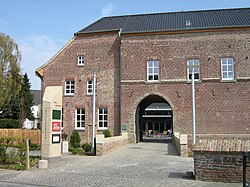 Castle Baesweiler, front | |
 Coat of arms | |
Location of Baesweiler
within Aachen district | |
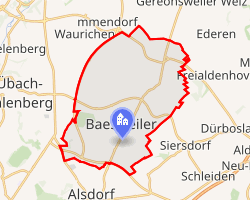 Location of Baesweiler | |
Baesweiler Baesweiler | |
| Coordinates: 50°54′N 6°11′E / 50.900°N 6.183°E / 50.900; 6.183 | |
| Country | Germany |
| State | North Rhine-Westphalia |
| Admin. region | Köln |
| District | Aachen |
| Subdivisions | 7 |
| Government | |
| • Mayor (2025–30) | Pierre Froesch (CDU) |
| Area | |
• Total | 27.84 km2 (10.75 sq mi) |
| Elevation | 130 m (430 ft) |
| Population (2024-12-31)1 | |
• Total | 29,206 |
| • Density | 1,049/km2 (2,717/sq mi) |
| Time zone | UTC+01:00 (CET) |
| • Summer (DST) | UTC+02:00 (CEST) |
| Postal codes | 52499 |
| Dialling codes | 02401 |
| Vehicle registration | AC |
| Website | www.baesweiler.de |

Baesweiler (German pronunciation: [ˈbaːsvaɪlɐ] ⓘ) is a municipality in the district of Aachen, North Rhine-Westphalia, Germany.
Geography
Baesweiler is located approximately 20 km north-east of Aachen.
Neighbouring municipalities
Division of the municipality

The municipality has seven subdivisions since a local government reform in 1972 (populations as of January 2007):
- Baesweiler (13,864 inhabitants)
- Beggendorf (1,667 inhabitants)
- Floverich (408 inhabitants)
- Loverich (1,255 inhabitants)
- Oidtweiler (2,731 inhabitants)
- Puffendorf (441 inhabitants)
- Setterich (7,794 inhabitants)
History
On 22 August 1371, the Battle of Baesweiler took place between the armies of duke Wenceslaus I of Brabant on one hand, and dukes William II of Jülich and Edward of Guelders on the other.2 Wenceslaus suffered a humiliating defeat, and was captured by William II of Jülich afterwards. Edward of Guelders was killed not soon after the battle was over.3
Politics
The current mayor is Pierre Froesch of the CDU, who has been serving as mayor of Baesweiler since 2020. In the 2025 election he was reelected with 86,2 % of the vote.4
City council
After the 2025 local elections, the Baesweiler city council is composed as follows:
| Party | Votes | % | +/- | Seats | +/- | |
|---|---|---|---|---|---|---|
| Christian Democratic Union (CDU) | 7,028 | 60.2 |  2.4 2.4
|
23 |  1 1
| |
| Social Democratic Party (SPD) | 1,562 | 13.4 | 6.1
|
5 | 3
| |
| Alternative for Germany (AfD) | 1,558 | 13.4 | New | 5 | New | |
| Alliance 90/The Greens (Grüne) | 860 | 7.4 | 3.8
|
3 | 1
| |
| The Left (Linke) | 366 | 3.1 | 0.2
|
1 | ±0 | |
| Free Democratic Party (FDP) | 276 | 2.4 | 1.5
|
1 | ±0 | |
| Anton Dinslaken | 18 | 0.2 | New | 0 | New | |
| Valid votes | 11,668 | 98.5 | ||||
| Invalid votes | 173 | 1.5 | ||||
| Total | 11,841 | 100.0 | 38 | ±0 | ||
| Electorate/voter turnout | 21,128 | 56.0 | ||||
| Source: City of Baesweiler | ||||||
Population development
- 1950: 13.268
- 1970: 24.223
- 1998: 26.731
- 2000: 27.434
- 2002: 27.604
- 2004: 27.933
- 2006: 28.160
- 2008: 27.991
- 2010: 27.898
- 2012: 26.445
- 2014: 26.597
- 2015: 26.819
Twin towns – sister cities
 Montesson, France (1990)
Notable people
- Matthias Goebbels (1836–1911), priest and artist
- Franz Loogen (1919–2010), pioneer of cardiology in Germany
- Ralph Gunesch (born 1983), footballer
References
References
- "Bevölkerung der Gemeinden Nordrhein-Westfalens am 31. Dezember 2024 – Fortschreibung des Bevölkerungsstandes auf Basis des Zensus 2022" (in German). Landesbetrieb Information und Technik NRW.
- Richard Vaughan, Philip the Bold, (The Boydell Press, 2009), 80.
- Richard Vaughan, Philip the Bold, 80.
- "Ergebnis". wahlen.regioit.de (in German). Retrieved 2026-03-18.
- "Städtepartnerschaft" (in German). Baesweiler. Retrieved 2021-12-08.
External links
External links
- Official site (in German)
-
 Monument for the coal pit "Carl-Alexander" erected on Reyplatz