| Seraphsidae Temporal range:
| |
|---|---|
| |
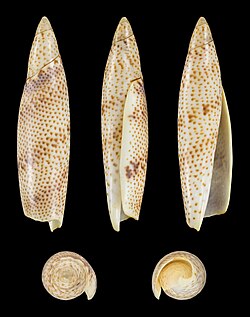
| Shell of Terebellum terebellum, a member of the family Seraphsidae | |
Scientific classification 
| |
| Kingdom: | Animalia |
| Phylum: | Mollusca |
| Class: | Gastropoda |
| Subclass: | Caenogastropoda |
| Order: | Littorinimorpha |
| Superfamily: | Stromboidea |
| Family: | Seraphsidae J. E. Gray, 1853 |
| Type genus | |
| Seraphs Montfort, 1810
| |
| Synonyms | |
Seraphsidae is a family of small to medium-sized sea snails, marine gastropod molluscs in the superfamily Stromboidea.23 Only one genus, Terebellum, is alive today, but several fossil genera are known, with the earliest records of the family dating back to the Danian age of the Paleocene.4 Seraphsids are adapted for a burrowing life, with a streamlined shell.56 Terebellum and its fossil relatives were originally classified as members of the closely related family Strombidae. When they were recognized as a separate family, the family was initially called Terebellidae, but as the name was already in use for a family of polychaete worms, the name Seraphsidae was proposed as a replacement, derived from the fossil genus Seraphs.6
Genera
There is one extant genus within the family Seraphsidae:
- Terebellum Röding, 1798
All other Seraphsidae genera are known only from the fossil record:7
- †Diameza Deshayes, 1865
- †Mauryna de Gregorio, 1880
- †Miniseraphs Jung,1974
- †Paraseraphs Jung, 1974
- †Pseudoterebellum Maxwell, Rymer & Congdon, 2021
- †Seraphs Montfort, 1810
Synonyms for Terebellum
- Artopoia Gistel, 1848: synonym of Terebellum Bruguière, 1798 (invalid: unnecessary substitute name for Terebellum)
- Lucis Gistel, 1848: synonym of Terebellum Bruguière, 1798
- Terebrina Rafinesque, 1815: synonym of Terebellum Bruguière, 1798
References
References
-
- "IRMNG name details: Seraphidae Gray, 1853". IRMNG – Interim Register of Marine and Nonmarine Genera.
- Kronenberg, Gijs C.; Wieneke, Ulrich (July 2020). "Röding's Stromboidea (Caenogastropoda): the remains of the Bolten collection in the Museum der Natur Gotha (Germany), a critical review of Röding's taxa, and notes on the Schmidt catalogue" (PDF). Basteria. 84 (1–3): 85–126.
The ... problem is on the spelling of the family name: Seraphidae or Seraphsidae. Both spellings are present in the literature ...
- Wieneke, Ulrich; Stoutjesdijk, Han; Simonet, Philippe; Liverani, Virgilio, eds. (10 February 2021). "Seraphidae (Stromboidea) Gray, 1853". Gastropoda Stromboidea.
- "Seraphsidae Gray, 1853". WoRMS - World Register of Marine Species.
- Bouchet, P. & Rocroi, J.-P. (2005). "Classification and Nomenclator of Gastropod Families". Malacologia. 47 (1–2).
- Maxwell, Stephen J.; Rymer, Tasmin L.; Congdon, Bradley C. (22 June 2021). "Resolving phylogenetic and classical nomenclature: A revision of Seraphsidae Jung, 1974 (Gastropoda: Neostromboidae)". Zootaxa. 4990 (3): 401–453. doi:10.11646/zootaxa.4990.3.1. PMID 34186750. S2CID 235686526.
- Abbott, Donald P. (1962-07-01). "Observations on the gastropod Terebellum terebellum (Linnaeus), with particular reference to the behavior of the eyes during burrowing". The Veliger. 5 (1): 1–3.
- Jung, Peter (1974-11-25). "A revision of the family Seraphsidae (Gastropoda: Strombacea)". Palaeontographica Americana. 8 (47): 1–72.
- "Taxon Details: Seraphsidae Gray, 1853". IRMNG – Interim Register of Marine and Nonmarine Genera.
Further reading
Further reading
- Bouchet P., Rocroi J.P., Hausdorf B., Kaim A., Kano Y., Nützel A., Parkhaev P., Schrödl M. & Strong E.E. (2017). "Revised classification, nomenclator and typification of gastropod and monoplacophoran families". Malacologia. 61 (1-2): 1–526.
- Gray, J. E. (1853). "On the division of ctenobranchous gasteropodous Mollusca into larger groups and families". Annals and Magazine of Natural History. 2 (11): 124–132
- Gray, J. E. (January 1853). "On the division of ctenobranchous gasteropodous Mollusca into larger groups and families". Proceedings of the Zoological Society of London. 21 (1): 32–44. doi:10.1111/j.1469-7998.1853.tb07174.x.
- Jung P. (1974). "A revision of the family Seraphsidae (Gastropoda: Strombacea)". Paleontographica Americana. 8 (47): 72 pp., 16 pls.
- Maxwell, Stephen J.; Liverani, Virgilio; Rymer, Tasmin L.; Congdon, Bradley C. (2018). "A revision of Terebellum delicatum Kuroda and Kawamoto in Kawamoto and Tanabe; 1956 (Gastropoda Seraphsidae)". The Proceedings of the Royal Society of Queensland. 123: 61–67. doi:10.5962/p.357828.