Article · Wikipedia archive·Last revised Jun 23, 2026
History of the alphabet
Alphabetic writing – where letters generally correspond to individual sounds in a language (phonemes), as opposed to having symbols for syllables or words – was likely invented once in human history. Virtually all later alphabets used throughout the world either descend directly from the Proto-Sinaitic script, or were directly inspired by it.
Alphabetic writing – where letters generally correspond to individual sounds in a language (phonemes), as opposed to symbols representing syllables or words – was likely invented once in human history. Virtually all later alphabets used throughout the world either descend directly from the Proto-Sinaitic script, or were directly inspired by it.123
It emerged during the 2nd millennium BC among a community of West Semitic laborers in the Sinai Peninsula. Exposed to the idea of writing through the complex system of Egyptian hieroglyphs used for the Egyptian language, their script instead wrote their native Canaanite language.4 It has been conjectured that the community selected a small number of the hieroglyphs commonly seen in their surroundings to describe the sounds, as opposed to the semantic values, of their own language.567 Mainly through the Phoenician alphabet that descended from this Proto-Sinaitic script, alphabetic writing spread throughout West and South Asia, North Africa, and Europe during the 1st millennium BC.
Some modern authors distinguish between consonantal alphabets, with the term abjad coined for them in 1996, and true alphabets with letters for both consonants and vowels. In this narrower sense, the first true alphabet would be the Greek alphabet, which was adapted from the Phoenician alphabet. Many linguists are skeptical of the value of wholly separating the two categories. Latin, the most widely used alphabet today,8 in turn derives from the Etruscan and Greek alphabets, themselves derived from Phoenician.
Predecessors
Two scripts are well attested from before the end of the 4th millennium BC: Mesopotamian cuneiform and Egyptian hieroglyphs. Hieroglyphs were employed in three ways in Ancient Egyptian texts: as pictograms depicting an object visually (or more complex logograms), as phonograms denoting sounds, or as determinatives which provide clues to meaning without directly writing sounds.9 Since vowels were mostly unwritten, the hieroglyphs which indicated each single consonant could have been used as a consonantal alphabet, or abjad. This possibility was not realized in Egyptian writing, but seems to have been an influence on the creation of the first alphabet.10 All subsequent alphabets around the world have either descended from this first Semitic alphabet, or have been inspired by one of its descendants by stimulus diffusion, with the possible exception of the Meroitic alphabet, a 3rd-century BC adaptation of hieroglyphs in Nubia to the south of Egypt. The rongorongo script of Easter Island may also be an independently invented alphabet, but too little is known of it to be certain.11
Consonantal alphabets
Semitic alphabet
The Proto-Sinaitic script was invented by a community of laborers in the Sinai Peninsula in the 2nd millennium BC, and was used to write their native West Semitic languages. It has not been fully deciphered. The oldest examples are found as graffiti in the Wadi el-Hol and date to c. 1850 BC.12 The letters denoted consonant sounds only: since meaning in semitic words is mainly expressed by their consonants, letters for vowels were unnecessary. The table below shows hypothesized prototypes of the Phoenician alphabet in Egyptian hieroglyphs, though several possibilities have been proposed.
The hieroglyphs were assigned phonetic values by the acrophonic principle: each letter denoted the first sound of the Semitic word for the object denoted.13 For example, the Egyptian hieroglyph per (a sketch of 4 walls and a doorway) meant 'house', which translated to Semitic bayt 'house': hence per was used to write the sound [b], becoming the progenitor of our letter B.14
Little of this Proto-Canaanite script has survived, but existing evidence suggests it retained its pictographic nature for half a millennium until it was adopted for governmental use in Canaan.15 The first Canaanite states to make extensive use of the alphabet were the Phoenician city-states, so later stages of the Canaanite script are called "Phoenician". The Phoenician cities were maritime states at the center of a vast trade network which spread their alphabet throughout the Mediterranean. Two subsequent variants had major historical impact: the Aramaic alphabet and the Greek alphabet.16
Descendants of the Aramaic abjad
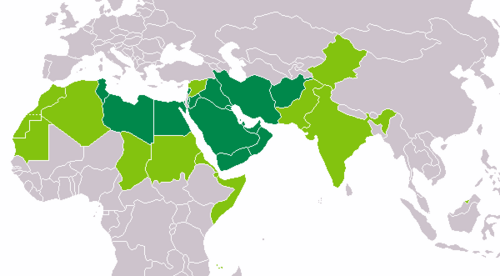
Global distribution of the Arabic alphabet. The dark green areas shows the countries where this alphabet is the sole main script. The light green shows the countries where the alphabet co-exists with other scripts. source ↗
The Phoenician and Aramaic alphabets, like their Egyptian prototype, represented only consonants, a system called an abjad. The Aramaic alphabet, which evolved from the Phoenician in the 8th century BC, to become the official script of the Assyrian, Babylonian, and Achaemenid Empires, appears to be the ancestor of nearly all the modern alphabets of Asia:
The Arabic alphabet descended from Aramaic via the Nabataean alphabet of what is now southern Jordan. It is the second-most widely used alphabetic script in the world (after Latin) and the most used abjad system.17
The Georgian scripts appear to be part of either the Persian-Aramaic or Greek family.
The Kharosthi and Brahmic scripts are descended from the Aramaic script, after the Achaemenid invasion of the Indus Valley in the 6th century BC.
Alphabets with vowels
Greek alphabet
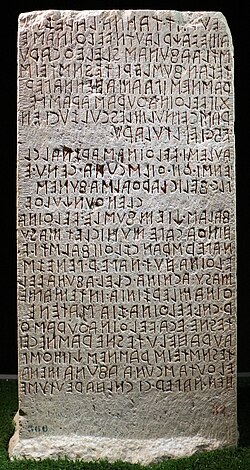
Greek alphabet on ancient black-figure pottery. There is a digamma but no ksi or omega. The letter phi upright in the photograph is missing a stroke and looks like the omicron Ο, but on the other side of the bottom it is a full Φ. source ↗Etruscan writing, the beginning of the writing with the Latin alphabetsource ↗
By the 8th century BC, the Greeks, also maritime traders, adapted the Phoenician alphabet to their own language,19 creating the first "true" alphabet in which vowels were accorded equal status with consonants. According to Greek legends transmitted by Herodotus, the alphabet was brought from Phoenicia to Greece by Cadmus.
The Greek alphabet contains the same letters in the same order as the Phoenician alphabet, but with different sound values.19 Though letters for vowels were not needed in semitic languages, their absence would create confusion in Greek, where vowels play a much larger semantic role.20 Hence some of the Phoenician letters representing consonants not present in Greek were re-purposed to write Greek vowel sounds. These letters had acrophonic Phoenician names unpronouceable in Greek; these initial consonants were dropped from the names, leaving initial vowels which became their sound values in the Greek alphabet. For example, Greek had no glottal stop or voiced pharyngeal sounds, so the Phoenician letters ’alep and `ayin became Greek alpha and o (later renamed omicron), standing for vowel sounds /a/ and /o/ rather than consonants /ʔ/ and /ʕ/. As this fortunate development only provided for five or six (depending on dialect) of the twelve Greek vowels, the Greeks eventually created digraphs and other modifications, such as ei, ou, and o—which became omega—or in some cases simply ignored the deficiency, as in long a, i, u.21
Several varieties of the Greek alphabet developed. The Cumae alphabet was used west of Athens and in southern Italy, while the Eastern Greek alphabet was used in Asia Minor. The Athenians (c. 400 BC) adopted the Eastern variation, and eventually the rest of the Greek-speaking world followed. The Greeks first right-to-left like the Phoenicians, then after a period includingboustrophedon writing, they settled on left-to-right. This switch led to many Greek letters being mirror images of their Phoenician models.
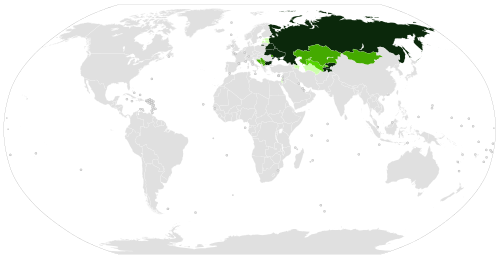
Global distribution of the Cyrillic alphabet. The dark green areas shows the countries where this alphabet is the sole main script. The light green shows the countries where the alphabet co-exists with other scripts. source ↗
Greek is in turn the source of all the modern scripts of Europe. The alphabet of the early western Greek dialects, where the letter eta remained /h/, gave rise to the Old Italic alphabet which in turn developed into the Old Roman alphabet. In the eastern Greek dialects, which did not have the /h/ sound, eta stood for a vowel, and remains a vowel in modern Greek and all other alphabets derived from the eastern variants: Glagolitic, Cyrillic, Armenian, Gothic—which used both Greek and Roman letters—and perhaps Georgian.22
This linear narrative simplifies a complex evolution. For example, Georgian scripts derive from the Semitic family, but were also strongly influenced by Greek. A modified version of the Greek alphabet, using an additional half-dozen Demotic hieroglyphs, was used to write Coptic Egyptian. In North America, the Cree syllabics are an abugida combining Devanagari and Pitman shorthand developed by the missionary James Evans.23
Latin alphabet
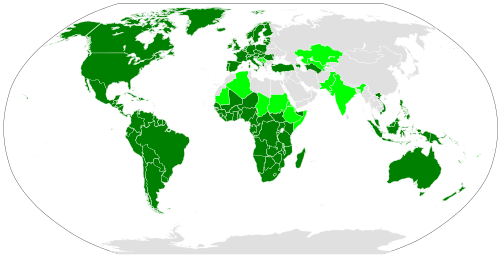
Global distribution of the Latin alphabet. The dark green areas show the countries where this alphabet is the sole main script. The light green shows the countries where the alphabet co-exists with other scripts. source ↗
The Latin tribes, who became the Romans, shared the Italian peninsula with the Western Greeks. From the Etruscans, a tribe living in the first millennium BC in central Italy, and the Western Greeks, the Latins adopted writing in about the 7th century BC. Latin dropped four characters from the Western Greek alphabet. It also adapted the Etruscan letter F pronounced /w/, used in Latin for the /f/ sound; and the Etruscan S, written with three zigzag lines, was curved to make the modern S. Latin originally used gamma to represent the /g/ sound in Greek and the /k/ sound in Etruscan. This produced the modern alphabet without the letters G, J, U, W, Y, and Z, as well as some other differences.
C, K, and Q in the Roman alphabet could all be used to write both /ɡ/ and /k/ sounds; but Latin soon modified C to create G, inserted as the seventh letter in place of Z, to maintain the gematria (the numerical sequence of the alphabet). Over the few centuries after Alexander the Great conquered the Eastern Mediterranean and other areas in the 3rd century BC, Latin began to borrow Greek words, and had to adapt its alphabet again to write these words. From the Eastern Greek alphabet, it borrowed Y and Z, which were added as supplements to the end of the alphabet, used only for Greek words.
The Anglo-Saxons began writing Old English using the Latin alphabet following its introduction during Augustine of Canterbury's Christian mission to Britain in the 6th century. The /w/ sound was originally written with the runewen, but this could easily be mistaken for a narrow p, and was replaced by double VV. The letter V was originally used for both consonant /v/ and vowel /u/, before the latter became differentiated as U, and the related letters U, V, W were placed consecutively in the alphabet. The letter J to write /j/ (written as Y in modern English) began as a variation of I, at first as the second letter of double II; general use of J for the consonant and I for the vowel was widespread by the 15th century and fully accepted in the mid-17th century.
Letter names and order
The order and number of letters in the original Proto-Sinaitic alphabet is unknown. The first attestation is from the 14th century BC in the town of Ugarit on Syria's northern coast.24 Tablets found there bear over one thousand distinct words in the Ugaritic alphabet, composed of thirty cuneiform characters adapted from the Proto-Sinaitic incision letters. About twelve tablets have the signs set out in alphabetic order. There are two orders found, one nearly identical to the order used for Hebrew, Greek and Latin, and a second very similar to that used for Geʽez.25
Among its descendants, the Ugaritic alphabet had 27 consonants, the South Arabian alphabets had 29, and the Phoenician alphabet had 22. These scripts were arranged in two orders, an ABGDE order in Phoenician and an HMĦLQ order in the south; Ugaritic preserved both orders. Both sequences proved remarkably stable among the descendants of these scripts.
The letter names proved stable among the many descendants of the Phoenician alphabet, including the Samaritan, Aramaic, Syriac, Arabic, Hebrew, and Greek alphabets. However, they were largely abandoned in Tifinagh, Latin and Cyrillic. The letter sequence continued more or less intact into Latin, Armenian, Gothic, and Cyrillic, but was abandoned in Brahmi, runes, and Arabic, although a traditional abjadi order remains or was reintroduced as an alternative in the latter.
The table shows Proto-Sinaitic and its descendants.
These 26 consonants account for the phonology of Northwest Semitic. Of the 29 consonant phonemes commonly reconstructed for Proto-Semitic, the voiceless fricatives ś, ṣ́, and ṯ̣ are missing. The phonemes ḏ, ṯ, ḫ, ġ disappeared in Canaanite, merging with z, š, ḥ, ʿ in Canaanite scripts, respectively. The six variant letters added in the Arabic alphabet include these (except for ś, which survives as a separate phoneme in Geʽezሠ):
One modern national alphabet that has not been graphically traced back to the Canaanite alphabet is the Maldivian script, which is unique in that, although it is clearly modeled after Arabic and perhaps other existing alphabets, it derives its letter forms from numerals. Others are the hangul alphabet used to write Korean, which was created in 1443; and Ogham, used for Primitive Irish inscriptions in the 3rd to 8th centuries AD.
Alphabets in other media
Changes to a new writing medium sometimes caused a break in graphical form, or make the relationship difficult to trace. It is not immediately obvious that the cuneiform Ugaritic alphabet derives from a prototypical Semitic abjad, for example, although this appears to be the case. And while manual alphabets are a direct continuation of the local written alphabet (both the British two-handed and the French/American one-handed alphabets retain the forms of the Latin alphabet, as the Indian manual alphabet does Devanagari, and the Korean does Hangul), Braille, semaphore, maritime signal flags, and the Morse codes are essentially arbitrary geometric forms. The shapes of the English Braille and semaphore letters are not derived from the graphic forms of the letters themselves. Most modern forms of shorthand are also unrelated to the alphabet, generally transcribing sounds instead of letters.
The Canaanites seem to have replaced the 𓄤 glyph with one resembling a spinning wheel (ṭayt) 𓊖.
A | glyph for ś has been found in the Canaanite Lachish Comb inscription, though no such glyph has been found in Proto-Sinaitic, and its origin has not been discovered.
Healy, John (1990). The Early Alphabet. British Museum Publications, Ltd. ISBN0714180734. Secondly, the texts are in Canaanite West Semitic, not Egyptian
Van De Mieroop, Marc (2022). "Vernaculars That Changed the World". Before and after Babel. Oxford University Press. pp. 149–C7.P48. ISBN978-0-19-763466-0.
"Arabic Alphabet". Encyclopædia Britannica. Archived from the original on 26 April 2015. Retrieved 2015-05-16.
Daniels & Bright 1996, p. 27, "there are languages for which an alphabet is not an ideal writing system. The Semitic abjads really do fit the structure of Hebrew, Aramaic, and Arabic very well, [more] than an alphabet would ... since the spelling ensures that each root looks the same through its plethora of inflections and derivations.".
Wilson-Wright, Aren Max (2016). "Sinai 357: A Northwest Semitic Votive Inscription to Teššob". Journal of the American Oriental Society. 136 (2): 247–263. doi:10.7817/jameroriesoci.136.2.247. ISSN0003-0279.
Haarmann, Harald (2004). Geschichte der Schrift [History of Writing] (in German) (2nd ed.). Munich: C. H. Beck. ISBN3-406-47998-7.
Hooker, J. T., ed. (1998) [1990]. Reading the past: ancient writing from cuneiform to the alphabet. London: British Museum Press. ISBN978-0-7141-8077-9.
Ladefoged, Peter; Disner, Sandra Ferrari (2012) [2001]. Vowels and Consonants (3rd ed.). Wiley. ISBN978-1-4443-3429-6.
Drucker, Johanna (2022). Inventing the Alphabet. University of Chicago Press. ISBN978-0-226-81581-7.
Fischer, Steven Roger (2021) [2005]. A history of writing (New ed.). London: Reaktion. ISBN978-1-78914-349-2.
Hoffman, Joel M. (2004). In the beginning: a short history of the Hebrew language. New York University Press. ISBN978-0-8147-3654-8.
Logan, Robert K. (2004) [1986]. The alphabet effect: a media ecology understanding of the making of Western civilization. Cresskill, NJ: Hampton. ISBN978-1-57273-522-4.
Naveh, Joseph (1997) [1982]. Early history of the alphabet: an introduction to west Semitic epigraphy and palaeography (Reprint ed.). Jerusalem: Magnes. ISBN978-965-223-436-0.
Powell, Barry B. (1991). Homer and the origin of the Greek alphabet. Cambridge University Press. ISBN978-0-521-37157-5.
Ullman, B. L. (1927). "The Origin and Development of the Alphabet". American Journal of Archaeology. 31 (of 3): 311–328. doi:10.2307/497822. ISSN0002-9114. JSTOR497822.





 𐡀 'ālap̱


 𐡁 bēṯ
𐡁 bēṯ


 gāmal
gāmal


 𐡃 dālaṯ


 𐡄 hē
𐡄 hē


 𐡅 waw
𐡅 waw
 29
29

 𐡆 zayn


 𐡇 ḥēṯ
𐡇 ḥēṯ

 a
a
 )
)
 𐡈 ṭeṯ)


 𐡉 yoḏ
𐡉 yoḏ


 𐡊 kāp̱


 𐡋 lāmaḏ


 𐡌 mim
𐡌 mim


 𐡍 nun
𐡍 nun

 𐡎 semkaṯ


 𐡏 ʿayn


 𐡐 pē
𐡐 pē


 𐡑 ṣāḏē


 𐡒 qop̱


 𐡓 rēš
𐡓 rēš
 31
31
 ?b32
?b32


 𐡔 šin
𐡔 šin
 𐡕 taw
𐡕 taw


