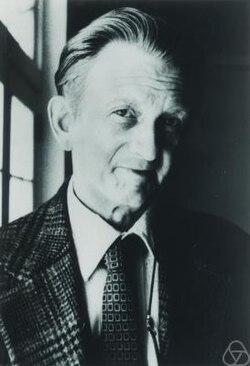
In mathematics, the Selberg class is an axiomatic definition of a class of L-functions. The members of the class are Dirichlet series which obey four axioms that seem to capture the essential properties satisfied by most functions that are commonly called L-functions or zeta functions. Although the exact nature of the class is conjectural, the hope is that the definition of the class will lead to a classification of its contents and an elucidation of its properties, including insight into their relationship to automorphic forms and the Riemann hypothesis. The class was defined by Atle Selberg in (Selberg 1992), who preferred not to use the word "axiom" that later authors have employed.1
Definition
The formal definition of the class S is the set of all Dirichlet series
absolutely convergent for Re(s) > 1 that satisfy four axioms (or assumptions as Selberg calls them):
- Analyticity: has a meromorphic continuation to the entire complex plane, with the only possible pole (if any) when s = 1.
- Ramanujan conjecture: and for any ε > 0;
- Functional equation: there is a gamma factor of the form
where Q is real and positive, Γ the gamma function, the ωi real and positive, and the μi complex with non-negative real part, as well as a so-called root number
- ,
such that the function
satisfies
- Euler product: For Re(s) > 1, F(s) can be written as a product over primes:
with
and, for some θ < 1/2,
Comments on definition
- Without the condition , there would be:
- which violates the Riemann hypothesis.
- Without this functional equation we would have Dirichlet L-functions for any imprimitive character. If is Dirichlet character induced by , then we have:
- Despite this function satisfies any other axiom, from that additional factors follows that it has infinitely many zeros on . They are not symmetric with respect to and without functional equation proposed by Selberg it is hard to distinguish between trivial and nontrivial zeros of this function.
- If function F satisfies functional equation with different gamma factors, then using Stirling formula for gamma function one can show:
- .
- However, by the multiplication formula the same gamma factor can be expressed in many different ways, involving different number of gamma functions with different constants. Despite this, Selberg proved that the sum is independent of the choice of the gamma factor formula.
- The condition that the real part of μi be non-negative is because there are known L-functions that do not satisfy the Riemann hypothesis when μi is negative. Specifically, there are Maass forms associated with exceptional eigenvalues, for which the Ramanujan–Petersson conjecture holds, and which have a functional equation, but do not satisfy the Riemann hypothesis.
- Having Euler product is essential, as notable counterexample given by Davenport and Heilbronn:
- despite having analytic continuation, having periodic coefficients (thus satisfying Ramanujan conjecture) and satisfying functional equation have zeros lying outside critical line.
Properties
The Selberg class is closed under multiplication of functions: product of each two functions belonging to S are also in S. It is also easy to check that if F is in S, then function involved in functional equation:
satisfies axioms and is also in S. If F is entire function in S, then for is also in S.
From the Ramanujan conjecture, it follows that, for every :
then Dirichlet series defining function is absolutely convergent in the half-plane: .
Despite the unusual version of the Euler product in the axioms, by exponentiation of Dirichlet series, one can deduce that an is a multiplicative sequence and that
From follows that for each factor of Euler product:
is absolutely convergent in . Then is absolutely convergent and in this region. In half-plane of absolute convergence of original Dirichlet series function is absolutely convergent product of non-vanishing factors, then for functions in Selberg class in .
From the functional equation follows that every pole of the gamma factor γ(s) in must be cancelled by a zero of F. Such zeros are called trivial zeros; the other zeros of F are called non-trivial zeros. All nontrivial zeros are located in the critical strip, , and by the functional equation, the nontrivial zeros are symmetrical about the critical line, .
The real non-negative number
is called the degree (or dimension) of F. Since this sum is independent of the choice of functional equation, it is well-defined for any function F. If F and G are in the Selberg class, then degree of their product is:
It can be shown that F = 1 is the only function in S whose degree is . Kaczorowski & Perelli (2011) showed that the only cases of are the Dirichlet L-functions for primitive Dirichlet characters (including the Riemann zeta-function). Denoting the number of non-trivial zeros of F with 0 ≤ Im(s) ≤ T by NF(T),2 Selberg showed that:
An explicit version of the result was proven by Palojärvi (2019).
It was proven by Kaczorowski & Perelli (2003) that for F in the Selberg class, for is equivalent to
where is a real number and is the prime-counting function. This result can be thought of as a generalization of the prime number theorem. Nagoshi & Steuding (2010) showed that functions satisfying the prime-number theorem condition have a universality property for the strip , where . It generalizes the universality property of the Riemann zeta function and Dirichlet L-functions.
A function in S is called primitive if, whenever it is written as , with both of function in Selberg class, then or . As a consequence that degree is additive with respect to multiplication of functions and only function of degree is , every function F ≠ 1 can be written as a product of primitive functions. However, uniqueness of this factorization is still unproven.
Examples
The prototypical example of an element in S is the Riemann zeta function.3 Also, most of generalizations of the zeta function, like Dirichlet L-functions or Dedekind zeta functions, belong to the Selberg class.
Examples of primitive functions include the Riemann zeta function and Dirichlet L-functions of primitive Dirichlet characters or some Artin L-functions for irreducible representations of Galois group of Galois extension of rational numbers (in general case of Artin L-function non-existence of poles violating analictity axiom is subject of Artin conjecture).
Another example is the L-function of the modular discriminant Δ,
where is the Ramanujan tau function.4 This example can be considered a "normalized" or "shifted" L-function for the original Ramanujan L-function, defined as
whose coefficients satisfy . It has the functional equation
and is expected to have all nontrivial zeros on the line .
All known examples are automorphic L-functions, and the reciprocals of Fp(s) are polynomials in p−s of bounded degree.5
Conjectures
Selberg's conjectures
In (Selberg 1992), Selberg made conjectures concerning the functions in S:
- Conjecture 1: For all F in S, there is an integer nF such that and nF = 1 whenever F is primitive.
- Conjecture 2: For distinct primitive F, F′ ∈ S,
- Conjecture 3: If F is in S with primitive factorization χ is a primitive Dirichlet character, and the function is also in S, then the functions Fiχ are primitive elements of S (and consequently, they form the primitive factorization of Fχ).
- Generalized Riemann hypothesis for S: For all F in S, the non-trivial zeros of F all lie on the line Re(s) = 1/2.
The first two Selberg conjectures are often collectively called the Selberg orthogonality conjecture.
Other conjectures
It is conjectured that Selberg class is equal to class of automorphic L-functions. Primitive functions are expected to be associated with irreducible automorphic representations.
It is conjectured that all reciprocals of factors Fp(s) of the Euler products are polynomials in p−s of bounded degree.
It is conjectured that, for any F in the Selberg class, is a nonnegative integer. The best particular result due to Kaczorowski & Perelli shows this only for .
Consequences of the conjectures
The Selberg orthogonality conjecture has numerous consequences for functions in the Selberg class:
- The factorization of function F in S into primitive functions would be unique.
- If is a factorization of F in S into primitive functions, then . In particular, this implies that if and only if F is a primitive function.6
- The functions in S have no zeros on . This implies that they satisfy a generalization of the prime number theorem and have a universality property.
- If F has a pole of order m at s = 1, then F(s)/ζ(s)m is entire. In particular, they imply Dedekind's conjecture.7
- M. Ram Murty showed in (Murty 1994) that the orthogonality conjecture implies the Artin conjecture.8
- In the same article Murty proven that ortogonality conjecture implies Langlands reciprocity for Artin L-functions of solvable extensions.
- L-functions of irreducible cuspidal automorphic representations that satisfy the Ramanujan conjecture are primitive.9
The Generalized Riemann Hypothesis for S implies many different generalizations of the original Riemann Hypothesis, the most notable being the generalized Riemann hypothesis for Dirichlet L-functions and extended Riemann Hypothesis for Dedekind zeta functions, with multiple consequences in analytic number theory, algebraic number theory, class field theory, and numerous branches of mathematics.
Combined with the Generalized Riemann hypothesis, different versions of orthogonality conjecture imply certain growth rates for the function and its logarithmic derivative.101112
If the Selberg class equals the class of automorphic L-functions, then the Riemann hypothesis for S would be equivalent to the Grand Riemann hypothesis.
Notes
Notes
- The title of Selberg's paper is somewhat a spoof on Paul Erdős, who had many papers named (approximately) "(Some) Old and new problems and results about...". Indeed, the 1989 Amalfi conference was quite surprising in that both Selberg and Erdős were present, with the story being that Selberg did not know that Erdős was to attend.
- The zeros on the boundary are counted with half-multiplicity.
- Murty 2008
- Murty 2008
- Murty 1994
- Conrey & Ghosh 1993, § 4
- A celebrated conjecture of Dedekind asserts that for any finite algebraic extension of , the zeta function is divisible by the Riemann zeta function . That is, the quotient is entire. More generally, Dedekind conjectures that if is a finite extension of , then should be entire. This conjecture is still open.
- In fact, Murty showed that Artin L-functions corresponding to irreducible representations of the Galois group of a solvable extension of the rationals are automorphic representation as predicted by the Langlands conjectures.Murty 1994, Theorem 4.3
- Murty 1994, Lemma 4.2
- Aistleitner, Christoph; Pańkowski, Łukasz (2017). "Large values of L-functions from the Selberg class". J. Math. Anal. Appl. 446 (1): 345–364. arXiv:1507.06066. doi:10.1016/j.jmaa.2016.08.044.
- Palojärvi, Neea; Simonič, Aleksander (2022). "Conditional estimates for L-functions in the Selberg class". arXiv:2211.01121 [math.NT].
- Palojärvi, Neea; Simonič, Aleksander (2024). "Conditional upper and lower bounds for L-functions in the Selberg class close to the critical line". arXiv:2410.22711 [math.NT].
References
References
- Selberg, Atle (1992), "Old and new conjectures and results about a class of Dirichlet series", Proceedings of the Amalfi Conference on Analytic Number Theory (Maiori, 1989), Salerno: Univ. Salerno, pp. 367–385, MR 1220477, Zbl 0787.11037 Reprinted in Collected Papers, vol 2, Springer-Verlag, Berlin (1991)
- Conrey, J. Brian; Ghosh, Amit (1993), "On the Selberg class of Dirichlet series: small degrees", Duke Mathematical Journal, 72 (3): 673–693, arXiv:math.NT/9204217, doi:10.1215/s0012-7094-93-07225-0, MR 1253620, Zbl 0796.11037
- Murty, M. Ram (1994), "Selberg's conjectures and Artin L-functions", Bulletin of the American Mathematical Society, New Series, 31 (1): 1–14, arXiv:math/9407219, doi:10.1090/s0273-0979-1994-00479-3, MR 1242382, S2CID 265909, Zbl 0805.11062
- Murty, M. Ram (2008), Problems in analytic number theory, Graduate Texts in Mathematics, Readings in Mathematics, vol. 206 (Second ed.), Springer-Verlag, Chapter 8, doi:10.1007/978-0-387-72350-1, ISBN 978-0-387-72349-5, MR 2376618, Zbl 1190.11001
- Kaczorowski, Jerzy & Perelli, Alberto (2011). "On the structure of the Selberg class, VII" (PDF). Annals of Mathematics. 173: 1397–1441. doi:10.4007/annals.2011.173.3.4.
- Palojärvi, Neea (2019). "On the explicit upper and lower bounds for the number of zeros of the Selberg class". J. Number Theory. 194: 218–250. arXiv:1709.07170. doi:10.1016/j.jnt.2018.07.006.
- Kaczorowski, J. & Perelli, A. (2003). "On the prime number theorem for the Selberg class". Archiv der Mathematik. 80 (3): 255–263. doi:10.1007/s00013-003-0032-9. MR 1981179.
- Nagoshi, Hirofumi & Steuding, Jörn (2010). "On the prime number theorem for the Selberg class". Lithuanian Mathematical Journal. 50: 293–311. doi:10.1007/s10986-010-9087-z.