Segregating sites are positions which show differences (polymorphisms) between related genes in a sequence alignment (are not conserved).1 Segregating sites include conservative, semi-conservative and non-conservative mutations.
The proportion of segregating sites within a gene is an important statistic in population genetics since it can be used to estimate mutation rate assuming no selection. For example, it is used to calculate the Tajima's D neutral evolution statistic.
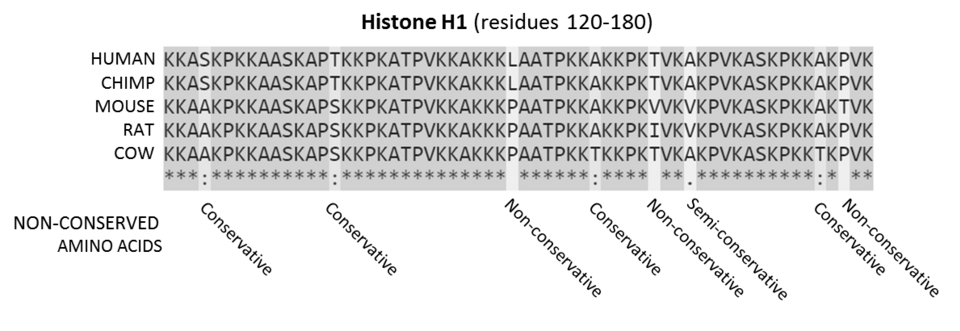
Sequences are the amino acids for residues 120-180 of the proteins. Residues that are conserved across all sequences are highlighted in grey. Below the protein sequences is a key denoting conserved sequence (*), conservative mutations (:), semi-conservative mutations (.), and non-conservative mutations ( ).2 source ↗
See also
See also
References
References
- Fu, YX (Oct 1995). "Statistical properties of segregating sites". Theoretical Population Biology. 48 (2): 172–97. Bibcode:1995TPBio..48..172F. doi:10.1006/tpbi.1995.1025. PMID 7482370.
- "Clustal FAQ #Symbols". Clustal. Retrieved 8 December 2014.