| Scapteromys Temporal range: Late Pliocene to Recent
| |
|---|---|
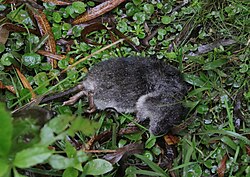
| |
| Scapteromys aquaticus | |
Scientific classification 
| |
| Kingdom: | Animalia |
| Phylum: | Chordata |
| Class: | Mammalia |
| Infraclass: | Placentalia |
| Order: | Rodentia |
| Family: | Cricetidae |
| Subfamily: | Sigmodontinae |
| Tribe: | Akodontini |
| Genus: | Scapteromys Waterhouse, 1837 |
| Type species | |
| Mus tumidus Waterhouse, 1837
| |
| Species | |
|
Scapteromys aquaticus | |
Scapteromys is a genus of South American rodents in the tribe Akodontini of family Cricetidae. Three species are known, found in northern Argentina, southern Brazil, Paraguay and Uruguay.12 They are as follows:
- Argentine swamp rat (Scapteromys aquaticus)
- Plateau swamp rat (Scapteromys meridionalis)
- Waterhouse's swamp rat (Scapteromys tumidus)
Species are semiaquatic, living in and near marshes and other bodies of water. They reach a body length of 15 to 20 cm and a tail length of 13–17 cm, and weigh 110-200 g. Fur color is dark gray on top and light gray on the underside. They are primarily crepuscular and nocturnal. Their diet consists mainly of insects; they also consume other invertebrates and plant material.
The three species differ in karyotype, with aquaticus having 2n = 32, tumidus 2n = 241 and meridionalis 2n = 34/36.2
References
References
- Musser, G. G.; Carleton, M. D. (2005). "Superfamily Muroidea". In Wilson, D. E.; Reeder, D. M. (eds.). Mammal Species of the World: A Taxonomic and Geographic Reference (3rd ed.). Johns Hopkins University Press. p. 1172. ISBN 978-0-8018-8221-0. OCLC 62265494.
- Quintela, F.M.; Goncalves, G.L.; Althoff, S.L.; Sbalqueiro, I.J.; Oliveira, L.F.B.; de Freitas, T.R.O. (2014). "A new species of swamp rat of the genus Scapteromys Waterhouse, 1837 (Rodentia: Sigmodontinae) endemic to Araucaria angustifolia forest in southern Brazil". Zootaxa. 3811 (2): 207–225. doi:10.11646/zootaxa.3811.2.3. PMID 24943159.
- Nowak, Ronald M. (1999). Walker's Mammals of the World. Vol. 2 (6th ed.). Johns Hopkins University Press. pp. 1398–1399. ISBN 978-0-8018-5789-8. OCLC 39045218.