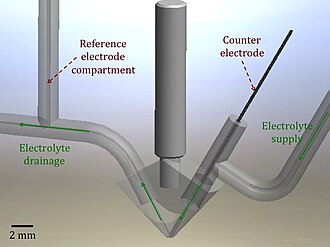
Scanning Flow Cell (SFC) is an electrochemical technique, based on the principle of the channel electrode. In an SFC, electrolyte is continuously flowing over a small polycarbonate block which contains two intersecting channels that form an elliptical opening. 1
SFC utilizes V-formed geometry with a small opening on the bottom (in range of 0.2-1mm diameter) used to establish the contact with sample. The convective flow is sustained also in the non-contact mode of operation that allows easy exchange of the working electrode.1
Application
The SFC is employed for combinatorial and high-throughput electrochemical studies. Due to its non-homogenous flow profile distribution, it is currently used for comparative kinetic studies. SFC is predominantly used for coupling of electrochemical measurements with post analytical techniques like UV-Vis, ICP-MS, ICP-OES etc. This makes possible a direct correlation of electrochemical and spectrometric signal. This methodology was successfully applied for corrosion studies.23
References
References
- "Scanning Flow Cell". www.mpie.de. Retrieved 2023-09-23.
- Topalov, A.A.; and Katsounaros, I.; Michael, A.; Cherevko, S.; Meier, J.C.; Klemm, S.O.; Mayrhofer, K.J.J. (2012). "Dissolution of Platinum: Limits for the Deployment of Electrochemical Energy Conversion?". Angewandte Chemie International Edition. 51 (50): 12613–12615. doi:10.1002/anie.201207256. ISSN 1521-3773. PMC 3556695. PMID 23124819.
- Klemm, S.O.; Topalov, A.A.; Laska, C.A.; Mayrhofer, K.J.J. (2011). "Coupling of a high throughput microelectrochemical cell with online multielemental trace analysis by ICP-MS". Electrochemistry Communications. 13 (12): 1533–1535. doi:10.1016/j.elecom.2011.10.017. ISSN 1388-2481.