| Sayrite | |
|---|---|
| General | |
| Category | Minerals |
| Formula | Pb2(UO2)5O6(OH)24(H2O)+ |
| IMA symbol | Syr1 |
| Strunz classification | 4/H.07-40 |
| Dana classification | 5.9.6.1 |
| Crystal system | monoclinic |
| Unit cell | a = 10.7 Å, b = 6.96 Å, c = 14.53 Å β = 116.81° |
| Identification | |
| Colour | orange |
| Cleavage | Distinct |
| Density | 6.76 |
| Refractive index | 1.77 |
| Birefringence | Biaxial (-) |
| Dispersion | relatively weak |
| Other characteristics |  Radioactive Radioactive |
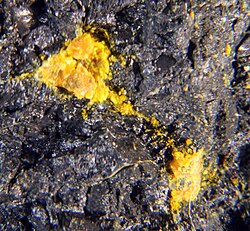
Sayrite (Pb2(UO2)5O6(OH)24(H2O)) is an alteration product of uraninite named after the X-ray crystallographer David Sayre. Sayrite contains hydrogen, oxygen, uranium and lead. It is mined at Shinkolobwe Mine, (Kasolo Mine), Kambove District, Haut-Katanga, Democratic Republic of the Congo. It is usually orange in color but also can be reddish and yellowish and is in the monoclinic crystal system.23
References
References
- Warr, L.N. (2021). "IMA–CNMNC approved mineral symbols". Mineralogical Magazine. 85 (3): 291–320. Bibcode:2021MinM...85..291W. doi:10.1180/mgm.2021.43. S2CID 235729616.
- "Sayrite: Mineral information, data and localities". www.mindat.org. Retrieved 2019-04-03.
- "Sayrite Mineral Data". webmineral.com. Retrieved 2019-04-03.