| Sandy ray | |
|---|---|

| |
| Illustration of dorsal surface, Jonathan Couch | |
Scientific classification 
| |
| Kingdom: | Animalia |
| Phylum: | Chordata |
| Class: | Chondrichthyes |
| Subclass: | Elasmobranchii |
| Order: | Rajiformes |
| Family: | Rajidae |
| Genus: | Leucoraja |
| Species: | L. circularis
|
| Binomial name | |
| Leucoraja circularis (Couch, 1838)
| |
| Synonyms | |
|
Raia circularis | |
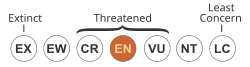
The sandy ray (Leucoraja circularis) or sandy skate2 is a species of ray in the family Rajidae.34
Description

It maximum length is 1.2 m (3 ft 11 in), typical adults measuring 70 cm (2.3 ft). It has a short snout with a spinulose reddish-brown dorsal surface, a tail only slightly longer than body, and a white underside. A distinctive feature is the 4–6 creamy-coloured spots on each wing.5 Its ventral surface is white in colour with pale grey margins, and the area around its snout is rough in texture. There are 8 orbital thorns around the eyes of the sandy skate, and adult males have both alar and malar thorns. Its upper and lower jaws have between 64-84 rows of teeth.6
Habitat
The sandy ray lives in the demersal zone of the offshore waters of Western Europe and the Mediterranean Sea, at depths between 70 m (230 ft) and 676 m (2,218 ft).7 It lives on seabeds with substrates of sand and mud.6 According to the FAO this species should be considered extinct in Mediterranean Sea, but recent records contradict this view.8
Behaviour
The sandy ray is oviparous and lays its egg cases between August and November. The egg cases measure 8–9 centimetres (3.1–3.5 in) long and 5–5.5 centimetres (2.0–2.2 in) wide.6 It feeds on benthic invertebrates and small bony fish.9
References
References
- Froese, Rainer; Pauly, Daniel (eds.). "Leucoraja circularis". FishBase. June 2021 version.
- International), Sonja Fordham (Shark Advocates; Group), Jim Ellis (IUCN SSC Shark Specialist; Group), Rachel Walls (IUCN SSC Shark Specialist; McCully, Sophy (October 30, 2014). "IUCN Red List of Threatened Species: Leucoraja circularis". IUCN Red List of Threatened Species.
- Carrier, Jeffrey C.; Musick, John A.; Heithaus, Michael R. (March 9, 2010). Sharks and Their Relatives II: Biodiversity, Adaptive Physiology, and Conservation. CRC Press. ISBN 9781420080483 – via Google Books.
- "Leucoraja circularis, Sandy ray : Fisheries".
- "sandy-ray-leucoraja-circularis-the-shark-trust". yumpu.com.
- "MarLIN - The Marine Life Information Network - Sandy ray (Leucoraja circularis)". www.marlin.ac.uk.
- Ebert, David A.; Dando, Marc (2021). Field Guide to Sharks, Rays, and Chimaeras of Europe and the Mediterranean. Princeton, New Jersey: Princeton University Press. p. 104. ISBN 978-0-691-20598-4.
- "Leucoraja circularis, Sandy ray : fisheries". www.fishbase.se. Retrieved 2023-02-20.
- Guide of Mediterranean Skates and Rays (Leucoraja circularis). Oct. 2022. Mendez L., Bacquet A. and F. Briand. https://ciesm.org/marine/programs/skatesandrays/leucoraja-circularis/
- Last, Peter; Naylor, Gavin; Séret, Bernard; White, William; Stehmann, Matthias; Carvalho, Marcelo de (December 1, 2016). Rays of the World. Csiro Publishing. ISBN 9780643109155 – via Google Books.