| Rusingoryx Temporal range: Early Pleistocene – Late Pleistocene
| |
|---|---|
| |
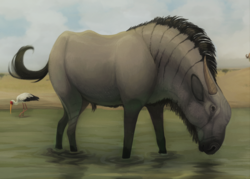
| Rusingoryx drinking | |
Scientific classification 
| |
| Kingdom: | Animalia |
| Phylum: | Chordata |
| Class: | Mammalia |
| Infraclass: | Placentalia |
| Order: | Artiodactyla |
| Family: | Bovidae |
| Subfamily: | Alcelaphinae |
| Genus: | †Rusingoryx Pickford & Thomas, 1984 |
| Species: | †R. atopocranion
|
| Binomial name | |
| †Rusingoryx atopocranion Pickford & Thomas, 1984
| |
| Synonyms | |
| |
Rusingoryx is a genus of extinct alcelaphine bovid artiodactyl closely related to the wildebeest. It contains only one species, R. atopocranion, that lived on the plains of Kenya during the Pleistocene.1 It was originally named as a species of Megalotragus.
Rusingoryx is known for its strange pointed nose with a large nasal dome. This structure represents an instance of convergent evolution with the crests of hadrosaurid dinosaurs, which were used for display and vocalization.123 Studies have shown that the Rusingoryx is a specialized grazing animal, with a preference for arid grasslands.42 Rusingoryx was migratory.5
The first specimens, which were poorly preserved, were described in 1983, having been taken from a site called Bovid Hill on Rusinga Island in Lake Victoria.36 Butchered bones found in 2011 with stone tools suggested that they had been killed by humans.42 In 2016, remains of an additional 26 better preserved individuals were discovered.
References
References
- Haley D. O'Brien; J. Tyler Faith; Kirsten E. Jenkins; Daniel J. Peppe; Thomas W. Plummer; Zenobia L. Jacobs; Bo Li; Renaud Joannes-Boyau; Gilbert Price; Yue-xing Feng; Christian A. Tryon (2016). "Unexpected Convergent Evolution of Nasal Domes between Pleistocene Bovids and Cretaceous Hadrosaur Dinosaurs". Current Biology. 26 (4): 503–508. doi:10.1016/j.cub.2015.12.050. PMID 26853365.
- "Revealed: Rusingoryx, an ancient wildebeest cousin with bizarre dinosaur traits". The Guardian. 5 February 2016. Retrieved 28 March 2016.
- "Pleistocene Mammal Rusingoryx atopocranion Had Dinosaur-Like 'Nose'". sci-news.com. 5 February 2016. Retrieved 28 March 2016.
- Faith J. Tyler; et al. (2011). "Taxonomic status and paleoecology of Rusingoryx atopocranion (Mammalia, Artiodactyla), an extinct Pleistocene bovid from Rusinga Island, Kenya" (PDF). Quaternary Research. 75 (3): 697–707. Bibcode:2011QuRes..75..697F. doi:10.1016/j.yqres.2010.11.006. S2CID 17630698.
- O’Brien, Kaedan; Podkovyroff, Katya; Fernandez, Diego P.; Tryon, Christian A.; Cerling, Thure E.; Ashioya, Lilian; Faith, J. Tyler (27 May 2024). "Limited herbivore migration during the Last Glacial Period of Kenya". Nature Ecology & Evolution. 8 (6): 1191–1198. doi:10.1038/s41559-024-02413-9. ISSN 2397-334X. Retrieved 30 June 2024.
- Gentry A. W. (2010) Bovidae, Cenozoic Mammals of Africa, 747-803