| Rumi Darwaza | |
|---|---|
 | |
Location in eastern Uttar Pradesh, India Show map of Uttar PradeshRumi Darwaza (India) Show map of India | |
| 26°51′38″N 80°54′57″E / 26.860556°N 80.915833°E / 26.860556; 80.915833 | |
| Location | Lucknow, Uttar Pradesh, India |
| History | |
| Founder | Nawab Asaf-Ud-Daula, Mughal |
| Built | 1784 |
| Site notes | |
| Height | 18m (60 ft) |
Architectural style | Awadhi |
The Rumi Darwaza (sometimes known as the Turkish Gate), in Lucknow, Uttar Pradesh, India, is a gateway which was built by Nawab Asaf-Ud-Daula in 1784.1 It is an example of Awadhi architecture.1 The Rumi Darwaza is sixty feet tall2 and was modeled after the Sublime Porte in Istanbul.3
It is adjacent to the Asafi Imambara, Teele Wali Masjid and used to mark the entrance to Old Lucknow. When the city grew and expanded, it was used as an entrance to a palace which was later demolished by the British Raj following the Indian Rebellion of 1857.
Etymology
The gate was modelled after a historical gate in Constantinople. Rumi refers to Rûm, the historical name used by the Islamic world to denote the region roughly corresponding to Anatolia, or the dominion of the former Eastern Roman Empire. "Rumi Darwaza" in Hindustani translates to "Turkish Gate" in English.4
Design
The darwaza is distinct from Mughal architecture in terms of style and materials used. The design consists of a big arch and on top of that, there is a half-spherical dome resting on half-octagonal plan. The gate is built using thin burnt clay bricks and lime-crushed brick aggregate mortar (Lakhori and Surkhi respectively, which was prevalent during the rule of Nawabs in the 18th century). The gate boasts of intricate carvings of flowers.567
Location
The gate is between Bara Imambara and Chota Imambara.
Gallery
-
Rumi Darwaza or Roomi Gate in Lucknow
-
 Darwaza viewed from the front
 -
 Rumi Gate (far background) and Bara Imambara
 -
 Darwaza viewed from the back
 -
 Darwaza viewed at night
 -

-

-

-

-
 Rumi Darwaza viewed from Bara Imambara
 -

-
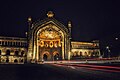 A long exposure photograph of the gate at night
 -

See also
See also
References
References
- "Rumi Darwaza - Lucknow". All India Tour Travel. Retrieved 21 May 2007.
- "Rumi Darwaza - Rumi Darwaza Lucknow - Rumi Darwaja in Lucknow India".
- "Lucknow". Encyclopædia Britannica. Retrieved 20 May 2008.
- Singh, Shalini (1989). A Study in Cultural Expressions of the Nawabs of Avadh, Tourism Recreation Research, pp. 75-79. https://www.tandfonline.com/doi/abs/10.1080/02508281.1989.11014557
- "Canada Masonry Design Centre – DYNAMIC CHARACTERIZATION AND SEISMIC ASSESSMENT OF HISTORIC MASONRY STRUCTURE OF RUMI DARWAZA". 19 May 2023. Retrieved 19 May 2023.
- Rai, Durgesh C.; Dhanapal, S. (3 April 2015). "Mineralogical and Mechanical Properties of Masonry and Mortars of the Lucknow Monuments Circa the 18th Century". International Journal of Architectural Heritage. 9 (3): 300–309. doi:10.1080/15583058.2013.780109. ISSN 1558-3058. S2CID 108451574.
- "Unveiling Rumi Darwaza The Untold Legacy of Lucknow's Heritage". In Lucknow. 25 January 2025. Retrieved 30 January 2025.