| Atherton raspberry | |
|---|---|

| |
Scientific classification 
| |
| Kingdom: | Plantae |
| Clade: | Embryophytes |
| Clade: | Tracheophytes |
| Clade: | Spermatophytes |
| Clade: | Angiosperms |
| Clade: | Eudicots |
| Clade: | Rosids |
| Order: | Rosales |
| Family: | Rosaceae |
| Genus: | Rubus |
| Species: | R. probus
|
| Binomial name | |
| Rubus probus | |
| Synonyms2 | |
| |
Rubus probus, commonly known as Atherton raspberry or wild raspberry, is a species of plant in the rose family Rosaceae. It has edible fruit and is native to Queensland, Australia, and nearby islands.
Description
Rubus probus is a scrambling, non-woody shrub growing to about 2 m (6+1⁄2 ft) high, and has recurved thorns on the undersides of leaves and twigs. The leaves are compound, with five ovate leaflets that are up to 10 cm (4 in) long and 5 cm (2 in) wide. The terminal leaflet is usually larger than the others, and they all have deeply toothed margins.34
Flowers are bisexual (i.e. they have both functional stamens and functional carpels)5: 369 and have five pale green sepals and five white petals.34 The fruit is an aggregate fruit, composed of numerous small drupes,5: 352 and they grow up to 15 mm (0.6 in) long and 20 mm (0.8 in) wide.3 The fruit is edible.6
Atherton raspberry is a rampant grower and, like most Rubus species, can form dense thorny thickets.4
Phenology
Flowering and fruiting occurs from April to December.7
Distribution and habitat
In Australia the species has been recorded along the Queensland coastal areas from Brisbane as far north as the Daintree National Park, and the Australasian Virtual Herbarium also has records from Bougainville Island.8 In addition to this, the Global Biodiversity Information Facility includes Papua New Guinea in the species' range9 and the Australian Tropical Rainforest Plants identification key states that the species also occurs in Malesia.3
The plant is favoured by disturbance, and grows in rainforest at altitudes from sea level to about 1,100 m (3,600 ft).3
Taxonomy
The plant was first described as Rubus muelleri in 1884 by Frederick Manson Bailey, based on a collection of material from Helidon in southern Queensland, "near waterfalls".10
Conservation status
This species is listed as least concern under the Queensland Government's Nature Conservation Act.1 As of June 2026, it has not been assessed by the International Union for Conservation of Nature (IUCN).
Gallery
-
 Habit
Habit -
 Thorns
 -
 Flower buds
 -
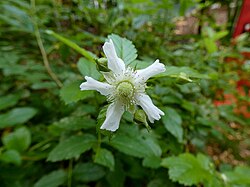 Flower
 -
 Fruit
Fruit
References
References
- "Taxon - Rubus probus". WildNet. Queensland Government. 2026. Retrieved 2 June 2026.
- "Rubus probus". Plants of the World Online. Royal Botanic Gardens, Kew. Retrieved 26 June 2021.
- F.A.Zich; B.P.M.Hyland; T.Whiffen; R.A.Kerrigan (2020). "Rubus probus". Australian Tropical Rainforest Plants Edition 8 (RFK8). Centre for Australian National Biodiversity Research (CANBR), Australian Government. Retrieved 26 June 2021.
- "Rubus probus". Australian Native Plants Society. 2016. Retrieved 26 June 2021.
- Kalkman, C. (2004). "Rosaceae". In Kubitzki, Klaus (ed.). Flowering Plants, Celastrales, Oxalidales, Rosales, Cornales, Ericales. The Families and Genera of Vascular Plants. Vol. 6. Berlin: Springer. pp. 343–386. doi:10.1007/978-3-662-07257-8. ISBN 978-3-642-05714-4.
- "Rubus Probus – Atherton Raspberry – Australia". Jane Grows Garden Rooms. Retrieved 2 June 2026.
- Cooper, Wendy; Cooper, William T. (June 2004). Fruits of the Australian Tropical Rainforest. Clifton Hill, Victoria, Australia: Nokomis Editions. p. 471. ISBN 978-0-9581742-1-3.
- "Search: species: Rubus probus | Occurrence records". Australasian Virtual Herbarium. Australian Government. Retrieved 2 June 2026.
- "Rubus probus L.H.Bailey". Global Biodiversity Information Facility. 2026. Retrieved 2 June 2026.
- Bailey, Frederick Manson (1884). "Contributions to the Queensland Flora". The Proceedings of the Royal Society of Queensland. 1: 9.
External links
External links
- Map of herbarium records of this species at the Australasian Virtual Herbarium
- Observations of this species on iNaturalist
- Images of this species on Flickriver.com