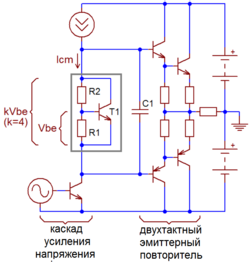
In electronics, a rubber diode or VBE multiplier is a bipolar junction transistor circuit that serves as a voltage reference. It consists of one transistor and two resistors, and the reference voltage across the circuit is determined by the selected resistor values and the base-to-emitter voltage (VBE) of the transistor. The circuit behaves as a voltage divider, but with the voltage across the base-emitter resistor determined by the forward base-emitter junction voltage.
It is commonly used in the biasing of push-pull output stages of amplifiers, where one benefit is thermal compensation: The temperature-dependent variations in the multiplier's VBE, approximately -2.2 mV/°C, can be made to match variations occurring in the VBE of the power transistors by mounting to the same heat sink.1 In this context, it is sometimes called bias servo.2
References
References
- Crecraft, David; Gergely, Stephen (May 21, 2002). Analog Electronics. Butterworth-Heinemann. p. 188. ISBN 0080475833. Retrieved August 11, 2015.
- Elliott, Rod (27 Dec 2006). "Power Amplifier Design Guidelines". Elliott Sound Products. Retrieved Oct 1, 2021.