Erwin Rommel | |
|---|---|
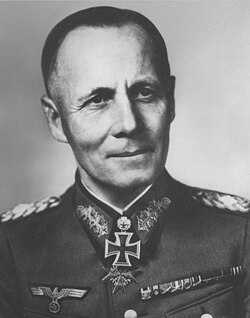 Rommel in 1941 | |
| Nickname | Der Wüstenfuchs (The Desert Fox) |
| Born | Johannes Erwin Eugen Rommel1 (1891-11-15)15 November 1891 Heidenheim, Germany |
| Died | 14 October 1944(1944-10-14) (aged 52) Herrlingen, Germany |
Cause of death | Forced suicide by cyanide poisoning |
| Buried | Herrlingen cemetery |
| Allegiance |
|
Branch | |
Service years | 1911–1944 |
Rank | Generalfeldmarschall |
| Commands | |
Conflicts | See battles
|
| Awards | |
| Alma mater | Kriegsschule |
| Spouse |
Lucia Maria Mollin (m. 1916) |
| Children |
|
| Signature |  |
Johannes Erwin Eugen Rommel (pronounced [ˈɛɐviːn ˈʁɔməl] ⓘ; 15 November 1891 – 14 October 1944), known as The Desert Fox (German: Wüstenfuchs, pronounced [ˈvyːstn̩ˌfʊks] ⓘ), was a German Generalfeldmarschall (field marshal) during World War II. He served in the Wehrmacht of Nazi Germany, as well as in the Reichswehr of the Weimar Republic, and Imperial German Army of the German Empire.
Rommel was a highly decorated officer in World War I and awarded the Pour le Mérite for his actions on the Italian Front. In 1937, he published his classic book on military tactics, Infantry Attacks, drawing on his experiences in that war. In World War II, he commanded the 7th Panzer Division during the 1940 invasion of France. His leadership of German and Italian forces in the North African campaign established his reputation as one of the ablest tank commanders of the war, and earned him the nickname der Wüstenfuchs, "the Desert Fox". Among his British adversaries he had a reputation for chivalry, and his phrase "war without hate" has been uncritically used to describe the North African campaign.2 Other historians have rejected the phrase as a myth, citing crimes against North African Jewish populations.3 Others note there is no clear evidence Rommel was involved in or aware of these crimes.45 He later commanded the German forces opposing the Allied cross-channel invasion of Normandy in June 1944.
After the Nazis gained power, Rommel pledged allegiance to the new regime. However, historians have given different accounts of the specific period and his motivations.6 At least until near the war's end, he was a loyal supporter of Adolf Hitler, but not of the Nazi party and the SS.7 In 1944, Rommel was implicated in the 20 July plot (or Operation Valkyrie) to assassinate Hitler. Subsequently, Rommel was given a choice between suicide or facing a trial that would result in his disgrace and execution. He ultimately chose the former and took a cyanide pill.8 Rommel was given a state funeral, and it was announced he had succumbed to injuries from the strafing of his car in Normandy. He is considered the best-known general on any side of World War II, with his actions in the war still attracting major attention to this day.910
Rommel became a larger-than-life figure in Allied and Nazi propaganda, and in postwar popular culture. Numerous authors portray him as an apolitical, brilliant commander and a victim of Nazi Germany, although others have contested this assessment and called it the "Rommel myth". Rommel's reputation for conducting a clean war was used in the interest of the West German rearmament and reconciliation between the former enemies – the UK and the US on one side and the new Federal Republic of Germany on the other. Several of Rommel's former subordinates, notably his chief of staff Hans Speidel, played key roles in West German rearmament and integration into NATO in the postwar era. The German Army's largest military base, the Field Marshal Rommel Barracks, Augustdorf, and a third ship of the Lütjens-class destroyer of the German Navy are both named in his honour. His son Manfred Rommel was the longtime mayor of Stuttgart, Germany, and namesake of Stuttgart Airport.
Early life and career
Rommel was born on 15 November 1891 in Heidenheim, 45 kilometres (28 mi) from Ulm, in the Kingdom of Württemberg, then part of the German Empire. He was the third of five children born to Erwin Rommel senior (1860–1913) and his wife Helene von Luz. Her father, Karl von Luz, headed the local government council. As a young man, Rommel's father had been an artillery lieutenant. Rommel had one older sister who was an art teacher and his favourite sibling, one older brother named Manfred who died in infancy, and two younger brothers, of whom one became a successful dentist and the other an opera singer.11
At age 18, Rommel joined the Württemberg Infantry Regiment No. 124 in Weingarten as a Fähnrich (ensign), in 1910, studying at the Officer Cadet School in Danzig.12 He graduated in November 1911 and was commissioned as a lieutenant in January 1912 and was assigned to the 124th Infantry in Weingarten.13 He was posted to Ulm in March 1914 to the 49th Field Artillery Regiment, XIII (Royal Württemberg) Corps, as a battery commander. He returned to the 124th when war was declared.14 While at Cadet School, Rommel met his future wife, 17-year-old Lucia (Lucie) Maria Mollin (1894–1971), of Italian and Polish descent.15
World War I
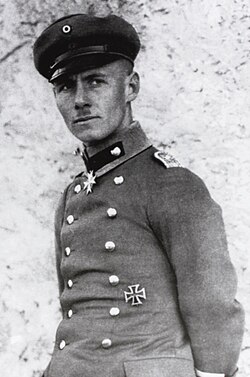
During World War I, Rommel fought in France as well as in the Romanian campaign, notably at the Second Battle of the Jiu Valley, and the Italian campaigns. He successfully employed the tactics of penetrating enemy lines with heavy covering fire coupled with rapid advances, as well as moving forward rapidly to a flanking position to arrive at the rear of hostile positions, to achieve tactical surprise.16 His first combat experience was on 22 August 1914 as a platoon commander near Verdun, when – catching a French garrison unprepared – Rommel and three men opened fire on them without ordering the rest of his platoon forward.17 The armies continued to skirmish in open engagements throughout September, as the static trench warfare typical of the war was still in the future.18 For his actions in September 1914 and January 1915, Rommel was awarded the Iron Cross, Second Class.19 Rommel was promoted to Oberleutnant (first lieutenant) and transferred to the newly created Royal Wurttemberg Mountain Battalion of the Alpenkorps in September 1915, as a company commander.20 In November 1916 in Danzig, Rommel and Lucia married.21
In August 1917, his unit was involved in the battle for Coșna Hill, a heavily fortified objective on the border between Hungary and Romania, which they took after weeks of difficult uphill fighting.22 The Mountain Battalion was next assigned to the Isonzo front, in a mountainous area in Italy. The offensive, known as the Battle of Caporetto, began on 24 October 1917.23 Rommel's battalion, consisting of three rifle companies and a machine gun unit, was part of an attempt to take enemy positions on three mountains: Kolovrat, Matajur, and Stol.24 From 25 to 27 October, Rommel and his 150 men captured 81 guns and 9,000 men, at a loss of six dead and 30 wounded.25 Rommel achieved this by taking advantage of the terrain to outflank the Italian forces, attacking from unexpected directions or behind enemy lines, and taking the initiative to attack when he had orders to the contrary. In one instance, the Italian forces, taken by surprise and believing their lines had collapsed, surrendered after a brief firefight.26 In this battle, Rommel helped pioneer infiltration tactics, a new form of manoeuvre warfare being adopted by German armies, and later by foreign armies,27 and later described by some as Blitzkrieg without tanks.28 However, he played no role in the early adoption of Blitzkrieg in World War II.29
Acting as advance guard in the capture of Longarone on 9 November 1917, Rommel again decided to attack with a much smaller force. Convinced that they were surrounded by an entire German division, the 1st Italian Infantry Division – 10,000 men – surrendered to Rommel. For this and his actions at Matajur, he received the order of Pour le Mérite.273031
In January 1918, Rommel was promoted to Hauptmann (captain) and assigned to a staff position in the 64th Army Corps, where he served for the remainder of the war.32 In his book Infanterie greift an, Rommel wrote in detail about his activities during World War I.
Interwar period
Rommel remained with the 124th Regiment until October 1920.3325 The regiment was involved in quelling riots and civil disturbances occurring throughout Germany.34 Wherever possible, Rommel avoided the use of force.35 In 1919, he was briefly sent to Friedrichshafen on Lake Constance, where he restored order by "sheer force of personality" in the 32nd Internal Security Company, which was composed of rebellious and pro-communist sailors.36 He decided against storming nearby Lindau, which had been taken by revolutionary communists.37 Instead, Rommel negotiated with the city council and returned it to the legitimate government through diplomatic means.3839 This was followed by his defence of Schwäbisch Gmünd, again bloodless.40 He was then posted to the Ruhr, where a Red Army was responsible for fomenting unrest. Historian Raffael Scheck praised Rommel as a coolheaded and moderate mind, exceptional amid the many takeovers of revolutionary cities by regular and irregular units and the associated violence.38
According to Reuth, this period gave Rommel the indelible impression that "Everyone in this Republic was fighting each other", along with the direct experience of people who attempted to convert Germany into a socialist republic on Soviet lines. Like Rommel, Hitler had known the solidarity of trench warfare and had participated in the Reichswehr's suppression of the First and Second Bavarian Soviet Republics. The need for national unity thus became a legacy of the first World War.39 Brighton noted that while both believed in the stab-in-the-back myth, Rommel was able to succeed using peaceful methods because he saw the problem as related to economics, rather than Judeo-Bolshevism – which right-wing soldiers such as Hitler blamed for the chaos.41
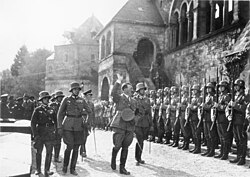
On 1 October 1920, Rommel was appointed to a company command with the 13th Infantry Regiment in Stuttgart, a post he held for the next nine years.33 He was then assigned to an instruction position at the Dresden Infantry School from 1929 to 1933. In April 1932, he was promoted to major.25 While at Dresden, he wrote a manual on infantry training, published in 1934. In October 1933, he was promoted to Oberstleutnant (lieutenant colonel) and given his next command, the 3rd Jäger Battalion, 17th Infantry Regiment, stationed at Goslar.42 There he first met Adolf Hitler, who inspected his troops on 30 September 1934.43
In September 1935, Rommel was moved to the Kriegsschule (War Academy) in Potsdam as an instructor, serving for the next three years.44 His book Infanterie greift an (Infantry Attacks), a description of his wartime experiences along with his analysis, was published in 1937. It became a bestseller, which, according to Scheck, later "enormously influenced" many armies.38 Hitler owned a copy.45
Hearing of Rommel's reputation as an outstanding military instructor, in February 1937 Hitler assigned him as the War Ministry liaison officer to the Hitler Youth in charge of military training. Here, Rommel clashed with Baldur von Schirach, the Reichsjugendführer, over the training the boys should receive.46 Trying to fulfil a mission assigned to him by the Ministry of War,47 Rommel had twice proposed a plan that would have effectively subordinated Hitler Youth to the Wehrmacht, removing it from NSDAP control. That went against Schirach's express wishes. Schirach appealed to Hitler; consequently, Rommel was quietly removed from the project in 1938.48 He had been promoted to Oberst (colonel), on 1 August 1937. After the Anschluss in March 1938, he was appointed commandant of the Theresian Military Academy at Wiener Neustadt.49
In October 1938, Adolf Hitler specially requested that Rommel be seconded to command the Führerbegleitbatallion (his escort battalion).50 This unit accompanied Hitler whenever he travelled outside of Germany.43 Rommel indulged his interest in engineering and mechanics by learning about the inner workings and maintenance of combustion engines and heavy machine guns.51 He memorised logarithm tables in his spare time, and enjoyed skiing and other outdoor sports.52 Ian Beckett wrote that by 1938, Rommel drifted towards uncritical acceptance of the Nazi regime, quoting Rommel's letter to his wife in which he stated "The German Wehrmacht is the sword of the new German world view", as a reaction to a speech by Hitler.53
During his visit to Switzerland in 1938, Rommel reported that Swiss soldiers who he met showed "remarkable understanding of our Jewish problem".54 Biographer Daniel Allen Butler commented that he did share the view (popular in Germany and many countries) that the Jews were loyal to themselves rather than the nations in which they lived. Despite this, other evidence shows he considered the Nazi racial theories to be rubbish.55 Alaric Searle comments that Rommel knew the official stand of the regime, but in this case, the phrase was ambiguous and there is no evidence after or before this event that he ever sympathised with the antisemitism of the Nazi movement.56 Rommel's son Manfred Rommel stated in the documentary The Real Rommel that his father would "look the other way" when faced with anti-Jewish violence on the streets. But Rommel requested proof of "Aryan descent" from the Italian boyfriend of his illegitimate daughter Gertrud.5758 During his time in Goslar, he repeatedly clashed with the SA whose members terrorised the Jews and dissident citizens. After the Röhm Purge (1934), he mistakenly believed that the worst was over, although restrictions on Jewish businesses were still being imposed and agitation against Jews continued. Manfred Rommel recounted that his father knew about and privately disagreed with the regime's antisemitism, but he had not actively campaigned on behalf of the Jews.59 However, Uri Avnery notes that even when Rommel was a low-ranking officer, he protected Jews who lived in his district.60 Manfred Rommel told the Stuttgarter Nachrichten that their family lived in isolated military facilities but knew about discrimination against the Jews occurring outside. They could not foresee the enormity of the impending atrocities, about which they only knew much later.61
Rommel wrote to his wife that Hitler had a "magnetic, maybe hypnotic, strength" that had its origin in Hitler's belief that he "was called upon by God", and Hitler sometimes "spoke from the depth of his being [...] like a prophet".62
World War II
Poland 1939
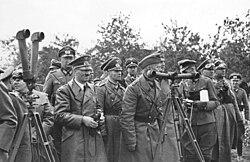
Rommel was promoted to Generalmajor in August 1939 and assigned commander of the Führerbegleitbatallion, guarding Hitler and his field headquarters during the invasion of Poland, which began on 1 September.63 Rommel's letters show he did not understand Hitler's true nature and intentions, as he quickly went from predicting a swift peaceful settlement to approving Hitler's reaction ("bombs will be retaliated with bombs") to the Gleiwitz incident, a false flag operation used as pretext for the invasion.64 Rommel attended Hitler's daily briefings and accompanied him everywhere, making use of the opportunity to observe first-hand the use of tanks and other motorised units.65 On 26 September Rommel returned to Berlin to set up a new headquarters for his unit in the Reich Chancellery.66 Rommel briefly returned to occupied Warsaw on 5 October to prepare for the German victory parade.67 In a letter to his wife he claimed that the occupation by Nazi Germany was "probably welcomed with relief" by the inhabitants of the ruined city and that they were "rescued".6869
France 1940
Promotion to armoured division commander
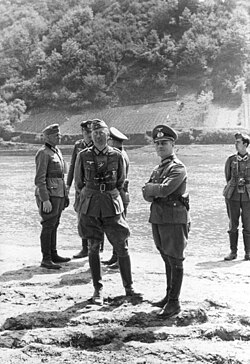
Following the invasion of Poland, Rommel began lobbying for command of one of Germany's panzer divisions, of which there were then only ten.70 Rommel's successes in World War I were based on surprise and manoeuvre, two elements for which the new panzer units were ideally suited.71 Rommel received promotion to general from Hitler ahead of more senior officers. Rommel obtained the command he aspired to, despite having been earlier turned down by the army's personnel office, which had offered command of a mountain division instead.72 Rommel was backed by Hitler, the influential Fourteenth Army commander Wilhelm List, a fellow Württemberger middle-class "military outsider", and likely Heinz Guderian, commander of XIX Army Corps.73
Going against military protocol, this promotion added to Rommel's growing reputation as one of Hitler's favoured commanders,74 although his outstanding leadership in France quelled complaints about his promotion and political scheming.75 The 7th Panzer Division had been converted to an armoured division consisting of 218 tanks in three battalions,76 with two rifle regiments, a motorcycle battalion, an engineer battalion, and an anti-tank battalion.77 Upon taking command on 10 February 1940, Rommel set his unit to practising the manoeuvres they would need in the upcoming campaign.78
Invasion of the Netherlands, Belgium and France
The invasion began on 10 May 1940. By the third day Rommel and advance elements of his division, with a detachment of the 5th Panzer Division, had reached the Meuse, where they found the bridges had been destroyed.7980 Rommel was active in the forward areas, directing efforts to make a crossing, which were initially unsuccessful because of suppressive fire by the French. Rommel brought up tanks and flak units to provide counter-fire and had nearby houses set on fire to create a smokescreen. He sent infantry across in rubber boats, appropriated the bridging tackle of the 5th Panzer Division, grabbed a light machine gun to fight off a French counterattack supported by tanks, and went into the water himself, encouraging the sappers and helping lash together the pontoons.8182 By 16 May Rommel reached Avesnes, and contravening orders, pressed on to Cateau.83 That night, the French II Army Corps was shattered and on 17 May, Rommel's forces took 10,000 prisoners, losing 36 men. He was surprised to find only his vanguard had followed his tempestuous surge. The High Command and Hitler had been nervous about his disappearance, although they awarded him the Knight's Cross. Rommel and Guderian's successes and the possibilities offered by the new tank arm were welcomed by a few generals, but worried and paralysed the rest.84
On 20 May, Rommel reached Arras.85 General Hermann Hoth received orders that the town should be bypassed and its British garrison thus isolated. He ordered the 5th Panzer Division to move to the west and the 7th Panzer Division to the east, flanked by the SS Division Totenkopf.86 The following day, the British launched a counterattack in the Battle of Arras. It failed and the British withdrew.87
7th Panzer continued its advance, reaching Lille on 27 May.88 The Siege of Lille continued until 31 May, when the French garrison of 40,000 men surrendered. Rommel was summoned to Berlin to meet Hitler. He was the only divisional commander present at the planning session for Fall Rot (Case Red), the second phase of the invasion of France.
Drive for the Channel
Rommel, resuming his advance on 5 June, drove for the River Seine to secure bridges near Rouen. Advancing 100 kilometres (60 mi) in two days, the division reached Rouen to find it defended by three French tanks which destroyed German tanks before being destroyed themselves. The German force, enraged by this, forbade fire brigades access to the burning district of the Norman capital, so most of the historic quarter was reduced to ashes.89 Rommel instructed the German artillery to bombard the city as a "fire demonstration".90 The smoke was intense enough that it reached Paris.91 Daniel Allen Butler states that the bridges to the city were already destroyed. After the fall of the city, an estimated 100 black civilians and colonial troops were executed on 9 June by unknown German units.92939495 Rouen fell to the 5th Panzer Division, while Rommel advanced from the Seine towards the Channel.9697 On 10 June, Rommel, near Dieppe, sent Hoth the message "Am on the coast".98 On 17 June, 7th Panzer was ordered to advance on Cherbourg, where British evacuations were under way. The division advanced 240 km (150 mi) in 24 hours, and after two days of shelling, the French garrison surrendered.99 The speed and surprise it consistently achieved, to the point that both the enemy and the Oberkommando des Heeres (OKH; German "High Command of the Army") at times lost track of its whereabouts, earned the 7th Panzers the nickname Gespensterdivision ("ghost division").100
After the armistice with the French was signed on 22 June, the division was placed in reserve, being sent first to the Somme and then Bordeaux to reequip and prepare for Unternehmen Seelöwe (Operation Sea Lion), the planned invasion of Britain.101 This invasion was cancelled.102
North Africa 1941–1943
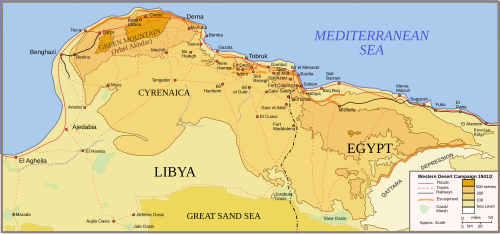
On 6 February 1941, Rommel was appointed commander of the new Afrika Korps (Deutsches Afrika Korps; DAK), consisting initially of the 5th Light Division (later 21st Panzer Division) and 15th Panzer Division.103 Promoted to Generalleutnant, he arrived in Tripoli on 12 February.104 The DAK had been sent in Operation Sonnenblume to support Italian forces that had suffered heavy defeats in Operation Compass.104 His operations in the Western Desert Campaign soon earned him the nickname "Desert Fox" in both Allied and German reporting.105N 1 Allied troops in the theatre were commanded by General Archibald Wavell.106
First Axis offensive
Formally subordinate to Italian commander-in-chief General Italo Gariboldi,103 Rommel rejected the instructions of the Oberkommando der Wehrmacht (OKW) to hold a defensive line near Sirte.107 Encouraged by Hitler to act aggressively, he launched a limited offensive on 24 March 1941 with 5th Light Division and two Italian divisions, even though 15th Panzer Division had not yet arrived.108109 The British, weakened by the transfer of formations to the Battle of Greece,110 fell back to Mersa El Brega, where they were defeated on 31 March.111
Rommel then pushed rapidly east, taking Benghazi on 3 April as the British withdrew.112113 When Gariboldi ordered him to halt at Mersa El Brega, Rommel argued that "one cannot permit unique opportunities to slip by for the sake of trifles",114 and misrepresented a signal from General Franz Halder so as to claim freedom of action.115 By 8 April Axis forces had reoccupied most of Cyrenaica; only the port of Tobruk held out and was invested on 11 April.116117 Throughout the campaign fuel, food and water remained chronic problems, as everything had to be brought from Europe and moved over difficult desert tracks.118119
Siege of Tobruk
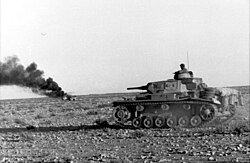
Tobruk was not fully encircled, since the garrison could be supplied by sea,120 but Rommel regarded its capture as essential to shorten his overstretched supply line and gain port capacity for further operations.121 The strongly fortified port, held by about 36,000 Commonwealth troops under Australian Lieutenant General Leslie Morshead,122123 withstood a surprise assault on 14 April.124
Repeated German–Italian attacks failed. A second assault at the end of April 1941 was repulsed, and an Allied attempt to break the siege in Operation Brevity in May,125 followed by Operation Battleaxe in June, also ended in failure.126 The outcome contributed to Wavell’s replacement by General Claude Auchinleck as theatre commander.127
In August 1941 Rommel was appointed commander of the newly created Panzer Army Africa, with Fritz Bayerlein as chief of staff.128 The Afrika Korps (15th Panzer and the reinforced 21st Panzer Division) under Generalleutnant Ludwig Crüwell, together with 90th Light Division and several Italian formations, formed his main striking force, while Field Marshal Albert Kesselring was given overall responsibility for the Mediterranean area to improve air and sea coordination.129
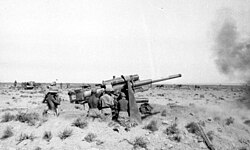
Auchinleck reorganised his forces into XXX and XIII Corps, forming the British Eighth Army under General Alan Cunningham.130 As Rommel prepared another attempt on Tobruk for November, Auchinleck launched Operation Crusader on 18 November 1941 to relieve the garrison.131132
In the confused fighting that followed, the Eighth Army lost large numbers of tanks, but Rommel’s armoured forces also suffered heavy casualties and supply problems.133 On 24 November he attempted a wide counterstroke towards the Egyptian frontier—the so-called "dash to the wire"—which overextended his forces and was criticised by the German high command and his own staff.134135 While he advanced into Egypt, Commonwealth troops east of Tobruk endangered his rear. With losses mounting, Rommel withdrew, and on 27 November the British linked up with the Tobruk garrison. By early December he had fallen back to a defensive line at Gazala, just west of Tobruk, under heavy pressure from the Desert Air Force.136 The British recovered most of Cyrenaica, but his retreat shortened Axis supply lines to El Agheila.137138
Battle of Gazala and capture of Tobruk
Receiving new tanks and supplies in January 1942, Rommel launched a counteroffensive from El Agheila on 21 January.139140 Taking the British by surprise, he retook Benghazi on 29 January and forced them back to a defensive line west of Tobruk near Gazala.141
Between December 1941 and June 1942, Axis intelligence was aided by detailed reports from US military attaché Bonner Fellers, whose messages were sent in a compromised code.142 Following Kesselring's temporary neutralisation of Malta in April 1942, supply deliveries improved,143 and Rommel sought to pre-empt a British offensive. On 26 May he attacked first, starting the Battle of Gazala.144 The main armoured force swung south and then north behind the British left flank.145
After heavy fighting, including a stubborn defence by the Free French at Bir Hakeim until 10 June,146 the British line collapsed and the Eighth Army began a rapid retreat towards Egypt, dubbed the "Gazala Gallop".147 Rommel pressed on and assaulted Tobruk on 20 June; the garrison, this time under South African not Australian command, surrendered the next day.148 Around 32,000 Commonwealth troops were captured, along with substantial supplies and the port itself.149 Only at the fall of Singapore earlier that year had more British Commonwealth troops been taken prisoner. On 22 June Hitler promoted Rommel to Generalfeldmarschall.150
Rommel wished to exploit the victory immediately by advancing into Egypt, aiming at Alexandria and the Suez Canal, which he saw as a decisive strategic objective linking to operations in the Caucasus and Middle East.151152 His success at Tobruk, however, contributed to Hitler’s decision to postpone Operation Herkules, the projected assault on Malta,153 allowing Allied interdiction of Axis supplies to resume.
Auchinleck relieved Lieutenant General Neil Ritchie of command of the Eighth Army and took over personally.154 Rommel, aware that delay favoured the British, attacked the new fallback position at Mersa Matruh on 28 June.155 The fortress fell the next day, and large stocks of fuel, vehicles and equipment were captured, many of which were pressed into Axis service.156
El Alamein
First Battle of El Alamein
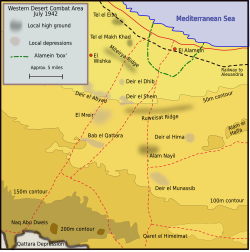
The Eighth Army withdrew to prepared positions near El Alamein, where the sea to the north and the impassable Qattara Depression to the south created a narrow defensive front that could not easily be outflanked.157 Axis propaganda leaflets, distributed in Egypt and Syria, urged local populations to support Rommel’s advance and portrayed the struggle in strongly antisemitic terms.158
The First Battle of El Alamein began on 1 July 1942. Rommel had about 100 operational tanks,159 and his troops faced a numerically superior enemy with growing air supremacy. Delayed by sandstorms and artillery fire, his attacks made little headway, and by early July he recorded in his diary that his strength had "faded away".160 Both sides suffered comparable losses during the month, but the Axis supply situation continued to deteriorate, and Rommel recognised that the initiative was slipping away.161162
In August Auchinleck was replaced by General Harold Alexander as theatre commander, and Bernard Montgomery took over the Eighth Army (after the death of General William Gott in an air attack).163 Expecting a major British build-up—Rommel knew a large convoy was due in September164—he tried to pre-empt it with another attack. He planned an armoured thrust through the southern sector using 15th and 21st Panzer Divisions, 90th Light Division and Italian XX Motorized Corps.157165
Battle of Alam El Halfa
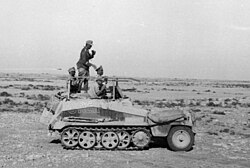
The resulting Battle of Alam el Halfa opened on 30 August 1942. Forced by terrain and minefields to repeat a wide sweep to the south, Rommel’s armour became bogged down in unexpected soft ground and came under heavy fire from British artillery and aircraft; Montgomery had even arranged for him to receive a falsified map of the area.166167 By 2 September, with fuel running short and no prospect of outflanking the British, Rommel broke off the attack and withdrew.168
A British spoiling attack on 3 September was repulsed by 90th Light Division, and Montgomery chose not to pursue, preferring to conserve strength and train his army for a set-piece offensive.169 Rommel had suffered nearly 3,000 casualties and lost about 50 tanks, similar numbers of guns and some 400 lorries—losses he could not easily replace—while British losses were lighter except in tanks.170171 He concluded that the war in Africa could no longer be won and, suffering from illness and exhaustion, flew to Germany to recuperate; General Georg Stumme took over command.164171172
Second Battle of El Alamein
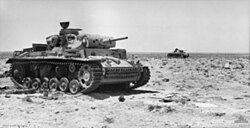
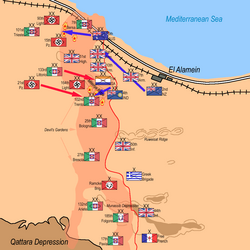
By late 1942 British code-breaking and naval-air interdiction meant that only a fraction of Axis supplies reached North Africa.173 Mussolini diverted some deliveries to garrisons in Tripoli and refused further reinforcements,174 leaving Rommel’s forces short of fuel, ammunition and replacements.175 The Axis defensive line west of El Alamein was anchored on a deep mine belt and prepared infantry positions, behind which armoured reserves were to counterattack any breakthrough.176177
The British offensive began on 23 October. Stumme died of a heart attack at the front on 24 October, and Rommel, recalled from Germany, resumed command the next day.178 Montgomery aimed to cut corridors through the northern minefields, then grind down the Axis armour. By 25 October, 15th Panzer Division had only 31 operational tanks left from an initial 119,179 and Rommel pulled 21st Panzer and the Italian Ariete Division north to reinforce the sector.180
After several days of attritional fighting, Rommel had about 150 operational tanks, facing some 800 British tanks, many of them Shermans.180 On 2 November Montgomery launched "Operation Supercharge" with a massive artillery barrage, breaking through the depleted Axis front.181 Rommel ordered a withdrawal, but on 3 November Hitler radioed a "stand fast" order, instructing him to hold the line to the last man.182183 Rommel initially complied, but after discussions with Kesselring and other commanders he again ordered a retreat on 4 November, a delay he later called his greatest mistake in Africa.184185 The British 1st and 7th Armoured Divisions broke through and attempted to encircle the retreating Axis forces.186 That evening Hitler finally authorised withdrawal.187
End of Africa campaign
Rommel conducted a fighting retreat across Libya towards Tunisia, seeking to preserve as many men and vehicles as possible. Heavy rain and temporary grounding of the Desert Air Force occasionally aided his withdrawal, but the Eighth Army’s pressure, together with Allied control of the air and sea, forced him to abandon much Italian equipment and rely increasingly on improvised combat groups.188189190 Kesselring criticised the retreat because each abandoned airfield extended Allied air range, but Rommel argued that any attempt to stand and fight would simply lead to encirclement and destruction of his remaining forces.191

In Tunisia, Rommel struck at the US II Corps to secure his lines of communication to Tunis, inflicting a sharp defeat at the Battle of Kasserine Pass in February 1943—his first major engagement against American forces and his last significant battlefield victory.192 He then turned back to face the Eighth Army behind the old French Mareth Line defences on the Libyan–Tunisian border.
While Rommel was at Kasserine, Italian General Giovanni Messe was appointed commander of Panzer Army Africa, now redesignated the Italo–German Panzer Army. Though nominally replacing Rommel, he deferred to him in practice, and on 23 February Army Group Africa was created with Rommel in overall command, including Messe’s army in the south and General Hans-Jürgen von Arnim’s German Fifth Panzer Army in northern Tunisia.
Rommel’s final offensive in North Africa came on 6 March 1943, when he attacked the British Eighth Army at the Battle of Medenine with 10th, 15th and 21st Panzer Divisions.193 Forewarned by Ultra intercepts, Montgomery had sited strong anti-tank defences along the expected axes of advance. After losing 52 tanks in failed assaults, Rommel broke off the attack.194 On 9 March he returned to Germany to recover his health and report to Hitler; command of Army Group Africa passed to von Arnim, and Rommel did not return to the African theatre.195196
Italy 1943
On 23 July 1943, Rommel was moved to Greece as commander of Army Group E to counter a possible British invasion. He arrived in Greece on 25 July but was recalled to Berlin the same day following Mussolini's dismissal from office. This caused the German High Command to review the defensive integrity of the Mediterranean and it was decided Rommel should be posted to Italy as commander of the newly formed Army Group B. On 16 August 1943, Rommel's headquarters moved to Lake Garda in north Italy and he assumed command of the group, consisting of the 44th Infantry Division, the 26th Panzer Division and the 1st SS Panzer Division Leibstandarte SS Adolf Hitler. When Italy announced its armistice with the Allies on 8 September, Rommel's group took part in Operation Achse, disarming the Italian forces.197198
Hitler met with Rommel and Kesselring on 30 September 1943 to discuss operations in Italy. Rommel insisted on a defensive line north of Rome, while Kesselring was more optimistic and advocated holding a line south of Rome. Hitler preferred Kesselring's recommendation, and therefore revoked his decision for the subordination of Kesselring's forces to Rommel's army group. On 19 October, Hitler decided that Kesselring would be the overall commander of the forces in Italy, sidelining Rommel.199 Rommel had wrongly predicted that the collapse of the German line in Italy would be fast. On 21 November, Hitler moved Rommel and Army Group B to Normandy in France, with responsibility for defending the coast against the anticipated Western Allied invasion.200
Atlantic Wall 1944

In November 1943 Rommel was appointed General Inspector of the Western Defences, with authority to inspect the Atlantic Wall and recommend improvements. Hitler, who increasingly disagreed with him on military issues, also hoped to use Rommel’s prestige to bolster German morale.201
There was sharp disagreement in the German high command over how to meet an Allied landing in France. Commander-in-Chief West, Gerd von Rundstedt, favoured holding the armoured reserves inland near Paris for a concentrated counter-attack, repeating the operational methods of 1940 and in line with practice on the Eastern Front.202 Rommel, drawing on his North African experience of Allied air superiority, believed German armour would be destroyed before it could assemble and argued that the invasion must be defeated on or very close to the beaches. Rundstedt privately told him the Atlantic Wall was largely a propaganda project.203
On arriving in northern France Rommel was dismayed by the state of the defences. Initially only in an inspection role, he pressed his ideas down the chain of command, but encountered resistance from above until January 1944, when he was given command of Army Group B, controlling the 7th and 15th Armies and a coastal strip from the Zuiderzee to the Loire estuary.204205 The command structure remained fragmented: Luftwaffe and Kriegsmarine units answered to their own chiefs, and Rommel needed Hitler’s approval to commit panzer divisions.206
Rommel energetically expanded the Atlantic Wall, with millions of mines and extensive beach obstacles, anti-landing stakes (later dubbed Rommel's asparagus), and strengthened strongpoints, including in areas suitable for airborne landings.207 His staff developed or adapted a wide variety of obstacles to hinder landing craft and armour; Steven Zaloga calls this Rommel’s most important contribution to the defence of Normandy.208 Shortages of materials, manpower and time meant many positions were unfinished by June 1944, and numerous units were poorly trained or inadequately supplied.209207
Rundstedt expected the main invasion at the Pas-de-Calais—the shortest route from Britain and closest to Germany.210 Rommel’s and Hitler’s views shifted, but most senior commanders, influenced by Allied deception operations, ultimately believed that even if landings occurred elsewhere, a second and larger blow would fall in the Calais area.211 Hitler compromised between the rival strategies, assigning three panzer divisions (2nd, 21st and 116th) to Rommel, four to Rundstedt and others to Army Group G, satisfying no one.212213
Bad weather in the Channel at the start of June 1944 led German meteorologists to rule out an imminent invasion. On 5 June Rommel travelled to Germany for his wife's fiftieth birthday.207 When the Allied landings in Normandy began on 6 June, Hitler initially refused to release the armoured reserve, and German commanders hesitated, still suspecting a diversion. Only limited panzer movements were authorised, and heavy Allied air attacks disrupted counter-attacks planned for 7 June.214215 By nightfall on D-Day the Allies had secured five beachheads and landed about 155,000 troops.216
As the bridgehead expanded despite strong resistance, Rommel concluded that German forces should withdraw out of range of Allied naval guns, regroup and attempt a counter-attack from a shorter line. He persuaded Rundstedt, but both failed to convince Hitler, who insisted the Wehrmacht hold its positions. At a meeting at the Wolfsschlucht II headquarters near Margival on 17 June, Rommel warned Hitler that the front would collapse, but was brusquely told to concentrate on military operations.217218

By mid-July the German position in Normandy was deteriorating rapidly. On 17 July 1944, while returning from a visit to I SS Panzer Corps headquarters, Rommel’s staff car was strafed by Allied fighters near Sainte-Foy-de-Montgommery. The driver lost control and crashed; Rommel was thrown from the vehicle and suffered severe head and facial injuries, including three skull fractures, which forced his removal from command.219220 Responsibility for the attack has been variously attributed to pilots Charley Fox, Jacques Remlinger and Johannes Jacobus le Roux.221222223224
Plot against Hitler
The extent of Rommel’s involvement in the military resistance against Hitler and the 20 July plot is disputed, as most conspirators were killed and documentation is fragmentary.225226 One important piece of evidence is a conversation recorded by British intelligence in which Heinrich Eberbach, in captivity, recalled Rommel telling him that Hitler and his closest associates had to be killed as the only way out for Germany, a month before Rommel’s forced suicide.227228229
Further evidence comes from the papers of Rudolf Hartmann and Carl-Heinrich von Stülpnagel, discovered in 2018, which include Hartmann’s account of a meeting between Rommel and Stülpnagel in May 1944 and photographs of a gathering of the resistance inner circle with Rommel at Mareil-Marly. According to Hartmann, by late May Rommel was involved in their plans.230 In a post-war account, Stuttgart mayor Karl Strölin stated that he, Stülpnagel and Alexander von Falkenhausen approached Rommel in early 1944, and Rommel agreed in February to support the resistance.231

On 15 April 1944, Rommel’s new chief of staff, Hans Speidel, arrived in Normandy and reintroduced him to Stülpnagel.232 The conspirators needed an active field marshal and instructed Speidel to bring Rommel into their circle.233 Late in May, Speidel met former foreign minister Konstantin von Neurath and Strölin, who advocated opening surrender negotiations with the Western Allies; Speidel later claimed Rommel agreed to further steps in this direction.218
At least initially Rommel opposed assassinating Hitler, fearing civil war and a martyr-cult, and instead favoured arrest and trial.234235 He did not attempt to seize Hitler when he visited Margival on 17 June, an operation that would in any case have been highly unlikely to succeed given Hitler’s security and Rommel’s former role in his protection detail.236 Rommel repeatedly urged Hitler to seek peace with the Western Allies, a stance many historians describe as politically naïve, since the Allies no longer trusted Hitler.23738238
Post-war, Rommel’s widow Lucie resisted linking her husband to the conspiracy, partly because many Germans continued to view the plotters as traitors.239 At the time, however, the resistance hoped to harness Rommel’s popularity to win over the army and population.240241 Several contemporaries, including Siegfried Westphal, later recalled Rommel’s refusal to accept further “senseless sacrifices”.240 According to recollections reported by Butler and others, Rommel told Hitler that if he personally stood in the way of peace he should resign or kill himself, but Hitler insisted on continued resistance.242243 Historians note that Rommel’s blunt demands for political solutions were unusual among senior Wehrmacht officers.244245
On 15 July, Rommel wrote to Hitler giving him what he described as a last chance to end hostilities with the Western Allies and urging him to “draw the proper conclusions without delay”.246 The letter reached Hitler only after a delay, partly due to Ob. West commander Günther von Kluge’s attempts to shield himself and others in the tense days before and after the 20 July plot.247 Several senior commanders in the West indicated they would support Rommel, while others, such as Erich von Manstein, rejected approaches but did not inform Hitler.225248249
On 17 July 1944, Rommel was gravely wounded in an Allied air attack, removing him from command just days before the bomb attempt on Hitler. Many authors consider this a crucial blow to the conspirators, who had hoped to rely on him in the West.250251252 After the failure of the 20 July plot, mass arrests followed. Rommel was first implicated when the badly injured Stülpnagel repeatedly muttered his name before attempting suicide; under torture, Caesar von Hofacker also named Rommel as involved.253254 Civilian resistance leader Carl Goerdeler had listed Rommel as a potential Reich President, though this plan was never discussed with him.255256
On 27 September, Martin Bormann submitted a memorandum to Hitler stating that Stülpnagel, Hofacker and other defendants had testified that Rommel knew about the assassination plan and had promised to serve the new government.257 Gestapo surveillance of Rommel’s home in Ulm followed.258 Historian Peter Lieb identifies Bormann’s memo, Eberbach’s intercepted conversation and the testimonies of surviving resistance members such as Hartmann as the key sources indicating Rommel’s support for the conspiracy, while acknowledging that some, notably Speidel, had strong post-war motives to emphasise their own roles.259 Other historians stress that, whatever his precise involvement in the bomb plot, Rommel developed his own plan to end the war in the West and sought, increasingly openly, to bring senior commanders over to his side.260
Death


Rommel's case was turned over to the "Court of Military Honour"—a drumhead court-martial convened to decide the fate of officers involved in the conspiracy. The court included Generalfeldmarschalls Wilhelm Keitel and Gerd von Rundstedt, Generaloberst Heinz Guderian, General der Infanterie Walther Schroth and Generalleutnant Karl-Wilhelm Specht, with General der Infanterie Karl Kriebel and Generalleutnant Heinrich Kirchheim (whom Rommel had fired after Tobruk in 1941)261 as deputy members and Generalmajor Ernst Maisel as protocol officer. The Court acquired information from Speidel, Hofacker and others that implicated Rommel, with Keitel and Ernst Kaltenbrunner assuming he had taken part. Keitel and Guderian then made the decision that favoured Speidel's case and shifted the blame to Rommel.262263264 By normal procedure, this would lead to Rommel's being brought to Roland Freisler's People's Court, a kangaroo court that always decided in favour of the prosecution. However, Hitler knew having Rommel executed as a traitor would damage morale on the home front.265266 He decided to offer Rommel the chance to take his own life.267
Two generals from Hitler's headquarters, Wilhelm Burgdorf and Ernst Maisel, visited Rommel at his home on 14 October 1944. Burgdorf informed him of the charges and offered him three options: (a) defend himself in front of Hitler in Berlin,N 2 or refuse, but this would be taken as admission of guilt; (b) face the People's Court, which would have been tantamount to a death sentence; or (c) choose death by suicide. In (b), his family would have suffered even before the all-but-certain conviction and execution, and his staff would have been arrested and executed as well. In (c), the government would claim he died a hero and bury him with military honours, and his family would receive pensions. In support of the suicide option, Burgdorf had brought a cyanide capsule.269
Rommel chose suicide, and explained his decision to his wife and son.270 Wearing his Afrika Korps jacket and carrying his field marshal's baton, he got into Burgdorf's car, driven by SS-Stabsscharführer Heinrich Doose, and was driven out of the village. After stopping, Doose and Maisel walked away from the car leaving Rommel with Burgdorf. Five minutes later Burgdorf gestured to the two men to return, and Doose noticed Rommel was slumped over. He died before being taken to the Wagner-Schule field hospital. Ten minutes later, the group telephoned Rommel's wife to inform her.271272273

The official notice of Rommel's death reported to the public stated he had died of either a heart attack or cerebral embolism—a complication of the skull fractures he had suffered in the strafing of his staff car.274275276277 To strengthen the story, Hitler ordered a day of mourning. As promised, Rommel was given a state funeral, but it was held in Ulm instead of Berlin, as had been requested by Rommel.278 Hitler sent Field Marshal Rundstedt, who was unaware Rommel had died as a result of Hitler's orders, as his representative to the funeral.279 The truth behind Rommel's death became known to the Allies when intelligence officer Charles Marshall interviewed Rommel's widow,280 as well as from a letter by Rommel's son Manfred in 1945.
Rommel's grave is located in Herrlingen, a short distance west of Ulm. For decades after the anniversary of his death, veterans of the Africa campaign, including former opponents, would gather at his grave.281
Style as military commander
On the Italian front in the First World War, Rommel developed a preference for fast-moving, mobile operations and bold initiative. He concluded that seizing the momentum and denying the enemy time to regroup was key to victory. Some authors argue that many of his early opponents were second-rate, disorganised or depleted, and that his methods proved less effective against well-led and well-equipped forces later in the Second World War.282 Others note that throughout his career he often fought while outnumbered and outgunned, sometimes overwhelmingly so, and also had to contend with internal opponents in Germany who hoped for his failure.283284285286
Rommel is praised by numerous authors as a gifted and charismatic commander.287288289290 Basil Liddell Hart described him as a strong leader, worshipped by his troops and respected by his adversaries, and considered him one of the "Great Captains of History".291 Owen Connelly likewise writes that "no better exemplar of military leadership can be found", citing Friedrich von Mellenthin on the close, almost intuitive understanding between Rommel and his men.292 Hitler, by contrast, remarked that Rommel was a "very great leader" in success but an "absolute pessimist" when difficulties arose.293 Claus Telp criticises him for advancing the careers of his own officers while ignoring or slighting peers in his reports.294

Surprise and psychological pressure were central to Rommel's approach to offensive warfare. He used sandstorms, darkness and rapid manoeuvre to conceal his movements and unsettle the enemy.296 He was notably aggressive and often directed operations from the front or flew over the battlefield in a reconnaissance aircraft. When the British mounted Operation Flipper deep behind German lines to kill him and his staff before Operation Crusader, Rommel was indignant that they expected to find his headquarters 400 kilometres (250 miles) behind the front.297 His habit of personally intervening at the decisive point of battle could, however, leave him out of touch with the wider situation: Mellenthin cites his counterattack during Operation Crusader as an example.298299 Butler agrees that, although leading from the front inspired his troops, Rommel carried it to such extremes—sometimes directing individual companies or battalions—that communication and coordination suffered and his own life was put at unnecessary risk.101 Albert Kesselring complained that Rommel "cruised about the battlefield" like a divisional or corps commander rather than an army leader, but his staff officers Gause and Westphal argued that in the African desert this methods was often the only way to command effectively.300301 His staff admired his dedication but complained about his austere, almost Spartan lifestyle, which they felt made their tasks harder and reduced his effectiveness.302303304
During the 1940 campaign in France, Rommel's leadership of the 7th Panzer Division attracted both praise and criticism. Officers such as General Georg Stumme, who had previously commanded the division, were impressed by the speed and success of its advance.305 Others, including his corps commander Kluge, considered his decisions impulsive and accused him of claiming excessive credit, for example by presenting misleading diagrams or failing to acknowledge the contribution of other units, particularly the Luftwaffe.306 His division took heavy casualties, but in exchange for 2,160 men and 42 tanks lost, it captured more than 100,000 prisoners and destroyed or seized about 450 tanks, vehicles and guns.307308
Rommel spoke German with a marked southern German, or Swabian, accent and did not belong to the Prussian aristocracy that dominated the German high command, which made him something of an outsider to the traditional power structure.309310 He believed a commander should be physically more robust than his troops and lead by example.311N 3 He expected his subordinate commanders to display similar stamina.312
Personally, Rommel was direct, unbending and often brusque with both superiors and subordinates, and he could be disobedient to Hitler when he felt orders were impractical or harmful, while remaining gentle and diplomatic with lower-ranking soldiers.313314315316 Despite his willingness to work with propaganda photographers and journalists, he was personally shy, introverted and stiff in manner even with his closest aides, judging people primarily on merit.317 He could, however, show strong loyalty and warmth to a small circle of trusted individuals, including Hitler in the earlier years of their relationship.318319320
Relationship with Italian forces

Rommel’s relationship with the Italian high command in North Africa was tense. Although nominally subordinate to them, he exercised wide autonomy and directed both German and Italian formations, creating friction, especially over supplies, which Italian authorities tended to prioritise for their own units.321322 Rommel's blunt style did little to ease matters.323324 Italian commanders, though generally less aggressive than Rommel, were often capable logisticians and artillery tacticians, and their troops—despite poor equipment—were usually well trained.325 Disputes over supply and priorities were frequent, and Kesselring’s attempt to improve cooperation produced limited success; he later complained that Rommel ignored him much as he ignored the Italians.326327
Italian assessments of Rommel varied widely. Some senior officers criticised him or used him as a scapegoat, while others sought to appropriate parts of the Rommel myth; most, however, found his emotional and chaotic leadership difficult to work with.328 Among rank-and-file troops he enjoyed a stronger reputation and “became sort of a myth”.329 Rommel himself rated Italian soldiers more highly than their leaders and, unlike many German officers, was generally described as “kindly disposed” towards Italians as a people.330331 By contrast, James J. Sadkovich cites cases of Rommel refusing cooperation, abandoning Italian units and blaming them for his own failures, characterising him as “arrogantly ethnocentric”.332
Views on the conduct of war
Combat

Many authors describe Rommel as a chivalrous and professionally minded officer who generally tried to observe the customary laws of war and who won the respect of both his troops and many of his enemies.333334335336337 This reputation has led some commentators to contrast him with more ideologically driven Nazi commanders, though others argue that it forms part of a post-war "clean Wehrmacht" image that needs careful scrutiny.
During Operation Achse, the German disarmament of Italian forces after the Armistice of Cassibile in 1943, harsh orders signed by Rommel and Kesselring contributed to brutal behaviour elsewhere. Gerhard Schreiber quotes their directive that "sentimentality" towards former Italian allies was misplaced and that those fighting against German troops "shall experience toughness". He interprets this as a hate-filled order aimed primarily at Italian soldiers rather than partisans and argues that it helped brutalise the campaign.338 Remy cautions against taking the order out of context, noting that disarmament in Rommel's sector occurred largely without major bloodshed and that Rommel insisted Italian prisoners be treated on the same footing as German civilians.339 Peter Lieb similarly concludes that the order did not significantly radicalise the war in Rommel's area of responsibility, although Italian internees were subsequently deported to Germany for forced labour, something Rommel is not believed to have known about.340 Historian Dennis Showalter comments that Rommel was not directly involved in the anti-partisan war in Italy, but that orders prescribing death for Italian soldiers captured in arms or civilians sheltering escaped prisoners suggest he might not have behaved fundamentally differently from many of his Wehrmacht contemporaries.341
Lieb and others argue that Rommel repeatedly refused to carry out illegal orders, most notably Hitler's Commando Order instructing the execution of captured Allied commandos, which he did not pass on to his subordinates.342 Units under his command reported treating such captives as regular prisoners of war, and it is likely he behaved similarly in North Africa.342 Historian Szymon Datner suggests that Rommel may have wished to keep Nazi atrocities hidden from the Western Allies.343 Remy argues that although Rommel heard rumours about massacres while in Africa, his personality and circumstances meant he was not fully confronted with the scale of Nazi crimes until 1944.344 When he learned of atrocities committed by the Leibstandarte in Italy in 1943, he reportedly forbade his son from joining the Waffen-SS.345
Attitude toward colonial troops

French colonial troops were depicted in Nazi propaganda as symbols of French decadence, and several historians argue that Rommel shared some of the racial attitudes common among German officers of his time. Myron Echenberg writes that he, like Hitler, regarded black French soldiers with particular disdain.346 Ward Rutherford and Vaughn Raspberry present him as considering non-European troops, especially black Africans and Indians, to belong to "inferior races" and resenting their use against German forces.347348
Other authors emphasise a more complex picture. Bruce Watson notes that whatever racist assumptions Rommel initially brought to the desert war, they eroded when he encountered the effectiveness of units such as the 4th Indian Division, whose fighting qualities he later praised.349350 Initially reluctant to employ Indian volunteers captured from Allied units under his command, he later visited the Indian Legion in France, commended their performance and supported their integration despite prejudice within the Wehrmacht.351352
Reports from black South African prisoners of war describe Rommel ordering that they be housed and queued for food together with white prisoners, telling them that brave soldiers should be treated alike.353 Accounts from veterans of the 28th Māori Battalion suggest that, although Rommel complained that some of their tactics violated European norms, he generally treated captured Māori soldiers fairly and expressed respect for their combat skills.354355356 Historian Ralf Georg Reuth argues that Rommel tried to ensure correct treatment of colonial prisoners within his command, while distancing himself from Hitler's racist war in the East and maintaining an idealised, selective view of the Führer.357
Reputation as a military commander

Rommel was famous in his lifetime, including among adversaries. His tactical prowess and decency in the treatment of Allied prisoners earned him the respect of opponents including Claude Auchinleck, Archibald Wavell, George S. Patton, and Bernard Montgomery.358
Rommel's military reputation has been controversial. While military practitioners acknowledge Rommel's excellent tactical skills and bravery, some, such as US major general David T. Zabecki, consider Rommel's performance as an operational level commander to be overstated and other officers agree.74N 4 General Klaus Naumann agrees with historian Charles Messenger that Rommel's violation of the unity of command principle, bypassing chain of command, was unacceptable and contributed to failure in North Africa.359N 5 Biographer Wolf Heckmann describes Rommel as "the most overrated commander of an army...".360
Nevertheless, there are many officers who admire his methods, like Norman Schwarzkopf who described Rommel as a genius at battles of movement saying "Look at Rommel. Look at North Africa, the Arab-Israeli wars, and all the rest of them. A war in the desert is a war of mobility and lethality. It's not a war where straight lines are drawn in the sand and [you] say, 'I will defend here or die."361362 Ariel Sharon deemed the military model used by Rommel superior that used by Montgomery.363 His compatriot Moshe Dayan considered Rommel a model and icon.364 Wesley Clark states that "Rommel's military reputation...has lived on, and still sets the standard for a style of daring, charismatic leadership to which most officers aspire."365 During later desert wars, Rommel's theories attracted interest from policymakers and military instructors.366367 Chinese military leader Sun Li-jen had the laudatory nickname "Rommel of the East".368 Certain military historians are sceptical of Rommel as an operational, let alone strategic level commander. They point to Rommel's lack of appreciation for Germany's strategic situation, his misunderstanding of the relative importance of his theatre to German High Command, poor grasp of logistical realities, and, according to Ian Beckett, "penchant for glory hunting".369370 Citino credits Rommel's limitations as an operational level commander as "materially contributing" to the demise of the Axis in Africa,370N 6 while Addington focuses on the struggle over strategy, whereby Rommel's initial brilliant success resulted in "catastrophic effects" for Germany in Africa.371 Porch highlights Rommel's "offensive mentality", symptomatic of Wehrmacht commanders as a whole, that tactical and operational victories would lead to strategic success.372
Geoffrey P. Megargee points out Rommel's playing German and Italian command structures against each other to his advantage. Rommel used the confused structure—the High command of the Wehrmacht, the OKH (Supreme High Command of the Army) and Comando Supremo (Italian Supreme Command)—to disregard orders he disagreed with, or appeal to whatever authority would be most sympathetic to his requests.373

Some historians take issue with Rommel's absence from Normandy on the day of the Allied invasion. He left France on 5 June and was home on the 6th celebrating his wife's birthday. According to Rommel, he planned to see Hitler the next day to discuss the invasion situation.374375 Zabecki calls his decision to leave the theatre in view of imminent invasion "an incredible lapse of command responsibility".374 Lieb remarks that Rommel displayed mental agility, but the lack of an energetic commander, which caused the battle not to be conducted in his way, though the result was still better than Geyr's plan.376 Lieb opines that while his harshest critics often said Rommel was overrated or not suitable for higher commands, envy was a big factor.377
T.L. McMahon argues that while Rommel no doubt possessed operational vision, he did not have the strategic resources to effect his operational choices. While his forces provided the tactical ability to accomplish his goals, the German system was designed for commanders who led from the front, and he might have chosen the same options as Montgomery had he been put in the same conditions.378 Tactical flexibility was an advantage of the German system, but in the final years of the war, Hitler, Himmler and Goering had usurped more authority at the strategic level, leaving professionals like Rommel constrained.379 Martin Blumenson considers Rommel had a compelling view of strategy and logistics, demonstrated through his many arguments with superiors, although Blumenson thinks that what distinguished Rommel was his boldness and intuitive feel for the battlefield.335 Schwarzkopf comments "Rommel had a feel for the battlefield like no other..."380
Joseph Forbes comments: "The complex, conflict-filled interaction between Rommel and his superiors over logistics, objectives and priorities should not be used to detract from Rommel's reputation as a remarkable military leader", because Rommel was not given powers over logistics, and because if only generals who attain strategic goals are great, such highly regarded commanders as Robert E. Lee, Hannibal, and Charles XII would be excluded.381 General Siegfried Storbeck of the Bundeswehr, remarks that, Rommel's leadership style and offensive thinking, although carrying risks like losing overview of the situation and creating overlapping authority, have been proved effective, and been analysed and incorporated in the training of officers by "us, our Western allies, the Warsaw Pact, and even the Israel Defense Forces".382 Maurice Remy defends his strategic decision regarding Malta as, although risky, the only logical choice.N 7
Rommel was among the few Axis commanders targeted for assassination by Allied planners. Two attempts were made, the first was Operation Flipper in North Africa in 1941, and the second was Operation Gaff in Normandy in 1944.384 Research by Norman Ohler claims Rommel's behaviour was heavily influenced by Pervitin which he took in heavy doses. Ohler refers to him as "the Crystal Fox"385386—playing off the nickname "Desert Fox".387388
Debate about atrocities
Executions of prisoners and forced labour in France
Rommel ordered the execution of a French officer who refused three times to cooperate when taken prisoner; accounts differ on whether this was justified.389390 Caddick-Adams and Petitfrère see the act as legally problematic391 392 while others stress that the prisoner refused to surrender, with Telp writing that Rommel was normally considerate to prisoners.393394
Raffael Scheck points out that, although no direct evidence implicates Rommel personally, his 7th Panzer Division operated in areas where massacres of black French prisoners of war were frequent.395396397 Daniel Butler considers it possible that killings occurred in actions such as Le Quesnoy, but argues that existing evidence does not prove Rommel ordered or condoned them and that his own wording about enemy troops being "wiped out or forced to withdraw" has been overinterpreted.398 Rommel later protested the Oradour-sur-Glane massacre.399
Construction of the Atlantic Wall was formally the responsibility of the Organisation Todt,400 but Rommel took a close interest in strengthening the defences.401 He objected to the use of slave labour and suggested that French civilians should be recruited and paid proper wages,402 yet in practice French civilians and Italian prisoners of war were also forced by Vichy authorities, the Todt Organisation and SS units to work on defences he requested, often in very harsh conditions.403404405406
Treatment of Jews and other civilians in North Africa
Rolf-Dieter Müller notes that the desert war, although bloody, differed from the genocidal campaign in eastern Europe, as fighting was concentrated along a narrow coastal strip and affected fewer civilians.407 Dennis Showalter observes that both sides initially tried to wage a comparatively "clean" war, a 'war without hate', as Rommel put it in his reflections. Showalter cites the relative absence of civilians and Nazi political units, and the dominance of pre-war professional officers, though he stresses this did not mean the campaign was free of brutality.408
Patrick Bernhard argues that the North African campaign was "anything but war without hate", documenting rapes, ill-treatment and executions of prisoners, racially motivated killings of Arabs, Berbers and Jews, and the establishment of labour and detention camps.409 He shows that anti-Jewish and anti-Arab violence increased when Rommel and Ettore Bastico regained territory in 1941 and 1942, and that German officers representing Rommel urged Italian authorities to use whatever measures were necessary to suppress resistance in the rear areas. According to Bernhard, Rommel did not intervene against reprisals and thus became complicit in war crimes by effectively granting a free hand to Italian forces.410 Gershom Gorenberg similarly concludes that whether Rommel’s motivation was ideological or purely pragmatic, his demand for quiet rear areas enabled hangings and other abuses.411
Other historians emphasise the wider institutional context. Joachim Käppner and Richard J. Evans note that units of the Afrika Korps and other German forces in North Africa committed war crimes, including the rape of Jewish women and killings linked to the broader framework of the Holocaust.412413 Christopher Gabel cautions that attempts to portray Rommel as a war criminal solely by association have not produced clear evidence of his direct knowledge of specific atrocities.414 The documentary Rommels Krieg similarly concludes that, even if Rommel was unaware of crimes, his military successes created the conditions for forced labour, torture and robbery and thus formed part of Hitler's ideological war.415416 Hein Klemann argues that Afrika Korps requisitions and confiscations in its "foraging zone" endangered the survival of local civilians in a manner comparable to Wehrmacht economic practices in eastern Europe.417
The United States Holocaust Memorial Museum describes Rommel’s relationship to the proposed Einsatzkommando Egypt as "problematic". An SS unit under Walter Rauff was to be attached to his command to murder Jews in North Africa and Palestine should German forces advance into the Middle East. Rommel’s staff were visited by Rauff in 1942, and Rommel was aware that such planning was underway, although the Einsatzkommando was never activated and smaller SS detachments carried out killings independently.418
Klaus-Michael Mallmann and Martin Cüppers discuss a post-war CIA report that portrays Rommel as having angrily rejected Rauff’s proposals, but they argue that the meeting described could not have taken place as stated, since Rommel and Rauff were in different locations at the time.419 Rauff’s unit was later redirected to Greece and then withdrawn to Germany as the Axis position in Africa deteriorated.420 Jean-Christoph Caron finds no evidence that Rommel knew of, or would have supported, the SS mission, and concludes that he bore no direct responsibility for SS looting of Jewish property in Tunisia.421 Haim Saadon and others argue that Rauff’s surviving papers point primarily to plans for forced labour rather than systematic extermination, and that by the time labour camps were fully established in Tunisia Rommel was already in retreat and had no contact with the Einsatzkommando.422423424 A Haaretz investigation, drawing on additional declassified material, accepts that Rommel probably objected to Rauff’s proposals and suggests that his attitude may have somewhat moderated German policy towards Jews and other civilians in North Africa.425
Marvin Perry and Jan Friedmann note that the Axis bridgehead in Tunisia enabled the creation of a network of forced-labour camps where around 2,500 Tunisian Jews died during six months of German rule, with regular Wehrmacht units also involved in abuses.426427428 Caddick-Adams and Ben H. Shepherd emphasise that most SS activity in Tunisia took place when Rommel was already withdrawing and that no Waffen-SS units served directly under his command in Africa.350424 Wolfgang Mährle argues that Rommel's role as a Generalfeldmarschall in a criminal war is undeniable, but that this alone does not fully define his personal attitudes or all of his actions.429
Martin Kitchen suggests that the Afrika Korps’ reputation was partly shaped by circumstance: the sparsely populated desert limited opportunities for ethnic cleansing; German forces never reached the large Jewish communities of Egypt and Palestine; and in Tunisia and Tripolitania the Italian authorities often constrained German efforts against Jews who were Italian citizens.430 Nevertheless, many North African Jews later believed that Rommel’s failure to break through to Egypt and Palestine had spared them from the "Final Solution".431432 Curtis and Remy estimate that around 120,000 Jews lived in Algeria, 200,000 in Morocco and about 80,000 in Tunisia during the war; of these, several thousand were subjected to forced labour and other forms of persecution, particularly in Tunisia and Libya.433434
Some authors highlight cases where Rommel appears to have opposed or ignored Nazi racial policy. Shepherd notes that he complained to Italian authorities about indiscriminate reprisals against Arabs, arguing that punishing civilians without identifying the perpetrators was neither just nor militarily useful.435 Several sources state that he refused to implement Hitler’s directives to kill Jewish prisoners of war.426436 Bryan Mark Rigg argues that the Afrika Korps was relatively lenient in applying racial laws to soldiers of partial Jewish descent, citing officers such as Horst von Oppenfeld and Fritz Bayerlein who served under Rommel without being dismissed, although he concedes that this may also reflect gaps in enforcement rather than deliberate protection.437
Alleged treasure and spoils
Stories linking Rommel to the plunder of Jewish property in Tunisia are often grouped under the label "Rommel's treasure" or "Rommel's gold".438439440 Michael FitzGerald and Jean-Christoph Caron argue that such stories are better described as "Rauff's gold": SS units under Walter Rauff looted Jewish property in Tunisia, and later rumours placed part of this loot in Corsica, where Rauff served in 1943, but there is no evidence that Rommel was involved.438421 According to Caron and Jörg Müllner, the legend originated with an SS veteran who produced a false treasure map after the war; Rommel's name became attached simply because of his fame as commander in North Africa.440
Rick Atkinson criticises Rommel for accepting a looted stamp collection and a villa taken from Jewish owners.441 Other authors note that Rommel reacted angrily when he discovered SS looting and abuses in Italy and that the villa in question was only made available to his family after their own house had been destroyed, without being transferred to their ownership.442443444 Rommel was one of the few senior officers who declined the large landed estates and cash gifts with which Hitler rewarded many of his generals.445
In Nazi and Allied propaganda
In the beginning, although Hitler and Goebbels took notice of Rommel, the elites had no intention of creating one war hero, partly out of fear he would offset Hitler,446447 generating propaganda campaigns for not only Rommel but also Gerd von Rundstedt, Walther von Brauchitsch, Eduard Dietl, and Sepp Dietrich.448250449 Nevertheless, several factors—including Rommel's unusual charisma,N 8N 9 his talents in military matters and public relations,451N 10, the efforts of Goebbels's propaganda machine, and the Allies' participation in mythologising him (either for political benefits,448 sympathy for someone who evoked a romantic archetype,453 or genuine admiration for his actions454)—gradually contributed to Rommel's fame. Spiegel wrote, "Even back then his fame outshone that of all other commanders."

Rommel's victories in France were featured in the German press and the February 1941 film Sieg im Westen (Victory in the West), in which Rommel helped direct a segment reenacting the crossing of the Somme River.456 While there is no evidence of Rommel committing crimes, during the shooting of the movie, African prisoners of war were forced to take part in its making and carry out humiliating acts.457458 Stills from the re-enactment are found in the "Rommel Collection"; it was filmed by Hans Ertl, assigned to this task by Kurt Hesse, a friend of Rommel, who worked for Wehrmacht Propaganda Section V.459 Rommel's victories in 1941 were played up by Nazi propaganda, even though his successes in Africa were in one of Germany's least important theatres.391N 11 In November 1941, Goebbels wrote about "the urgent need" to have Rommel "elevated to a kind of popular hero." Rommel, with his innate abilities as a commander and love of the spotlight, was a perfect fit for the role Goebbels designed.391
Successes in North Africa
Rommel received help in cultivating his image from Alfred Ingemar Berndt, an official at the Reich Propaganda Ministry who had volunteered for military service.460 Seconded by Goebbels, Berndt was assigned to Rommel's staff and became a close aide. Berndt acted as a liaison between Rommel, the Propaganda Ministry, and the Führer Headquarters. He directed Rommel's photo shoots and filed radio dispatches describing the battles.461370
In the spring of 1941, Rommel's name began to appear in the British media. In the autumn of 1941 and the subsequent winter, he was mentioned almost daily. Toward the end of the year, the Reich propaganda machine used Rommel's successes in Africa as a diversion from the Wehrmacht's challenging situation with the stall of Operation Barbarossa.462463N 12 The American press soon began to take notice of Rommel, following the country's entry into the war in December 1941, writing that "The British...admire him because he beat them and were surprised to have beaten in turn such a capable general." General Auchinleck distributed a directive to his commanders seeking to dispel the notion that Rommel was a "superman".464465 Rommel, no matter how hard the situation was, made an effort to spend time with soldiers and patients, his own and POWs, which contributed greatly to his reputation of not only being a great commander but "a decent chap".454466
The attention of the Western press thrilled Goebbels, who wrote in his diary in early 1942: "Rommel continues to be the recognized darling of even the enemies' news agencies."467 The Field Marshal was pleased by the media attention, although he knew the downsides.467N 13468 Hitler took note of the British propaganda, commenting in summer 1942 that Britain's leaders must have hoped "to be able to explain their defeat to their own nation more easily by focusing on Rommel".469
Rommel was the commander most frequently covered in German media and the only one to be given a press conference, in October 1942.370470 It was moderated by Goebbels and attended by domestic and foreign media. Rommel declared: "Today we (...) have the gates of Egypt in hand, and with the intent to act!" Keeping the focus on Rommel distracted the public from Wehrmacht losses elsewhere as the tide of the war turned. He became a symbol to reinforce the public's faith in ultimate Axis victory.471
Military reverses
In the wake of the successful British offensive in November 1942 and other military reverses, the Propaganda Ministry directed the media to emphasise Rommel's invincibility. The charade was maintained until spring 1943, even as the German situation in Africa became increasingly precarious. To ensure the inevitable defeat in Africa would not be associated with Rommel, Goebbels had the Army High Command announce in May 1943 that Rommel was on a two-month leave for health reasons.472N 14 Instead, the campaign was presented by Berndt, who resumed his role in the Propaganda Ministry, as a ruse to tie down the British while Germany was turning Europe into an impenetrable fortress with Rommel at the helm. After the radio programme ran in May 1943, Rommel sent Berndt a case of cigars as a sign of his gratitude.472

Although Rommel then entered a period without a significant command, he remained a household name in Germany, synonymous with the aura of invincibility.474 Hitler made Rommel part of his defensive strategy for Fortress Europe by sending him to inspect the Atlantic Wall. Goebbels supported the decision, noting in his diary that Rommel was "undoubtedly the suitable man". The propaganda minister expected the move to reassure the German public and have a negative impact on the Allied forces' morale.475
In France, a Wehrmacht propaganda company frequently accompanied Rommel on his inspection trips to document his work for domestic and foreign audiences.476477 In May 1944 German newsreels reported on Rommel's speech at a Wehrmacht conference, where he stated his conviction that "every single German soldier will make his contribution against the Anglo-American spirit that it deserves for its criminal and bestial air war campaign against our homeland." The speech led to an upswing in morale and sustained confidence in Rommel.478
When Rommel was seriously wounded in July 1944, the Propaganda Ministry attempted to conceal this so as not to undermine morale. Despite this, the news leaked to the British press. To counteract the rumours of a serious injury and even death, Rommel was required to appear at a 1 August press conference. On 3 August, the German press published an official report that Rommel had been injured in a car accident. Rommel noted in his diary his dismay at this twisting of the truth, belatedly realising how much Reich propaganda was using him.478
Rommel's views on propaganda
Rommel was interested in propaganda beyond the promotion of his image. In 1944, after visiting Rommel in France and reading his proposals on counteracting Allied propaganda, Alfred-Ingemar Berndt remarked: "He is also interested in this propaganda business and wants to develop it by all means. He has even thought and brought out practical suggestions for each program and subject."479
Rommel saw the propaganda and education values in his and his nation's deeds. He also did value justice; according to Admiral Ruge's diary, Rommel told Ruge: "Justice is the indispensable foundation of a nation. Unfortunately, the higher-ups are not clean. The slaughterings are grave sins."480 The key to successfully creating an image, according to Rommel, was leading by example:
The men tend to feel no kind of contact with a commander who, they know, is sitting somewhere in headquarters. What they want is what might be termed a physical contact with him. In moments of panic, fatigue, or disorganization, or when something out of the ordinary has to be demanded from them, the personal example of the commander works wonders, especially if he has had the wit to create some sort of legend around himself.481
He urged Axis authorities to treat Arabs with the utmost respect to prevent uprisings behind the front.482 He protested the use of propaganda at the cost of explicit military benefits though, criticising Hitler's headquarters for being unable to tell the German people and the world that El Alamein had been lost and preventing evacuation of the German forces in Northern Africa in the process.483484 Ruge suggests that his chief treated his own fame as a kind of weapon.205
In 1943, he surprised Hitler by proposing a Jew should be made into a Gauleiter to prove to the world that Germany was innocent of accusations that Rommel had heard from the enemy regarding the mistreatment of Jews. Hitler replied, "Dear Rommel, you understand nothing about my thinking at all."6485486
Relationship with Nazism

Rommel was not a Nazi Party member,55 but like many Wehrmacht officers welcomed the Nazi rise to power.48772 He quickly developed a close, if complicated, relationship with Hitler. Rommel was one of Hitler's favourite generals and benefitted from the dictator’s patronage throughout his inter-war and wartime career.7448872 Historians such as Robert Citino describe him as “not apolitical”, noting that Rommel owed much of his rapid rise to Hitler’s favour,370 a view shared by Messenger.489 Kesselring characterised Rommel’s influence over Hitler as “hypnotic”.490 In 1944 Rommel told Ruge and his wife that Hitler possessed an irresistible “magnetic” aura.491 According to Remy, their relationship became personal in 1939 when Rommel proudly recounted that he had “sort of forced Hitler to go with me” to the Hradschin Castle in an open car, without bodyguards, under his protection—an episode Hitler “would never forget”.492
The close relationship continued after the 1940 campaign. Hitler praised a diary Rommel prepared on the 7th Division,493 though Speer recalled that Hitler was irritated by Rommel’s vague battlefield reports.N 15 Remy argues the relationship resembled a “dream marriage” until cracks appeared in 1942,495 eventually turning into what Ernst Jünger later called a “Haßliebe”.496 Rommel’s letters reveal fluctuating emotions: disgust at atrocities and mounting pessimism offset by enthusiasm whenever Hitler visited.497 Hitler displayed a similar ambivalence. He valued Rommel’s energy, spoke to him frequently about technical matters,498 and continued to seek his advice even as Rommel’s disobedience strained their relationship.499 Remy and Der Spiegel remark that Rommel’s later statement—“Once I have loved the Führer, and I still do”—was genuine, while Watson notes that Rommel believed he deserved death for his role in the conspiracy against Hitler.415500501
Rommel accepted the propaganda campaigns built around him and benefitted from them. Naumann notes that the regime used him to create a myth, which Rommel tolerated due to ambition and vanity.487 Although he wished to remain “a man of the troops”,N 16 and disliked political manoeuvring,503 he showed interest in aspects of Nazi ideology, including the Volksgemeinschaft and the idea of a “common man” general elevated by merit.504 Butler describes his politics as centrist, with mild leanings to the left.505
Historians disagree on when and how far Rommel broke with Hitler. Messenger argues that Rommel’s attitude changed only after recognising the war was lost following the Allied invasion of Normandy,489 while Remy believes Rommel never truly severed emotional ties but opposed Hitler when conscience demanded.495 Lieb notes that it is uncertain whether strategic defeat alone motivated Rommel’s desire to switch sides.506 Remy highlights a turning point in July 1943, when Hitler told Rommel that should Germany lose, the German people “could rot”; thereafter Rommel considered it fortunate that his Afrika Korps was safe as POWs.507508509 Die Welt later suggested that Hitler had favoured Rommel precisely because his non-Party status allowed him to appear “clean”.510
Rommel’s political inclinations were controversial among Nazi elites. While he supported some elements of Nazi ideology and cooperated with propaganda, he objected when media falsely portrayed him as an early Party member or son of a mason.511 Goebbels nonetheless insisted Rommel was “ideologically sound”.488 As defeat loomed, Hitler and Goebbels attempted unsuccessfully to find another general who could match Rommel’s energy and influence.512 Even after learning of Rommel’s involvement in the plot against him, Hitler initially considered retiring him rather than executing him.513415 Rommel’s refusal to publicly deny the accusations contributed to his forced suicide.514515
Several episodes have been cited as evidence of Rommel’s political naivety. After German forces murdered his wife’s uncle, Edmund Roszczynialski, in occupied Poland, Rommel—apparently failing to grasp the implications—wrote repeated letters to Himmler’s adjutants asking that he be looked after.516517 In 1943 he suggested that a Jewish Gauleiter be appointed, which scholars interpret as a sign he misunderstood the nature of Nazi antisemitism.518519 Lieb doubts that a commander of Rommel’s rank could have been unaware of Nazi atrocities, and Der Spiegel has described him as in denial about the crimes of the regime.345415 Searle argues that early, largely bloodless Nazi successes allowed Rommel to sustain a favourable image of Hitler, while Scheck cautions that it may never be possible to determine how far he understood the regime’s criminal nature.52038
Rommel myth
According to revisionist authors, an assessment of Rommel's role in history has been hampered by views formed for political reasons, creating what historians have called the "Rommel myth". The interpretation considered by some historians to be a myth is the depiction of the Field Marshal as an apolitical, brilliant commander and victim of Nazi Germany who participated in the 20 July plot against Hitler. There are authors who refer to "Rommel Myth" or "Rommel Legend" in a neutral or positive manner, though.521 The seeds of the myth can be found first in Rommel's drive for success as a young officer in World War I and in his popular 1937 book Infantry Attacks, which was written in a style that diverged from other military literature and became a best-seller.

The myth then took shape during the opening years of World War II, as a component of Nazi propaganda to praise the Wehrmacht and instil optimism in the public, with Rommel's willing participation. When Rommel came to North Africa, it was picked up and disseminated in the West by the British press, as the Allies sought to explain their inability to defeat the Axis in North Africa.522 British military and political figures contributed to the heroic image of Rommel, when he resumed offensive operations in January 1942 against British forces weakened by redeployments to the Far East. During parliamentary debate following the fall of Tobruk, Churchill described Rommel as an "extraordinary bold and clever opponent" and "great field commander".464
According to Der Spiegel following the war's end, West Germany yearned for father figures to replace the former ones who had been unmasked as criminals. Rommel was chosen because he embodied the decent soldier, cunning yet fair-minded, and if guilty by association, not so guilty he became unreliable, and comrades reported that he was close to the Resistance.415 While everyone else was disgraced, his star became brighter than ever, and he made the unprecedented leap over the threshold between eras: from Hitler's favourite general to the young republic's hero. Cornelia Hecht notes that despite the change of times, Rommel has become the symbol of different regimes and concepts, which is paradoxical, whoever the man he really was.523
The Western Allies, and particularly the British, depicted Rommel as the "good German". His reputation for conducting a clean war was used in the interest of the West German rearmament and reconciliation between former enemies—Britain and the US on one side and the new Federal Republic of Germany on the other.524 When Rommel's alleged involvement in the plot to kill Hitler became known after the war, his stature was enhanced in the eyes of former adversaries. Rommel was often cited in Western sources as a patriotic German willing to stand up to Hitler. Churchill wrote about him in 1950: "[Rommel] (...) deserves our respect because, although a loyal German soldier, he came to hate Hitler and all his works and took part in the conspiracy of 1944 to rescue Germany by displacing the maniac and tyrant."525
Family life
While at Cadet School in 1911, Rommel became engaged to 17-year-old Lucia (Lucie) Maria Mollin (1894–1971).21 While stationed in Weingarten in 1913, Rommel developed a relationship with Walburga Stemmer, which produced a daughter, Gertrud, in December 1913.526 Because of elitism in the officer corps, Stemmer's working-class background made her unsuitable as an officer's wife, and Rommel felt honour-bound to uphold his commitment to Mollin. With Mollin's cooperation, he accepted financial responsibility for the child.527 Rommel and Mollin were married in 1916 in Danzig.21 Rommel's marriage was happy, and he wrote his wife at least one letter every day while he was in the field.21
After the First World War, the couple settled in Stuttgart, and Stemmer and her child lived with them. Gertrud was referred to as Rommel's niece, a fiction that went unquestioned because of the many women widowed during the war.528 Walburga died suddenly in 1928, committing suicide as Lucia was pregnant. Gertrud remained a member of the household until Rommel's death in 1944.529 The incident with Walburga affected Rommel for the rest of his life: he would keep women distant.530 A son, Manfred Rommel, was born on 24 December 1928, and served as Mayor of Stuttgart from 1974 to 1996.531
Awards
- Military Merit Order (Württemberg)532
- Friedrich Order Knight 1st Class (Württemberg)
- Military Merit Cross, 3rd class with war decoration and swords (Austria-Hungary)
- Military Merit Order (Bavaria) 4th Class with Swords
- Iron Cross 2nd Class on 24 September 1914 and 1st Class on 29 January 1915533
- Pour le Mérite on 18 December 1917534
- Wound Badge 1918 in Silver
- Clasp to the Iron Cross 2nd Class on 13 May 1940 and 1st Class on 15 May 1940535
- Panzer Badge In Silver
- Knight's Cross of the Iron Cross with Oak Leaves, Swords and Diamonds
- Knight's Cross of the Iron Cross on 27 May 1940 as commander of the 7th Panzer-Division536
- Oak Leaves (10th recipient) on 20 March 1941 as commander of the 7th Panzer-Division536
- Swords (sixth recipient) on 20 January 1942 as commander of the Panzer Group Afrika536
- Diamonds (sixth recipient) on 11 March 1943 as commander in chief of the Army Group Afrika536
- Grand Officer of the Military Order of Savoy on 11 May 1941150
- Knight Grand Cross in the summer of 1942
- Italian Silver Medal of Military Valour in February 1942537
- Knight of the Colonial Order of the Star of Italy in February 1942538
Commemoration


The German Army's largest base, the Field Marshal Rommel Barracks, Augustdorf, is named in his honour; at the dedication in 1961, his widow Lucie and son Manfred were guests of honour.540 The Rommel Barracks, Dornstadt, was named for him in 1965.540 A third base, the Field Marshal Rommel Barracks, Osterode, closed in 2004. The German destroyer Rommel was named for him in 1969, christened by his widow, and decommissioned in 1998.541
The Rommel Memorial was erected in Heidenheim in 1961. In 2020, a sculpture of a landmine victim was placed next to it. The mayor Bernhard Ilg commented that, regarding "the great son of Heidenheim", "there are many opinions".542 Heidenheim eventually dedicated the Memorial towards a stand against war, militarism and extremism, stating that when the memorial was erected, statements were added that now are incompatible with modern knowledge about Rommel.543 Rommel's troops laid down landmines, and since statistics started in the 1980s, it is claimed 3,300 people have lost their lives, and 7,500 have been maimed due to these.544 It is disputed whether the landmines in El Alamein, the most notable portion of landmines left over, were left by the Afrika Korps or the British.545546
In Aalen, after a discussion on renaming a street named after him, a new place of commemoration was created, where stelae with information on Rommel and opponents of the regime stand together. The History Association of Aalen, together with a commission of historians from Düsseldorf, welcomes the keeping of the street's name and notes that Rommel was neither a war criminal nor resistance fighter, but a perpetrator and victim – he willingly served as figurehead for the regime, then recognised his mistake and paid with his life. An education program named "Erwin Rommel and Aalen" for schoolchildren in Aalen is aestablished.547548
In 2021, the Student Council of the University of Erlangen–Nuremberg changed the name of their Süd-Campus into Rommel-Campus, emphasising that the city of Erlangen stands behind the name and the university needs to do the same.549 The university's branch of the Education and Science Workers' Union describes the decision as problematic considering Rommel's history of supporting the Nazi regime.550
Numerous streets in Germany, especially in Rommel's home state of Baden-Württemberg, are named in his honour, including the street near his last home. The Rommel Museum opened in 1989 in the Villa Lindenhof in Herrlingen.551 It now operates under the name Museum Lebenslinien (Lifelines Museum), which presents the lives of Rommel and other notable residents of Herrlingen.552 There is a Rommel Museum in Mersa Matruh in Egypt which opened in 1977, and is located in one of Rommel's former headquarters; various other localities and establishments in Mersa Matruh, including Rommel Beach, are also named for Rommel.553 The reason for the naming is that he respected the Bedouins' traditions and sanctity of their homes (he kept his troops at least 2 kilometres from their houses) and refused to poison the wells against the Allies, fearing it would harm the population.554
In Italy, the annual marathon tour "Rommel Trail", celebrates Rommel and the Battle of Caporetto.555556
Portrayals
- Erich von Stroheim (1943) (Five Graves to Cairo)
- James Mason (1951) (The Desert Fox: The Story of Rommel)
- James Mason (1953) (The Desert Rats)
- Paul Klinger (1959) (Rommel Calls Cairo)
- Werner Hinz (1962) (The Longest Day)
- Christopher Plummer (1967) (The Night of the Generals)
- Robert Hossein (1969) (The Battle of El Alamein)
- Karl Michael Vogler (1970) (Patton)
- Wolfgang Preiss (1971) (Raid on Rommel)
- Ulrich Tukur (2012) (Rommel)
- Robert Pike Daniel (2014) (P-51 Dragon Fighter)
Notes
Notes
- It is not known exactly who first coined the name; Desert Fox and Wüstenfuchs came into use at about the same time.105
- "Burgdorf had with him copies of the interrogations of Hofacker, Stülpnagel and Speidel, along with a letter written by Keitel ostensibly dictated by Hitler himself. In the letter, the Führer gave Rommel an impossible choice: if he believed himself innocent of the allegations against him, then Rommel must report to Hitler in person in Berlin; refusal to do so would be considered an admission of guilt ... There was no mention of Rommel's case first being put to the Wehrmacht's Court of Honor, a curious omission if Rommel were indeed being brought to book as part of Stauffenberg's conspiracy."268
- According to Lewin, in 1933 when Rommel became commander of a Hanoverian Jäger battalion of experienced skiers, the officers tested him on the slopes. With no ski lift available, the men climbed the hill and skied down once, after which honour would normally have been satisfied. Rommel, then 41, led them up and down twice more before dismissing them.311
- According to Zabecki, Rommel's insubordination also played a role, leading to a calamitous misuse of resources when Rommel went over the head of his superior, Field Marshal Albert Kesselring, to appeal directly to Hitler to approve an assault on Egypt instead of occupying Malta, as Kesselring and OKW were planning.74
- Naumann: "Rommel's way out in Africa—bypassing the chain of command by seeking direct access to Hitler—must never be taken as an example to be followed." This allowed him to achieve some tactical victories, but this contributed to eventual operational and strategic failure in North Africa.359
- Robert Citino: "[Rommel's] disinterest in the dreary science of logistics, his love of action, his tendency to fly off to wherever the fighting was hottest—all of these qualities (...) are problems in a commander under modern conditions, and they all contributed materially to the disaster that ultimately befell him and his army in the desert."370
- Remy: Kesselring, ... in his memoirs that criticises the five-year younger and much more popular Rommel, ... he already knew at least since the war's end about American arms shipment and intention to intervene which would render the strategical value of Malta meaningless, that left Rommel only one choice ...383
- Remy:"On 8 August 1914, ... Rommel discovered that he had unusual charisma ... This effect (he had on the troops) would become the fundamental element of Mythos Rommel.",450
- Der Spiegel: "The Wehrmacht had many capable generals ... but none had the charisma of the Swabian with that distinctive round head."415
- Majdalany: Rommel was, among other things, clever at public relations.452
- Niall Barr: "... came to fame in a theatre which held almost no strategic interest for Hitler whatsoever."(Barr 2014, p. 60). Martin Kitchen: "German historians have largely ignored the North African campaign, not only because it was peripheral ..."(Kitchen 2009, p. 9).
- Peter Caddick-Adams: "Rommel's advances over the winter 1941–42 became a very useful distraction away from Germany's failure before Moscow."463
- Quote from one of Rommel's letters, January 1942: "The opinion of me in the world press has improved."467
- Peter Lieb: "Hitler was well aware that it would be unwise [...] to link the downfall of Army Group Africa to the name of Rommel, the child of Joseph Goebbel's propaganda machinery."473
- "He was bitterly annoyed with Rommel, who would often give extremely unclear bulletins on the day's movements. In other words, he "veiled" them from headquarters, sometimes for days, only to report an entirely changed situation. Hitler liked Rommel personally but could ill brook this sort of conduct."494
- Maurice Remy: "... Rommel wollte bleiben, was es war: ein Mann der Truppe."502
References
References
Citations
- Remy 2002, p. 15.
- Bierman, John; Smith, Colin (2004). War Without Hate: The Desert Campaign of 1940–43. Penguin Books. ISBN 978-0-14-200394-7.
- Villahermosa, Gilberto N. (2010). Hitler's paratrooper: the life and battles of Rudolf Witzig. London: Frontline Books. p. 137. ISBN 978-1-84832-559-3.
- Gabel 2014, p. 202.
- Dimbleby, Jonathan (2012). Destiny in the Desert: The road to El Alamein – the Battle that Turned the Tide. Profile Books. p. 273. ISBN 978-1-84765-467-0.
- "Der Mann wusste, dass der Krieg verloren ist". Frankfurter Allgemeine (in German). 3 November 2012. Archived from the original on 8 December 2021. Retrieved 15 June 2016.
- Searle 2014, p. 26.
- Martin, Douglas (9 November 2013). "Manfred Rommel, Son of German Field Marshal, Dies at 84". The New York Times. Archived from the original on 1 December 2021. Retrieved 26 February 2017.
- Mitchelhill-Green, David (8 July 2022). Rommel in North Africa: Quest for the Nile. Pen and Sword Military. p. 12. ISBN 978-1-4738-9222-4.
- Asher, Michael (1 December 2011). Get Rommel: The secret British mission to kill Hitler's greatest general. Orion. p. 236. ISBN 978-1-78022-255-4.
- Fraser 1993, p. 8.
- Hoffman 2004, p. 10.
- Butler 2015, pp. 30–31.
- Butler 2015, p. 43.
- Butler 2015, p. 31.
- Lewin 1998, p. 4.
- Fraser 1993, pp. 25, 27–29.
- Fraser 1993, p. 31.
- Fraser 1993, pp. 36, 43.
- Fraser 1993, pp. 43, 45.
- Fraser 1993, p. 19.
- Fraser 1993, pp. 53–60.
- Butler 2015, pp. 65–67.
- Hoffman 2004, p. 14.
- Hoffman 2004, p. 15.
- Butler 2015, pp. 71–77.
- Remy 2002, pp. 18–25.
- House 1985, p. 36.
- Carver 2005, p. 321.
- Der italienische Rückzug ('deutsche amtliche Meldung vom 12. November 1917): 10.000 Italiener mussten sich ergeben.
- Erwin Rommel: Infanterie greift an, p 328-350.
- Young 1950, p. 239.
- Butler 2015, p. 99.
- Butler 2015, p. 100.
- Fraser 1993, p. 86.
- Pimlott 1994, p. 31.
- Schweizer, Karl. 'Nach Absetzung der Dynastie zur freien Republik erklärt' Aus den Tagen der Novemberrevolution 1918 und der Räterepublik 1919 in Lindau/Bodensee (PDF). p. 7. Archived from the original (PDF) on 1 December 2021. Retrieved 13 August 2016.
- Scheck 2010.
- Reuth 2005, p. 18.
- Remy 2002, p. 100.
- Brighton 2008, pp. 46–47.
- Fraser 1993, p. 100.
- Lewin 1998, p. 9.
- Fraser 1993, p. 117.
- Butler 2015, pp. 133–134.
- Showalter 2006, p. 123.
- Remy 2002, p. 37.
- Searle 2014, pp. 19–21.
- Butler 2015, p. 137.
- Butler 2015, p. 142.
- Butler 2015, pp. 100, 103.
- Fraser 1993, p. 99.
- Beckett 2013, p. 22.
- "The Battle of Alamein: Turning Point, World War II", p. 57 John Bierman, Colin Smith – 2002
- Butler 2015, p. 138.
- Searle 2014, p. 23.
- [1] The Real Rommel, by Channel 4. archived on Archive.org 1 July 2020
- [2] Archived 2 December 2021 at the Wayback Machine The Real Rommel – Interview Tapes. Imperial War Museums.
- Remy 2002, pp. 32–35.
- Avnery, Uri (2003). "In Pursuit of the Desert Fox". Haaretz. Archived from the original on 2 December 2021. Retrieved 13 July 2020.
- Schunder, Josef (2013). "Erinnerung Manfred Rommel – Sein Vermächtnis bleibt". Schwarzwälder Bote Mediengruppe. Archived from the original on 2 December 2021. Retrieved 13 July 2020.
- Reuth 2005, pp. 36, 37.
- Butler 2015, p. 144.
- Remy 2002, pp. 42–44.
- Fraser 1993, p. 141.
- Fraser 1993, pp. 146, 149.
- Messenger 2009, p. 34.
- Searle 2014, p. 24.
- Maier 2013, p. 49.
- Butler 2015, p. 151.
- Hoffman 2004, p. 114.
- Watson 1999, p. 158.
- Caddick-Adams 2012, pp. 125, 141.
- Zabecki 2016.
- Zaloga 2013a, p. 64.
- Pimlott 1994, p. 49.
- Fraser 1993, pp. 156–157.
- Fraser 1993, pp. 151, 161.
- Butler 2015, pp. 154–155.
- Alexander, Bevin (2008). Inside the Nazi War Machine: How Three Generals Unleashed Hitler's Blitzkrieg Upon the World. Casemate Publishers. p. 104. ISBN 978-1-101-46091-7.
- Lewin 1998, p. 14.
- Murray & Millett 2009, p. 71.
- Butler 2015, pp. 160–161.
- Krause & Phillips 2007, p. 176.
- Butler 2015, p. 164.
- Fraser 1993, p. 183.
- Butler 2015, pp. 165–166.
- Messenger 2009, p. 51.
- "Three German Invasions of France: The Summers Campaigns of 1830, 1914, 1940" Douglas Fermer p. 210, Pen & Sword 2013
- Knight's Cross: A Life of Field Marshal Erwin Rommel by David Fraser, 1993, p. 198, David Fraser. "Rommel planned to send a force to a crossroads a few miles east of Rouen from which a powerful fire demonstration could be opened towards Rouen itself".
- Half Past when: An American with the Fighting French, Hassoldt Davis, p. 40, J. B. Lippincott Company, 1944 "On the tenth and eleventh of June the docks of Rouen were burned and an enormous cloud of black smoke settled over Paris. Rumour had it that the smoke was to hide the movements of the evacuees and to blind the German advance, but in our hearts we knew the truth, simply and terribly that Rouen was burning."
- Les Tirailleurs sénégalais; Les soldats noirs entre légendes et réalités 1939–1945 by Julien Fargetta, Tallandier 2012 Lyon ne constitue pas un cas unique puisque, à l'issue de la chute de Rouen, le 9 juin 1940, des exécutions de civils de couleur sont mentionnées, "Lyon is not a unique case since, after the fall of Rouen, on June 9, 1940, executions of colored civilians are mentioned".
- Rouen sous l'occupation: 1940–1944, Patrick Coiffier, p. 6, Bertout, 2004 Tous les hommes de couleur sont regroupés [...] Ils seront tous conduits sur les hauteurs, dans une propriété située au n° 11 rue de Bihorel où ils seront massacrés à la mitrailleuse. "All the men of color are grouped together [...] They will all be taken to the heights, to a property located at 11 rue de Bihorel where they will be massacred with a machine gun."
- Paroles de résistance – p. 75, Jean Pierre Brulé, ditions de la Veytizou, 2003 A Rouen, dès le 9 juin 1940, les premiers détachements Allemands entrés dans la ville s'emparèrent de civils d'origine africaine et, dans le parc d'une propriété où ils avaient installé un PC, 11 rue de Bihorel, ils les abattirent à la... "In Rouen, from June 9, 1940, the first German detachments to enter the city seized civilians of African origin and, in the park of a property [...], 11 rue de Bihorel, they shot them down".
- Histoire de la Normandie et questions diverses, Volume 2 Comité des Travaux Historiques et Scientifiques 1984, p. 373 Les exécutions de prisonniers, comme celle d'une centaine de nord – africains, rue Bihorel à Rouen, et "The executions of prisoners, like that of a hundred North Africans, rue Bihorel in Rouen"
- Showalter 2006, p. 182.
- Butler 2015, p. 174.
- Butler 2015, pp. 172, 174.
- Fraser 1993, pp. 204–206.
- Fraser 1993, pp. 191–192.
- Butler 2015, p. 177.
- Hoffman 2004, p. 26.
- Fraser 1993, p. 223.
- Fraser 1993, p. 217.
- Butler 2015, p. 17.
- Butler 2015, p. 182.
- Butler 2015, pp. 187–190.
- Remy 2002, p. 56.
- Butler 2015, pp. 193, 199.
- Butler 2015, p. 198.
- Fraser 1993, p. 229.
- Fraser 1993, p. 231.
- Butler 2015, pp. 204–205.
- Lewin 1998, p. 36.
- Butler 2015, p. 205.
- Fraser 1993, p. 236.
- Butler 2015, p. 220.
- Lewin 1998, p. 35.
- Butler 2015, pp. 205–207, 214.
- Butler 2015, p. 221.
- Butler 2015, p. 258.
- Butler 2015, pp. 221, 224.
- Hoffman 2004, p. 35.
- Fraser 1993, p. 242.
- Butler 2015, p. 250.
- Butler 2015, p. 271.
- Lewin 1998, p. 48.
- Lewin 1998, p. 53.
- Lewin 1998, p. 54.
- Butler 2015, pp. 292–293.
- Lewin 1998, p. 57.
- Butler 2015, p. 294.
- Butler 2015, p. 298.
- Fraser 1993, pp. 287–288.
- Butler 2015, pp. 300–301.
- Fraser 1993, pp. 291–293.
- Butler 2015, p. 304.
- Douglas-Home 1973, p. 131.
- Lewin 1998, pp. 99–101.
- Butler 2015, pp. 308, 311.
- Lewin 1998, p. 106.
- Butler 2015, pp. 309–310.
- Butler 2015, p. 321.
- Butler 2015, pp. 319, 323–324.
- Hoffman 2004, p. 45.
- Butler 2015, pp. 325–331.
- Fraser 1993, p. 334.
- Butler 2015, pp. 334–335.
- Fraser 1993, p. 337.
- Butler 2015, p. 337.
- Playfair 1960, p. 296.
- Butler 2015, pp. 285–286, 345–347.
- Butler 2015, p. 342.
- Butler 2015, pp. 339, 343.
- Fraser 1993, pp. 343–344.
- Butler 2015, pp. 338–339.
- Douglas-Home 1973, p. 163.
- Mallmann & Cüppers 2010, pp. 110–111.
- Butler 2015, pp. 347–350.
- Shirer 1960, p. 913.
- Fraser 1993, p. 346.
- Butler 2015, p. 354.
- Butler 2015, pp. 355, 370.
- Douglas-Home 1973, p. 171.
- Hoffman 2004, pp. 47–48.
- Hoffman 2004, p. 48.
- Douglas-Home 1973, p. 165.
- Carver 1962, p. 67.
- Carver 1962, p. 70.
- Rommel 1982, p. 286.
- Butler 2015, p. 372.
- Hoffman 2004, p. 50.
- Hoffman 2004, p. 52.
- Butler 2015, p. 362.
- Douglas-Home 1973, p. 172.
- Fraser 1993, p. 370.
- Rommel 1982, p. 299.
- Butler 2015, pp. 375–377.
- Fraser 1993, p. 373.
- Butler 2015, pp. 378–380.
- Fraser 1993, p. 378.
- Fraser 1993, pp. 379–380.
- Butler 2015, pp. 385–386.
- Fraser 1993, pp. 381–383.
- Rommel 1982, p. 327.
- Butler 2015, p. 389.
- Fraser 1993, p. 383.
- Scianna 2018, p. 135.
- Coggins 1980, p. 11.
- Lewin 1998, p. 192.
- Rommel 1982, pp. 342–357.
- Coggins 1980, p. 129.
- Coggins 1980, p. 134.
- Coggins 1980, p. 135.
- Lewin 1998, p. 209.
- Coggins 1980, p. 136.
- Lieb 2014, pp. 115–116.
- Peter Lieb: Erwin Rommel. Widerstandskämpfer oder Nationalsozialist? (VfZ Jahrgang 61 (2013), Heft 3, p 303-343).
- Lieb 2014, p. 117.
- Hoffman 2004, p. 117.
- Remy 2002, p. 215.
- Willmott 1984, p. 69.
- Lewin 1998, p. 213.
- Brighton 2008, p. 247.
- Ruge & Dihm 2015.
- Remy 2002, p. 219.
- Lieb 2014, p. 121.
- Zaloga 2013a, pp. 53, 57.
- Rice 2009, pp. 89–90.
- Willmott 1984, p. 60.
- Willmott 1984, p. 89.
- Harrison 1951, p. 247.
- Levine 2011, pp. 7–9.
- Messenger 2009, pp. 168–170.
- Willmott 1984, pp. 83, 89.
- Messenger 2009, p. 169.
- Lieb 2014, p. 125.
- Hart 2014, p. 146.
- Hoffman 2004, p. 65.
- Marshall 1994, p. 137.
- "Obituary: Flight Lieutenant Charley Fox". The Telegraph. 4 November 2008. Archived from the original on 10 January 2022.
- "funeral oration", by Pierre Clostermann.
- Véronique Chemla, "Jacques Remlinger (1923–2002), pilote chasse de la RAF et des FAFL", 18 June 2015.
- Marco Mattioli, "Chris" Le Roux, l'uomo che attaccò Rommel, in Aerei nella Storia, nº 76, Parma, West-Ward Edizioni, Feb.–Mar. 2011, pp. 12–15.
- Hansen 2014, p. 57.
- Beckett 2014, p. 6.
- Schröder 2008, p. 191.
- Hansen 2014, p. 56.
- Neitzel 2007, p. 103.
- Klaper 2018.
- Shirer 1960, p. 1031.
- Hart 2014, pp. 142–150.
- Hart 2014, pp. 139–142.
- Naumann 2009, pp. 189–191.
- Hart 2014, p. 140.
- Hart 2014, pp. 145–147.
- Pimlott 2003, pp. 213, 218.
- Knopp 2013, p. 81.
- Reuth 2005, pp. 119–120.
- Hecht 2008, pp. 90–137.
- Hoffmann 1996, p. 352.
- Butler 2015, p. 495.
- Reuth 2005, p. 45.
- Lieb 2014, pp. 132–136.
- Remy 2002, p. 337.
- Remy 2002, p. 301.
- Kane 2002, p. 187.
- Shepherd 2016, p. 587.
- Lemay 2010, p. 405.
- Hansen 2014, p. 46.
- Rice 2009, p. 95.
- Remy 2002, p. 306.
- Blumenson 2001, p. 375.
- Hart 2014, p. 152.
- Hansen 2014, p. 51.
- Reuth 2005, p. 183.
- Remy 2002, p. 293.
- Reuth 2005, p. 198.
- Kellerhoff 2018.
- Remy 2002, p. 358.
- Mitcham 2007, pp. 28, 175.
- Remy 2002, p. 335.
- Reuth 2005, p. 194.
- Hansen 2014, p. 70.
- Jones, Nigel (2008). Countdown to Valkyrie: The July Plot to Assassinate Hitler. Casemate Publishers. p. 261. ISBN 978-1-84832-508-1.
- Butler 2015, p. 538.
- Shirer 1960, p. 967.
- Butler 2015, pp. 540–541.
- Evans 2009, p. 642.
- Evans 2009, pp. 642–643.
- Manfred Rommel, Nuremberg testimony
- "Manfred Rommel, son of the Desert Fox, forged a great friendship with Monty's son which became a symbol of post-war reconciliation" Archived 7 December 2021 at the Wayback Machine. The Daily Telegraph. 10 November 2013.
- Butler 2015, p. 543.
- Rommel 1982, p. 505, Letter from Goering to Frau Rommel, 26 October 1944: "The fact that your husband, Field Marshal Rommel, has died a hero's death as a result of his wounds, after we had all hoped he would remain for the German people, has deeply touched me.".
- Shirer 1960, p. 1078.
- Marshall 1994, p. 173.
- Baxter 2016, p. 42.
- Manfred Rommel: Trotz allem heiter. Stuttgart 1998, 3rd ed., p. 69.
- Mellenthin 1956, p. 321.
- Marshall, Charles (1998). A Ramble Through My War: Anzio and Other Joys (1st ed.). Louisiana State University Press. pp. 230–232. ISBN 0807122823.
- Mausshardt, Philipp (20 October 1989). "Stramm am Grab". Die Zeit. Archived from the original on 8 December 2021. Retrieved 7 March 2013.
- Porch 2004, pp. 205–208.
- Ripley 2014.
- Rice 2009, pp. 21–25.
- Mitcham 2009, p. 22.
- Butler 2015, pp. 241, 281–283.
- Ambrose 1994, p. 63.
- Rice 2009, pp. 38, 42.
- Murray & Millett 2009, p. 266.
- Butler 2015, pp. 18, 249.
- Rommel 1982, p. xv, Liddell Hart in the introduction to the Rommel Papers: "Until I delved into Rommel's papers I regarded him as a brilliant tactician and great fighting leader, but did not realize how deep a sense of strategy he had.".
- Connelly, Owen (2009). On War and Leadership: The Words of Combat Commanders from Frederick the Great to Norman Schwarzkopf. Princeton University Press. p. 101. ISBN 978-1-4008-2516-5.
- Lieb 2014, p. 135.
- Beckett 2014, p. 54, Chapter 2 – Claus Telp, "Rommel and 1940".
- Jackson, Robert (2010), Tanky a další vojenská vozidla, Grada Publishing a.s., p. 75, ISBN 978-80-247-3466-8
- Hoffman 2004, p. 101.
- Brighton 2008, p. 108.
- Mellenthin 1956, p. 88.
- Hartmann, Bernd (2010). Panzers in the Sand: The History of Panzer-Regiment, 1935–1941. Stackpole Books. p. 201. ISBN 978-0-8117-0723-7.
- Mitcham 2007, p. 98.
- Yale, Wesley W.; White, Isaac Davis; Manteuffel, Hasso von (1970). Alternative to Armageddon: the peace potential of lightning war. Rutgers University Press. p. 84.
- Showalter 2006, p. 210.
- Mitcham 2007, p. 102.
- Cocks 2012, pp. 206–207.
- Lewin 1998, p. 16.
- Porch 2004, p. 204.
- Butler 2015, p. 168.
- Barnett 1989, p. 299.
- Lewin 1998, p. 1.
- Hoffman 2004, p. 92.
- Lewin 1998, p. 239.
- Heaton, Colin D.; Lewis, Anne-Marie (2012). The Star of Africa: The Story of Hans Marseille, the Rogue Luftwaffe Ace Who Dominated the WWII Skies. MBI Publishing Company. p. 165. ISBN 978-0-7603-4393-7.
- Caddick-Adams 2012, p. 368.
- Mellenthin 1956, p. 45.
- Baxter 2007, p. 35.
- Speier 2012, pp. 219–220.
- Remy 2002, pp. 24, 75, 90.
- Mitcham 2014, p. 190.
- Leckie 1987, p. 235.
- Forczyk, Robert (2008). Sevastopol 1942: Von Manstein's triumph. Osprey Publishing. p. 22. ISBN 978-1-84603-221-9.
- Watson 1999, p. 133.
- Latimer 2002, p. 31.
- "Diario storico del Comando Supremo", vol.5 to 9, Italian Army General Staff Historical Office
- "Verbali delle riunioni tenute dal Capo di SM Generale", vol. 2 and 3, Italian Army General Staff Historical Office
- Knox 2000, pp. 2–3, 10, 29, 116, 118.
- Zaloga 2013b, p. 23.
- Watson 1999, pp. 164–165.
- Scianna 2018, pp. 125–146.
- Caddick-Adams 2012, p. 247.
- Butler 2015, pp. 353–353.
- Giannone 2015, pp. 57, 69–70, 72.
- Sadkovich & Hixson 2003, pp. 238–267.
- Moreman 2010, p. 50.
- Williamson 2012, p. 2.
- Barnett 1989, p. 293.
- Khanna 2015, p. 20.
- Stein & Fairbank 2007, p. 242.
- Schreiber 1996, p. 49.
- Remy 2002, pp. 203–205.
- Lieb 2014, pp. 129–130.
- Showalter 2006, p. 334.
- Lieb 2014, p. 130.
- Datner 1964, p. 254.
- Remy 2002, pp. 245, 361.
- Lieb 2014, p. 129.
- Moore 2008, p. 33.
- Rutherford 1981, p. 30.
- Raspberry 2016, p. 34.
- Watson 1999, p. 129.
- Caddick-Adams 2012, p. 271.
- Pelinka 2017, p. 17.
- McCue 2008, p. 273.
- Honikman 2017.
- Ilott 1946, p. 22.
- Strachan 2005, p. 41.
- "What I Could Do With A Division Of NZ Maori." The 28th Māori Battalion website project. 13 June 2010. Archived from the original on 27 February 2021. Retrieved 8 June 2020.
- Reuth 2005, p. 28.
- Brighton 2008, p. xvii.
- Naumann 2009, pp. 189–190.
- Watson 1999, p. 118.
- Schwarzkopf, Norman; Pyle, Richard (1991). Schwarzkopf: the man, the mission, the triumph. Signet. p. 113.
- Blais, Jan David (2012). Twentieth Century Limited: Book Two, Age of Reckoning. eBookIt.com. ISBN 978-1-62346-356-4.
- Kimmerling 2003, p. 56.
- Balwant Sidhu Galib (2015). Rear View Mirror. AuthorHouse. ISBN 978-1-5049-1686-8.
- Messenger 2009, p. x.
- Leroux, Charles. "Rommel May Guide U.S. In Desert Warfare".
- Knigge, Jobst. "Paris stürzt sich auf Rommels Erinnerungen". Archived from the original on 5 November 2018. Retrieved 27 April 2016.
- 罗, 学蓬 (2012). 东方隆美尔: 解密蒋介石为何欲置孙立人于死地. 中国青年出版社. ISBN 978-7-5153-0597-4.
- Beckett 2014, pp. 4–6, I.F.W. Beckett, Introduction.
- Citino 2012.
- Addington 1967.
- Porch 2004, p. 206.
- Megargee 2000, p. 97.
- Zabecki March 2016.
- Lieb 2014.
- Lieb 2014, pp. 131–132.
- Wiederschein, Harald (22 June 2018). "Der Mythos vom Wüstenfuchs: Wie "ritterlich" kämpften Deutsche und Briten wirklich?". FOCUS. Archived from the original on 10 December 2021. Retrieved 16 March 2019.
- McMahon, T.L. (2014). Operational Principles: The Operational Art of Erwin Rommel And Bernard Montgomery. Pickle Partners. ISBN 978-1-78289-742-2.
- Zaloga, Steven J. (2012). D-Day 1944 (2): Utah Beach & the US Airborne Landings. Campaign 104. Osprey Publishing. ISBN 978-1-78200-147-8.
- Marshall, Charles F. (2017). Discovering the Rommel Murder. Stackpole Books. ISBN 978-0-8117-4278-8.
- Forbes, Joseph (1998). Rommel Myth – Military Review, Volume 78, Issue 3. Front Cover U.S. Army Combined Arms Center, Command and General Staff School (U.S.). p. 2.
- Storbeck 2013.
- Remy 2002, p. 107.
- Moorhouse 2007, pp. 157–158.
- Bloom, Katharina (11 September 2015). "'Der Totale Rausch' – von Crystal bis Kokain hat das Dritte Reich nichts ausgelassen". vice.com. Archived from the original on 10 December 2021. Retrieved 24 August 2017.
- Lavitt, John (8 March 2017). "Drug Use in the Third Reich: Q&A with Author Norman Ohler". The Fix. Archived from the original on 10 December 2021. Retrieved 24 August 2017.
- Schindler 2001.
- Zaloga 2013a.
- Pimlott 1994, p. 48.
- Sebag-Montefiore, Hugh (2007). Dunkirk: Fight to the Last Man. Penguin UK. ISBN 978-0-14-190616-4.
- Caddick-Adams 2012, pp. 471–472.
- Petitfrère 1962, p. 410.
- Beckett 2014, p. 52, Chapter 2 – Claus Telp, "Rommel and 1940", [3].
- Butler 2015, p. 160.
- Scheck 2006, p. 28.
- Pimlott 2003, p. 47.
- Lormier 2014.
- Butler 2015, pp. 173–174.
- Meyer 2000, p. 160.
- Harwood, Jeremy (2014). World War II From Above: An Aerial View of the Global Conflict. Voyageur Press. p. 161. ISBN 978-0-7603-4573-3.
- Rice 2009, p. 88.
- Holderfield & Varhola 2009, p. 36.
- Holderfield & Varhola 2009, p. 34.
- Beevor 2009, p. 37.
- Schofield 2011.
- Ambrose 1994, p. 100.
- Müller 2016, p. 171.
- Showalter 2006, p. 227.
- Bernhard 2019, pp. 83–122.
- Bernhard 2012.
- Gershom 2021, p. 250.
- Käppner 2016.
- Evans 2009, pp. 150–151.
- Gabel 2014, pp. 202, 270–271.
- Fleischhauer & Friedmann 2012.
- RommelsKrieg 2011.
- Klemann 2020, p. 75.
- USHMM 2020.
- Mallmann & Cüppers 2010, pp. 103–105.
- Wawrzyn 2013, p. 121.
- Caron 2007.
- Benishay 2016.
- Cohen 2015.
- Shepherd 2016, p. 357.
- Elam & Whitehead 2007.
- Perry 2012, p. 165.
- Friedmann 2007.
- Longerich & Pohl 1989, p. 255.
- Mährle 2017.
- Kitchen 2009, p. 10.
- "Rommel's Son Honoured". New Straits Times. No. 16 June 1987. Archived from the original on 8 December 2021. Retrieved 12 August 2020.
- "Jerusalem Medal to Stuttgart Mayor, Son of General Rommel". Jewish Telegraphic Agency. 17 June 1987. Archived from the original on 1 July 2016. Retrieved 3 August 2016.
- Curtis 2003, p. 117.
- Remy 2002, p. 96.
- Shepherd 2016, pp. 238–239.
- Mitcham 2014, p. 71.
- Rigg 2002, pp. 7, 131–132.
- FitzGerald 2019, p. 71.
- Caron 2007, p. 2.
- Felgenhauer 2007.
- Atkinson 2013, p. 83.
- Lucas & Cooper 1975, p. 25.
- Remy 2002, p. 304.
- Hecht 2008, p. 97.
- Butler 2015, p. 474.
- Latimer 2002, p. 27.
- Hitler & Domarus 2007, p. 124.
- Weinberg, Gerhard L.; Trevor-Roper, Hugh R. (2013). Hitler's Table Talk 1941–1944: Secret Conversations. Enigma Books. p. 397. ISBN 978-1-936274-93-2.
- Wistrich, Robert S. (2013). Who's Who in Nazi Germany. Routledge. p. 41. ISBN 978-1-136-41381-0.
- Remy 2002, p. 16.
- Messenger 2009, p. 179.
- Majdalany 2003, p. 31.
- Hansen 2014, pp. 46–47.
- Warner 2006, p. 108.
- Caddick-Adams 2012, pp. 210–211.
- Watson 1999, pp. 158–159.
- Hitler's African Victims: The German Army Massacres of Black French Soldiers in 1940, page 45, Raffael Scheck
- Scheck 2011, p. 42.
- Machin 2012, p. 171.
- Watson 1999, p. 159.
- Reuth 2005, p. 124.
- Reuth 2005, pp. 136–139.
- Caddick-Adams 2012, p. 471.
- Watson 1999, pp. 166–167.
- Reuth 2005, pp. 141–143.
- Majdalany 2003, pp. 31–32.
- Reuth 2005, p. 144.
- Zaloga 2013a, p. 24.
- Reuth 2005, p. 148.
- Reuth 2005, pp. 144–146.
- Reuth 2005, pp. 150–152.
- Reuth 2005, pp. 154–158.
- Lieb 2014, p. 113.
- Lieb 2014, pp. 113–115, 117–118.
- Lieb 2014, pp. 117–118.
- Lieb 2014, p. 120.
- Reuth 2005, p. 159.
- Reuth 2005, pp. 159–161.
- Fischer 2014.
- Remy 2002, p. 247.
- Rommel 1982, p. 241.
- Shepherd 2016, p. 356.
- Rommel 1982, p. 324.
- Perry 2012, p. 170.
- By John Mosier, John (2006). Cross of Iron: The Rise and Fall of the German War Machine, 1918–1945. Henry Holt and Company. p. 41. ISBN 978-0-8050-8321-7.
- Knab 1995, p. 79.
- Naumann 2009, p. 190.
- Reuth 2005, p. 54.
- Messenger 2009, pp. 185–186.
- Bungay 2013.
- Remy 2002, p. 282.
- Remy 2002, p. 41.
- Messenger 2009, p. 60.
- Speer 2015.
- Remy 2002, p. 355.
- Remy 2002, p. 253.
- Remy 2002, pp. 281, 282.
- Blumentritt 1952, p. 203.
- Linge 1955, p. 12.
- Remy 2002, pp. 188, 348.
- Watson 1999, p. 170.
- Remy 2002, pp. 24–25.
- Pyta 2015, p. 605.
- Watson 1999, p. 169.
- Butler 2015, p. 112.
- Lasserre 2014.
- Remy 2002, p. 327.
- Marshall 1994, p. 199.
- Butler 2015, p. 516.
- Seewald 2011.
- Butler 2015, p. 240.
- Pyta 2015, pp. 502–521.
- Butler 2015, p. 535.
- Röhr 2005, p. 52.
- Gorlitz & Keitel 2000, p. 194.
- Remy 2002, p. 44.
- Butler 2015, p. 148.
- Knopp 2013.
- Mosier 2006, p. 41.
- Searle 2014, pp. 25–26.
- Battistelli, Pier Paolo (2012). Erwin Rommel. Bloomsbury Publishing. ISBN 978-1-78096-471-3.
- Major 2008.
- Hecht 2008, pp. 9–11.
- Searle 2014, p. 9.
- Churchill 1950, p. 200.
- Butler 2015, p. 32.
- Butler 2015, pp. 32–33.
- Butler 2015, p. 101.
- Butler 2015, pp. 33, 104.
- Caddick-Adams 2012, pp. 24, note on 432.
- Butler 2015, p. 546.
- Butler 2015, photos after p. 240.
- Fraser 1993, p. 43.
- Butler 2015, p. 561.
- Fraser 1993, p. 172.
- Scherzer 2007, p. 638.
- "Commander of the German Corps in Africa in the Battle of Mechili, as always, he personally led the front-line units to victory, exposing himself in the air and on the ground with courage that, inflaming his subordinates with enthusiasm, lead them to the goal. A shining example of courage and a distinguished figure as a soldier and commander. — Mechili, April 8, 1941"
- Butler 2015, p. 315.
- Finklestone 2013, p. 16.
- Uwe Walter, Die Strukturen und Verbände des deutschen Heeres, vol. 1, 2017
- Wolfgang Harnack: Die Zerstörerflottille der Deutschen Marine von 1958 bis heute. Koehlers Verlagsgesellschaft, Hamburg 2001, ISBN 3-7822-0816-1
- Henzler, Claudia (23 July 2020). "Auf Rommels Denkmal fällt nun ein Schatten". Süddeutsche Zeitung. Archived from the original on 28 May 2021. Retrieved 3 May 2021.
- "Erwin Rommel Monument". Archived from the original on 4 September 2021. Retrieved 21 September 2021.
- [4] Archived 8 December 2021 at the Wayback Machine Die Welt Der Wüstenfuchs und seine tödlichen Minenfelder 23 July 2020
- "Landmine and Cluster Munition Monitor". archives.the-monitor.org. Archived from the original on 6 May 2024. Retrieved 3 January 2022.
- Deutsche Welle (23 July 2020). "Germany: Amputee statue added to Erwin Rommel monument in his hometown". Deutsche Welle. Archived from the original on 3 May 2021. Retrieved 3 May 2021.
- Stadt Aalen (25 February 2020). "Geschichtsverein möchte an Erwin Rommel erinnern". Stadt Aalen. Archived from the original on 3 May 2021. Retrieved 3 May 2021.
- Scheiderer, Eckard (22 April 2021). "Zeitgeschichte in Glanz und Rost – Stele erinnert auch an Erwin Rommel". Schwäbische Zeitung. Archived from the original on 3 May 2021. Retrieved 3 May 2021.
- Studierendenvertretung der Friedrich-Alexander-Universität Erlangen-Nürnberg. "Positionspapier des Studentischen Konvents 26. Februar 2021" (PDF). Stuve, Studierendenvertretung der Friedrich-Alexander-Universität Erlangen-Nürnberg. Archived from the original (PDF) on 3 May 2021. Retrieved 3 May 2021.
- GEW-Hochschulgruppe an der FAU Erlangen-Nürnberg (11 March 2021). "Noch unproblematischer als Brose: Hitlers Lieblingsgeneral Rommel als Namenspate für den Campus Süd!". GEW Gewerkschaft Erziehung und Wissenschaft. Gewerkschaft Erziehung und Wissenschaft. Archived from the original on 3 May 2021. Retrieved 3 May 2021.
- Museen in Baden-Württemberg, Landesstelle für Museumsbetreuung Baden-Württemberg and Museumsverband Baden-Württemberg 2013, 7th ed., Konrad Theiss Verlag Stuttgart, p. 70
- Villa Lindenhof Blaustein. "LEBENSLINIEN Historische Persönlichkeiten in Herrlingen" (PDF). Villa Lindenhof Blaustein. Archived (PDF) from the original on 3 May 2021. Retrieved 3 May 2021.
- Michael Haag, Egypt, p. 394, New Holland, 2004, ISBN 978-1-86011-163-1
- Samir, Salwa (2 September 2017). "Egypt revamps cave museum devoted to Nazi general". Al-Monitor. Archived from the original on 8 March 2021. Retrieved 1 May 2019.
- ERT – Erwin Rommel Trail. "History". rommeltrail.it. Archived from the original on 9 October 2017. Retrieved 8 October 2017.
- Consiglio Regionale Friuli Venezia Giulia – Gruppo Partito Democratico (3 October 2017). "Corsa Rommel Trail: Boem (Pd), Civati solleva caso per gusto polemica". Consiglio Regionale Friuli Venezia Giulia – Gruppo Partito Democratico. Archived from the original on 28 February 2021. Retrieved 8 October 2017.
Bibliography
- Addington, Larry H. (1967). "Operation Sunflower: Rommel Versus the General Staff". Military Affairs. 31 (3): 120–130. doi:10.2307/1984650. ISSN 0026-3931. JSTOR 1984650. Archived from the original on 12 December 2021. Retrieved 7 May 2022.
- Atkinson, Rick (2013). The Guns at Last Light. New York: Henry Holt and Company. ISBN 978-0-8050-6290-8.
- Ambrose, Stephen E. (1994). D-Day: June 6, 1944 – The Climactic Battle of WWII. Simon and Schuster. ISBN 978-0-671-67334-5.
- Barr, Niall (2014). "Rommel in the Desert, 1941". In I.F.W. Beckett (ed.). Rommel Reconsidered. Mechanicsburg, PA: Stackpole Books. ISBN 978-0-8117-1462-4.
- Beckett, Ian F.W., ed. (2014). Rommel Reconsidered. Stackpole Books. ISBN 978-0-8117-1462-4.
- Beckett, Ian (2013). Rommel: A Reappraisal. Pen and Sword. ISBN 978-1781593592.
- Barnett, Correlli (1989). Hitler's Generals. Grove Press. ISBN 0-8021-3994-9.
- Baxter, Colin F. (2007). The War in North Africa, 1940–1943: A Selected Bibliography. Greenwood Publishing Group.
- Baxter, Ian (2016). Wolf's Lair: Inside Hitler's East Prussian HQ. The History Press.
- Beevor, Antony (2009). D-Day: The Battle for Normandy. New York: Viking. ISBN 978-0-670-02119-2.
- Benishay, Guitel (4 May 2016). "Le journal de bord du chef SS en Tunisie découvert". Création Bereshit Agency. LPH info. Archived from the original on 12 December 2021. Retrieved 18 July 2017.
- Bernhard, Patrick (2012). "Behind the Battle Lines: Italian Atrocities and the Persecution of Arabs, Berbers, and Jews in North Africa during World War II". Holocaust and Genocide Studies. 26 (3): 425–446. doi:10.1093/hgs/dcs054.
- Bernhard, Patrick (2019). "Im Rücken Rommels: Kriegsverbrechen, koloniale Massengewalt und Judenverfolgung in Nordafrika, 1940–1943". Zeitschrift für Genozidforschung (in German). 16 (1–2): 83–122. doi:10.5771/1438-8332-2019-1-2-83.
- Blumentritt, Günther (1952). Von Rundstedt: The Soldier and the Man. Odhams Press.
Standing by Rommel, it could be observed with what animation Hitler and he conversed together.
- Blumenson, Martin (2001). Heroes Never Die: Warriors and Warfare in World War II. Cooper Square Press.
- Brighton, Terry (2008). Patton, Montgomery, Rommel: Masters of War. New York: Crown. ISBN 978-0-307-46154-4.
- Bungay, Stephen (2013). Alamein. Quarto Publishing Group USA. ISBN 978-1-85410-929-3.
- Butler, Daniel Allen (2015). Field Marshal: The Life and Death of Erwin Rommel. Havertown, PA / Oxford: Casemate. ISBN 978-1-61200-297-2.
- Caddick-Adams, Peter (2012). Monty and Rommel: Parallel Lives. New York: The Overlook Press. ISBN 978-1-59020-725-3.
- Caron, Jean-Christoph (2007). "Erwin Rommel: Auf der Jagd nach dem Schatz des "Wüstenfuchses"". p. 2. Archived from the original on 3 January 2017. Retrieved 1 July 2016.
- Carver, Michael (1962). El Alamein. Ware, Hertfordshire: Wordsworth Editions.
- Carver, Michael (2005). The Warlords. Pen and Sword. ISBN 978-1-4738-1974-0.
- Churchill, Winston (1950). The Grand Alliance. The Second World War. Vol. III. Boston; Toronto: Houghton Mifflin. OCLC 396147.
- Citino, Robert (2012). "Rommel's Afrika Korps". HistoryNet. Archived from the original on 11 December 2016. Retrieved 3 March 2016.
- Cocks, Geoffrey Campbell (2012). The State of Health: Illness in Nazi Germany. Oxford: Oxford University Press. ISBN 978-0199695676.
- Coggins, Jack (1980). The Campaign for North Africa. New York: Doubleday & Company. ISBN 0-385-04351-1.
- Cohen, Nir (17 April 2015). "Inside the diary of SS officer known as gas chamber 'mastermind'". Yedioth Internet. Ynetnews. Archived from the original on 12 December 2021. Retrieved 18 July 2017.
- Curtis, Michael (2003). Verdict on Vichy: Power and Prejudice in the Vichy France Regime. Arcade Publishing.
- Douglas-Home, Charles (1973). Rommel. The Great Commanders. New York: Saturday Review Press. ISBN 0-8415-0255-2.
- Datner, Szymon (1964). Crimes against Prisoners-of-War: Responsibility of the Wehrmacht. Zachodnia Agencja Prasowa.
- Elam, Keir; Whitehead, Kevin (2007). "Rommel on Screen: Representations of the Desert Fox in Film and Television". Journal of War & Culture Studies. 1 (2): 145–162.
- Evans, Richard J. (2009). The Third Reich at War. New York: Penguin. ISBN 978-0-14-101548-4.
- Felgenhauer, Uwe (23 May 2007). "Wo steckt Erwin Rommels Wüstenschatz?". Die Welt. Archived from the original on 31 July 2020. Retrieved 16 May 2020.
- Finklestone, Joseph (2013). Anwar Sadat: Visionary Who Dared. Routledge. p. 16. ISBN 978-1-135-19558-8.
- Fischer, Thomas (2 September 2014). "Propaganda-Star: Ein Mythos entsteht" (in German). Archived from the original on 29 March 2017.
- FitzGerald, Michael (2019). Unsolved Mysteries of World War II: From the Nazi Ghost Train and 'Tokyo Rose' to the Day Los Angeles Was Attacked by Phantom Fighters. Arcturus Publishing. ISBN 978-1-78950-445-3.
- Fleischhauer, Jan von; Friedmann, Jan (2012). "Die Kraft des Bösen". Der Spiegel (in German). No. 44. Archived from the original on 11 December 2016. Retrieved 30 April 2016.
- Fraser, David (1993). Knight's Cross: A Life of Field Marshal Erwin Rommel. New York: HarperCollins. ISBN 978-0-06-018222-9.
- Friedmann, Jan (23 May 2007). "World War II: New Research Taints Image of Desert Fox Rommel". Der Spiegel. Archived from the original on 11 December 2016. Retrieved 4 March 2016.
- Gabel, Christopher (2014). Great Commanders [Illustrated Edition]. Pickle Partners Publishing. ISBN 978-1-78289-446-9.
- Giannone, Massimiliano (2015). Enzo Collotti (ed.). I rapporti militari italo-tedeschi 1940–1943 (in Italian). Florence: Le Monnier.
- Gershom, Gorenberg (2021). War of Shadows: Codebreakers, Spies, and the Secret Struggle to Drive the Nazis from the Middle East. PublicAffairs.
- Gorlitz, Walter; Keitel, Wilhelm (2000). The Memoirs of Field-Marshal Wilhelm Keitel: Chief of the German High Command, 1938–1945. Cooper Square Press.
- Hansen, Randall (2014). Disobeying Hitler: German Resistance in the Last Year of WWII. Faber & Faber. ISBN 978-0-571-28452-8.
- Harrison, P. S. (1951). "The Desert Fox". Harrison's Reports: 247.
- Hart, Russel A. (2014). "Rommel and the 20th July Bomb Plot". In Ian F.W. Beckett (ed.). Rommel Reconsidered. Stackpole Books. ISBN 978-0-8117-1462-4.
- Häussler, Johannes; Linder, Rainer (2008). Hecht, Cornelia (ed.). Mythos Rommel (in German). Haus der Geschichte Baden-Württemberg. pp. 9–11. ISBN 978-3-933726-28-5.
- Hoffmann, Peter (1996). History of the German Resistance, 1933–1945. McGill-Queen's Press – MQUP. ISBN 978-0-7735-1531-4.
- Hoffman, K. (2004). Erwin Rommel. London: Brassey's. ISBN 978-1-85753-374-3.
- Hitler, Adolf; Domarus, Max (2007). The Essential Hitler: Speeches and Commentary. Bolchazy-Carducci.
- Holderfield, Randy; Varhola, Michael (2009). D-day: The Invasion of Normandy, June 6, 1944. Da Capo Press. ISBN 978-0-7867-4680-4.
- Honikman, Jason (2017). "Rommel and the German Resistance: A Reassessment". War in History. 24 (4): 456–474.
- House, J. M. (1985). Toward Combined Arms Warfare: A Survey of 20th-century Tactics, Doctrine, and Organization. Diane Publishing. ISBN 978-1-4289-1583-1.
- Ilott, Cyril (1946). "Rommel as the British Saw Him". The Listener. p. 22.
- Kitchen, Martin (2009). Rommel's Desert War: Waging World War II in North Africa, 1941–1943. Cambridge University Press. ISBN 978-0-521-50971-8.
- Kane, Robert B. (2002). Disobedience and Conspiracy in the German Army, 1918–1945. McFarland.
- Käppner, Joachim (2016). "Der Wüstenfuchs: Wie die Legende von Rommel entstand". Süddeutsche Zeitung (in German).
- Kellerhoff, Sven Felix (25 October 2018). "Erwin Rommel stand auf der Seite des Widerstandes". Die Welt (in German). Archived from the original on 26 October 2018. Retrieved 29 October 2018.
- Khanna, R.K. (2015). Blitzkrieg: The Unspoken Truth. New Delhi: Manas Publications.
- Kimmerling, Baruch (2003). Politicide: Ariel Sharon's War Against the Palestinians. Verso.
- Klaper, Elisabeth (28 April 2018). "Widerstandskämpfer und Demokrat ... Mythos Rommel" (in German). Retrieved 29 November 2025.
- Klemann, Hein A. M. (2020). "Rommel, Occupation Policy and the Holocaust". Journal of Modern European History. 18 (1): 75–92.
- Knopp, Guido (2013). Hitlers Krieger. Munich: C. Bertelsmann.
- Knab, Jakob (1995). Falsche Glorie: das Traditionsverständnis der Bundeswehr (in German). Ch. Links Verlag. ISBN 3-86153-089-9.
- Knox, MacGregor (2000). Hitler's Italian Allies: Royal Armed Forces, Fascist Regime, and the War of 1940–1943. Cambridge: Cambridge University Press.
- Krause, Michael D.; Phillips, R. Cody (2007). Historical Perspectives of the Operational Art. Center of Military History – US Army. ISBN 978-0-16-072564-7.
- Lasserre, Caroline (7 July 2014). "Erwin Rommel – ein umstrittener Mythos". Konrad-Adenauer-Stiftung (kas.de) (in German). Archived from the original on 11 December 2016.
- Latimer, Jon (2002). Alamein. Cambridge, MA: Harvard University Press. ISBN 978-0-674-01016-1.
- Lemay, Benoît (2010). Erich von Manstein: Hitler's Master Strategist. Casemate.
- Leckie, Robert (1987). Delivered from Evil: The Saga of World War II. Harper & Row.
- Levine, Joshua (2011). Operation Fortitude: The Story of the Spy Operation That Saved D-Day. HarperCollins.
- Lewin, Ronald (1998) [1968]. Rommel As Military Commander. New York: B&N Books. ISBN 978-0-7607-0861-3.
- Lieb, Peter (2014). "Rommel in Normandy". In Beckett, I.F.W. (ed.). Rommel Reconsidered. Mechanicsburg, PA: Stackpole Books. ISBN 978-0-8117-1462-4.
- Linge, Heinz (17 November 1955). "The Private Life of Adolf Hitler". Detroit Free Press. p. 12.
- Longerich, Peter; Pohl, Dieter (1989). Die Ermordung der europäischen Juden (in German). Munich: Piper.
- Lormier, Dominique (2014). Les crimes nazis lors de la libération de la France (1944–1945) (in French). Calmann-Lévy.
- Lucas, James; Cooper, James (1975). Panzer Army Africa. Sphere.
- Machin, Brian (2012). "'Every German had a bloody Leica': Heinrich von der Becke's 'Negro' and Other Photographs of Colonial POWs in World War II". In Hart, Christopher; Hodgson, Guy; Jones, Simon Gwyn (eds.). World War II and the Media: A Collection of Original Essays. Peter Lang. pp. 171–190.
- Maier, Manfred (2013). "Vortrag Manfred Maier zu der Geschichte des Heidenheimer Rommeldenkmals" [Lecture by Manfred Maier on the history of the Heidenheim Rommel Monument]. Vorlage für die Arbeitsgruppe "Umgestaltung des Rommel-Denkmals" [Template for the working group 'Redesign of the Rommel Monument'] (in German). Geschichtswerkstatt Heidenheim. p. 49.
- Major, Patrick (2008). "'Our Friend Rommel': The Wehrmacht as 'Worthy Enemy' in Postwar British Popular Culture". German History. 26 (4). Oxford University Press: 520–535. doi:10.1093/gerhis/ghn049.
- Mährle, Wolfgang (2017). "Rezension zu: Daniel Sternal, Ein Mythos wankt. Feldmarschall Erwin Rommel in der Erinnerungskultur der Bundeswehr". Vierteljahrshefte für Zeitgeschichte (in German). 65.
- Mallmann, Klaus-Michael; Cüppers, Martin (2010). Nazi Palestine: The Plans for the Extermination of the Jews in Palestine. Enigma Books.
- Majdalany, Fred (2003). The Battle of El Alamein: Fortress in the Sand. University of Pennsylvania Press. ISBN 978-0-8122-1850-3.
- Marshall, Charles F. (1994). The Rommel Murder: The Life and Death of the Desert Fox. Stackpole Marshall Books. ISBN 978-0-8117-2472-2.
- McCue, Paul (2008). Behind Enemy Lines with the SAS: The Story of Major Denis Rake MC. Pen & Sword.
- Megargee, Geoffrey P. (2000). Inside Hitler's High Command. Lawrence: Kansas University Press. ISBN 0-7006-1015-4.
- Mellenthin, Friedrich von (1956). Panzer Battles: A Study of the Employment of Armor in the Second World War. London: Cassell.
- Messenger, Charles (2009). Rommel: Leadership Lessons from the Desert Fox. Basingstoke, NY: Palgrave Macmillan. ISBN 978-0-230-60908-2.
- Meyer, Ahlrich (2000). Die deutsche Besatzung in Frankreich 1940–1944: Widerstandsbekämpfung und Judenverfolgung (in German). Wissenschaftliche Buchgesellschaft. ISBN 978-3-534-14966-7. Retrieved 3 January 2022.
- Mitcham, Samuel W. (2007). Rommel's Desert Commanders – The Men Who Served the Desert Fox, North Africa, 1941–42. Mechanicsburg, PA: Stackpole Books. ISBN 978-0-8117-3510-0.
- Mitcham, Samuel W. (2009). Defenders of Fortress Europe: The Untold Story of the German Officers During the Allied Invasion. Potomac Books, Inc. ISBN 978-1-59797-652-7.
- Mitcham, Samuel W. (2014). Rommel's Desert War: The Life and Death of the Afrika Korps. Stackpole Books. ISBN 978-0-8117-4152-1.
- Moore, Robert (2008). The British POW Experience: The Mediterranean and Middle East 1942–45. Pen & Sword.
- Moorhouse, Roger (2007). Killing Hitler: The Third Reich and the Plots Against the Führer. London: Random House. ISBN 978-1-84413-322-2.
- Moreman, Timothy R. (2010). Tobruk 1941: Rommel's Opening Move. Campaign. Osprey Publishing.
- Mosier, John (2006). Cross of Iron: The Rise and Fall of the German War Machine, 1918–1945. Henry Holt and Company. ISBN 978-0-8050-8321-7.
- Müller, Jörg (2016). Der Wüstenfuchs im Bild: Rommel und die deutsche Propaganda (in German). Schöningh.
- Murray, Williamson; Millett, Allan Reed (2009). A War To Be Won: fighting the Second World War. Harvard University Press. ISBN 978-0-674-04130-1.
- Naumann, Klaus (2009). "Afterword". In Messenger, Charles (ed.). Rommel: Leadership Lessons from the Desert Fox. Basingstoke, NY: Palgrave Macmillan. ISBN 978-0-230-60908-2.
- Neitzel, Sönke (2007). Tapping Hitler's Generals: Transcripts of Secret Conversations, 1942–1945. Frontline Books. ISBN 978-1-84415-705-1.
- Perry, Marvin (2012). World War II in Europe: A Concise History. Cengage Learning. p. 165. ISBN 978-1-285-40179-9.
- Pelinka, Anton (2017). Political Leadership and the Cult of Personality. Routledge.
- Petitfrère, Ray (1962). La mystique de la croix gammée (in French). Éditions France-Empire.
- Pimlott, John, ed. (1994). Rommel: In His Own Words. London: Greenhill Books. ISBN 978-1-85367-185-2.
- Pimlott, John (2003). Rommel and His Art of War. Greenhill Books. ISBN 978-1-85367-543-0.
- Playfair, Major-General I.S.O.; with Flynn, Captain F.C. RN; Molony, Brigadier C.J.C. & Gleave, Group Captain T.P. (2004) [1960 HMSO]. Butler, Sir James (ed.). The Mediterranean and Middle East: British Fortunes reach their Lowest Ebb (September 1941 to September 1942). History of the Second World War, United Kingdom Military Series. Vol. III. Uckfield, UK: Naval & Military Press. ISBN 1-84574-067-X.
- Porch, Douglas (2004). The Path to Victory: The Mediterranean Theater in World War II. New York: Farrar, Straus and Giroux. ISBN 978-0-374-20518-8.
- Pyta, Wolfram (2015). Hitler: Der Künstler als Politiker und Feldherr. Eine Herrschaftsanalyse. Siedler Verlag. ISBN 978-3-641-15701-2.
- Remy, Maurice Philip (2002). Mythos Rommel (in German). Munich: List Verlag. ISBN 3-471-78572-8.
- Reuth, Ralf Georg (2005). Rommel: The End of a Legend. London: Haus Books. ISBN 978-1-904950-20-2.
- Rice, Earle (2009). Erwin J. E. Rommel. Great Military Leaders of the 20th Century Series. Infobase. ISBN 978-1-4381-0327-3.
- Rigg, Bryan Mark (2002). Hitler's Jewish Soldiers: The Untold Story of Nazi Racial Laws and Men of Jewish Descent in the German Military. University Press of Kansas.
- Ripley, Tim (2014). The Wehrmacht: The German Army in World War II, 1939–1945. Routledge. ISBN 978-1-135-97034-5.
- Rommel, Erwin (1982) [1953]. Liddell Hart, B. H. (ed.). The Rommel Papers. New York: Da Capo Press. ISBN 978-0-306-80157-0.
- RommelsKrieg (2011). Rommels Krieg (Television documentary) (in German). ZDF.
- Ruge, Friedrich; Dihm, Friedrich (16 April 2015). "Rommel and the Atlantic Wall December 1943 – July 1944 Oral History – World War II – Invasion of Normandy (1944)". Naval History and Heritage Command. United States Navy. Archived from the original on 23 May 2019. Retrieved 16 August 2016.
- Röhr, Werner (2005). Der verdrängte Völkermord an den Armeniern im Ersten Weltkrieg. Bulletin für Faschismus- und Weltkriegsforschung, Issue 24 (in German). Edition Organon.
- Raspberry, Tracy (2016). "Framing the Desert Fox: Photography and Myth in the North African Campaign". Journal of Military History. 80 (1): 25–45.
- Rutherford, Ward (1981). Biography of Field Marshal Erwin Rommel. Bison Books.
- Sadkovich, James J.; Hixson, Walter L. (2003). "Rommel and the Italians in North Africa". In Walter L. Hixson (ed.). The American Experience in World War II, Vol. 5: The European Theatre. Routledge.
- Scheck, Raffael (2006). Hitler's African Victims: The German Army Massacres of Black French Soldiers in 1940. Cambridge University Press.
- Scheck, Raffael (2010). "Mythos Rommel (Raffael Scheck)". 19./20. Jahrhundert – Histoire Contemporaine. Archived from the original on 4 March 2021. Retrieved 27 April 2016.
- Scheck, Raffael (2011). "French Colonial Soldiers in German Captivity during World War II". French Politics, Culture & Society. 29 (2): 42–68.
- Scherzer, Veit (2007). Die Ritterkreuzträger 1939–1945 Die Inhaber des Ritterkreuzes des Eisernen Kreuzes 1939 von Heer, Luftwaffe, Kriegsmarine, Waffen-SS, Volkssturm sowie mit Deutschland verbündeter Streitkräfte nach den Unterlagen des Bundesarchives [The Knight's Cross Bearers 1939–1945 The Holders of the Knight's Cross of the Iron Cross 1939 by Army, Air Force, Navy, Waffen-SS, Volkssturm and Allied Forces with Germany According to the Documents of the Federal Archives] (in German). Jena, Germany: Scherzers Militaer-Verlag. ISBN 978-3-938845-17-2.
- Schindler, John R. (2001). Isonzo: The Forgotten Sacrifice of the Great War. Greenwood Publishing Group.
- Schofield, Hugh (2011). "Hitler's Atlantic Wall: Should France Preserve It?". BBC News.
- Schröder, Stephen (2008). Zwanzigste Juli 1944 – Profile, Motive, Desiderate (in German). LIT Verlag Münster.
- Scianna, Bastian Matteo (2018). "Rommel Almighty? Italian Assessments of the 'Desert Fox' During and After the Second World War". The Journal of Military History, Vol. 82, Issue 1. pp. 125–145.
- Searle, Alaric (2014). "Rommel and the rise of the Nazis". In Beckett, Ian F.W. (ed.). Rommel Reconsidered. Stackpole Books. ISBN 978-0-8117-1462-4.
- Schreiber, Gerhard (1996). Die italienisch-deutschen Beziehungen 1936–1943 (in German). Munich: Oldenbourg Verlag.
- Seewald, Berthold (2011). "Der Krieg um Hitlers Lieblingsgeneral Erwin Rommel". Die Welt.
- Shepherd, Ben H. (2016). Hitler's Soldiers: The German Army in the Third Reich. Yale University Press. ISBN 978-0-19-507903-6.
- Shirer, William L. (1960). The Rise and Fall of the Third Reich. New York: Simon & Schuster. LCCN 60-6729.
- Showalter, Dennis (2006). Patton And Rommel: Men of War in the Twentieth Century. Penguin. ISBN 978-1-4406-8468-5.
- Speer, Albert (2015). Inside the Third Reich. Hachette UK. ISBN 978-1-4746-0338-6.
- Speier, Hans (2012). From the Ashes of Disgrace: A Journal from Germany, 1945–1955. University of Massachusetts Press.
- Stein, George J.; Fairbank, John K. (2007). The German Way of War: Lessons from the Second World War. Department of Military Strategy, US Army War College.
- Storbeck, Siegfried F. (4 December 2013). "Erwin Rommel – Bitte mehr Sachlichkeit!" [Erwin Rommel – Please More Objectivity!]. Bundeswehr – IF Zeitschrift für Innere Führung (in German). Archived from the original on 28 August 2016. Retrieved 15 June 2016.
- Strachan, Hew (2005). The Direction of War: Contemporary Strategy in Historical Perspective. Cambridge University Press.
- Warner, Philip S. (2006). Auchinleck: The Lonely Soldier. Pen and Sword. ISBN 978-1-4738-1204-8.
- Watson, Bruce Allen (1999). Exit Rommel: The Tunisian Campaign, 1942–43. Westport, CT: Praeger Publishers. ISBN 978-0-275-95923-4. Archived from the original on 23 May 2019. Retrieved 26 April 2016.
- USHMM (2020). "Erwin Rommel". Holocaust Encyclopedia. Retrieved 29 November 2025.
- Wawrzyn, Heidemarie (2013). Nazis in the Holy Land, 1933–1948. De Gruyter Oldenbourg.
- Weinberg, Gerhard L.; Trevor-Roper, Hugh R. (2013). Hitler's Table Talk 1941–1944: Secret Conversations. Enigma Books.
- Williamson, Mitch (2012). German Commanders of World War II (2). Elite. Osprey Publishing.
- Willmott, H.P. (1984). June, 1944. Poole: Blandford Press. ISBN 0-7137-1446-8.
- Wistrich, Robert S. (2013). Who's Who in Nazi Germany. Routledge.
- Young, Desmond (1950). Rommel: The Desert Fox. New York: Harper & Row. OCLC 48067797.
- Zabecki, David T. (2016). "Rethinking Rommel". Military History. Vol. 32, no. 5. Herndon, VA: HistoryNet. pp. 24–29.
- Zabecki, David T. (2016). "March 2016 Readers' Letters". HistoryNet. Archived from the original on 11 May 2020. Retrieved 3 March 2016.
- Zaloga, Steven (2013a). The Devil's Garden: Rommel's Desperate Defense of Omaha Beach. Stackpole Books. ISBN 978-0-8117-5277-0.
- Zaloga, Steven J. (2013b) [2005]. Kasserine Pass 1943: Rommel's last victory. Campaign 152. illustrated by Michael Welply. Osprey Publishing. p. 23. ISBN 978-1-4728-0015-2.
External links
External links
- Works by or about Erwin Rommel at the Internet Archive
- Erwin Rommel. Biography.com
- Neitzel, Sönke (2005). "Rommel, Eugen Johannes Erwin". Neue Deutsche Biographie (in German). Vol. 22. Berlin: Duncker & Humblot. pp. 23–24. (full text online).
- "Defeating the Desert Fox": Video on YouTube, via the official channel of The National WWII Museum; session by Nigel Hamilton at the 2012 International Conference on World War II
- "Erwin Rommel 1891–1944". LeMO at Deutsches Historisches Museum (in German). Retrieved 13 May 2016.
- Newspaper clippings about Erwin Rommel in the 20th Century Press Archives of the ZBW