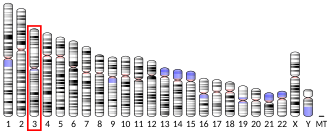





Roundabout homolog 1 is a protein that in humans is encoded by the ROBO1 gene.567
Function
Bilateral symmetric nervous systems have special midline structures that establish a partition between the two mirror image halves. Some axons project toward and across the midline in response to long-range chemoattractants emanating from the midline. The protein encoded by ROBO1 is structurally similar to a Drosophila integral membrane protein which is encoded by the Drosophila roundabout gene (a member of the immunoglobulin gene superfamily) and is both an axon guidance receptor and a cell adhesion receptor, known to be involved in the decision by axons to cross the central nervous system midline. Two transcript variants encoding different isoforms have been found for ROBO1.7
Clinical significance
ROBO1 was implicated in a communication disorder based on a Finnish pedigree with severe dyslexia. Analyses revealed a translocation had occurred disrupting ROBO1.8 Study of the phonological memory component of the language acquisition system suggests that ROBO1 polymorphisms are associated with functioning in this system.9 The gene is thought to be related to the brain's ability to represent quantities, and is correlated with better math scores of young children in one limited study.10
References
References
- GRCh38: Ensembl release 89: ENSG00000169855 – Ensembl, May 2017
- GRCm38: Ensembl release 89: ENSMUSG00000022883 – Ensembl, May 2017
- "Human PubMed Reference:". National Center for Biotechnology Information, U.S. National Library of Medicine.
- "Mouse PubMed Reference:". National Center for Biotechnology Information, U.S. National Library of Medicine.
- Kidd T, Brose K, Mitchell KJ, Fetter RD, Tessier-Lavigne M, Goodman CS, Tear G (Feb 1998). "Roundabout controls axon crossing of the CNS midline and defines a novel subfamily of evolutionarily conserved guidance receptors". Cell. 92 (2): 205–15. doi:10.1016/S0092-8674(00)80915-0. PMID 9458045. S2CID 2036419.
- Sundaresan V, Roberts I, Bateman A, Bankier A, Sheppard M, Hobbs C, Xiong J, Minna J, Latif F, Lerman M, Rabbitts P (Aug 1998). "The DUTT1 gene, a novel NCAM family member is expressed in developing murine neural tissues and has an unusually broad pattern of expression". Mol Cell Neurosci. 11 (1–2): 29–35. doi:10.1006/mcne.1998.0672. PMID 9608531. S2CID 7168171.
- "Entrez Gene: ROBO1 roundabout, axon guidance receptor, homolog 1 (Drosophila)".
- Hannula-Jouppi K, Kaminen-Ahola N, Taipale M, Eklund R, Nopola-Hemmi J, Kääriäinen H, Kere J (October 2005). "The axon guidance receptor gene ROBO1 is a candidate gene for developmental dyslexia". PLOS Genet. 1 (4): e50. doi:10.1371/journal.pgen.0010050. PMC 1270007. PMID 16254601.
- Bates TC, Luciano M, Medland SE, Montgomery GW, Wright MJ, Martin NG (January 2011). "Genetic variance in a component of the language acquisition device: ROBO1 polymorphisms associated with phonological buffer deficits". Behav. Genet. 41 (1): 50–7. doi:10.1007/s10519-010-9402-9. PMID 20949370. S2CID 13129473.
- "How genetic variation gives rise to differences in mathematical ability".
Further reading
Further reading
- Sundaresan V, Chung G, Heppell-Parton A, et al. (1998). "Homozygous deletions at 3p12 in breast and lung cancer". Oncogene. 17 (13): 1723–9. doi:10.1038/sj.onc.1202103. PMID 9796701.
- Zhao XC, Zhang LM, Li Q, Tong DY, Fan LC, An P, Wu XY, Chen WM, Zhao P, Wang J (2013). "Isoflurane post-conditioning protects primary cultures of cortical neurons against oxygen and glucose deprivation injury via upregulation of Slit2/Robo1". Brain Res. 1537: 283–9. doi:10.1016/j.brainres.2013.08.036. PMC 3820100. PMID 23994690.
- Brose K, Bland KS, Wang KH, et al. (1999). "Slit proteins bind Robo receptors and have an evolutionarily conserved role in repulsive axon guidance". Cell. 96 (6): 795–806. doi:10.1016/S0092-8674(00)80590-5. PMID 10102268. S2CID 16301178.
- Yuan W, Zhou L, Chen JH, et al. (1999). "The mouse SLIT family: secreted ligands for ROBO expressed in patterns that suggest a role in morphogenesis and axon guidance". Dev. Biol. 212 (2): 290–306. doi:10.1006/dbio.1999.9371. PMID 10433822.
- Bashaw GJ, Kidd T, Murray D, et al. (2000). "Repulsive axon guidance: Abelson and Enabled play opposing roles downstream of the roundabout receptor". Cell. 101 (7): 703–15. doi:10.1016/S0092-8674(00)80883-1. PMID 10892742. S2CID 2715852.
- Nguyen Ba-Charvet KT, Brose K, Ma L, et al. (2001). "Diversity and specificity of actions of Slit2 proteolytic fragments in axon guidance". J. Neurosci. 21 (12): 4281–9. doi:10.1523/JNEUROSCI.21-12-04281.2001. PMC 6762758. PMID 11404413.
- Wong K, Ren XR, Huang YZ, et al. (2001). "Signal transduction in neuronal migration: roles of GTPase activating proteins and the small GTPase Cdc42 in the Slit-Robo pathway". Cell. 107 (2): 209–21. doi:10.1016/S0092-8674(01)00530-X. PMID 11672528. S2CID 2458943.
- Dallol A, Forgacs E, Martinez A, et al. (2002). "Tumour specific promoter region methylation of the human homologue of the Drosophila Roundabout gene DUTT1 (ROBO1) in human cancers". Oncogene. 21 (19): 3020–8. doi:10.1038/sj.onc.1205421. PMID 12082532.
- Latil A, Chêne L, Cochant-Priollet B, et al. (2003). "Quantification of expression of netrins, slits and their receptors in human prostate tumors". Int. J. Cancer. 103 (3): 306–15. doi:10.1002/ijc.10821. PMID 12471613. S2CID 22859295.
- Strausberg RL, Feingold EA, Grouse LH, et al. (2003). "Generation and initial analysis of more than 15,000 full-length human and mouse cDNA sequences". Proc. Natl. Acad. Sci. U.S.A. 99 (26): 16899–903. Bibcode:2002PNAS...9916899M. doi:10.1073/pnas.242603899. PMC 139241. PMID 12477932.
- Hivert B, Liu Z, Chuang CY, et al. (2003). "Robo1 and Robo2 are homophilic binding molecules that promote axonal growth". Mol. Cell. Neurosci. 21 (4): 534–45. doi:10.1006/mcne.2002.1193. PMID 12504588. S2CID 19664833.
- Wang B, Xiao Y, Ding BB, et al. (2004). "Induction of tumor angiogenesis by Slit-Robo signaling and inhibition of cancer growth by blocking Robo activity". Cancer Cell. 4 (1): 19–29. doi:10.1016/S1535-6108(03)00164-8. PMID 12892710.
- Ota T, Suzuki Y, Nishikawa T, et al. (2004). "Complete sequencing and characterization of 21,243 full-length human cDNAs". Nat. Genet. 36 (1): 40–5. doi:10.1038/ng1285. PMID 14702039.
- Gerhard DS, Wagner L, Feingold EA, et al. (2004). "The status, quality, and expansion of the NIH full-length cDNA project: the Mammalian Gene Collection (MGC)". Genome Res. 14 (10B): 2121–7. doi:10.1101/gr.2596504. PMC 528928. PMID 15489334.
- Hannula-Jouppi K, Kaminen-Ahola N, Taipale M, et al. (2006). "The axon guidance receptor gene ROBO1 is a candidate gene for developmental dyslexia". PLOS Genet. 1 (4): e50. doi:10.1371/journal.pgen.0010050. PMC 1270007. PMID 16254601.
- Werbowetski-Ogilvie TE, Seyed Sadr M, Jabado N, et al. (2006). "Inhibition of medulloblastoma cell invasion by Slit". Oncogene. 25 (37): 5103–12. doi:10.1038/sj.onc.1209524. PMC 2072874. PMID 16636676.
- Muzny DM, Scherer SE, Kaul R, et al. (2006). "The DNA sequence, annotation and analysis of human chromosome 3". Nature. 440 (7088): 1194–8. Bibcode:2006Natur.440.1194M. doi:10.1038/nature04728. PMID 16641997.
- Gröne J, Doebler O, Loddenkemper C, et al. (2007). "Robo1/Robo4: differential expression of angiogenic markers in colorectal cancer". Oncol. Rep. 15 (6): 1437–43. doi:10.3892/or.15.6.1437. PMID 16685377.
- Ito H, Funahashi S, Yamauchi N, et al. (2007). "Identification of ROBO1 as a novel hepatocellular carcinoma antigen and a potential therapeutic and diagnostic target". Clin. Cancer Res. 12 (11 Pt 1): 3257–64. doi:10.1158/1078-0432.CCR-05-2787. PMID 16740745.