Robert D. Ray | |
|---|---|
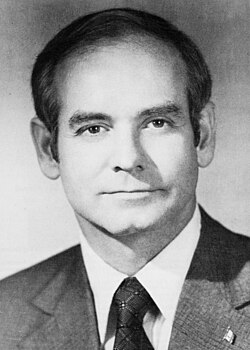 Ray in 1977 | |
| 38th Governor of Iowa | |
| In office January 16, 1969 – January 14, 1983 | |
Lieutenant Governor | Roger Jepsen Arthur Neu Terry Branstad |
| Preceded by | Robert D. Fulton |
| Succeeded by | Terry Branstad |
| President of Drake University (interim) | |
| In office 1998 | |
| Mayor of Des Moines | |
Acting | |
| In office May 5, 1997 – November 3, 1997 | |
| Preceded by | Arthur Davis |
| Succeeded by | Preston Daniels |
| Chair of the National Governors Association | |
| In office June 8, 1975 – July 4, 1976 | |
| Preceded by | Cal Rampton |
| Succeeded by | Cecil Andrus |
| Personal details | |
| Born | Robert Dolph Ray (1928-09-26)September 26, 1928 Des Moines, Iowa, U.S. |
| Died | July 8, 2018(2018-07-08) (aged 89) Des Moines, Iowa, U.S. |
| Party | Republican |
| Spouse |
Billie Hornberger (m. 1951) |
| Children | 3 daughters |
| Education | Drake University (BA, LLB) |
| Military service | |
| Allegiance |  United States United States |
| Branch/service |  United States Army United States Army |
Years of service | 1946-1948 |
Robert Dolph Ray (September 26, 1928 – July 8, 2018) was an American lawyer and politician. A member of the Republican Party, he served as the 38th governor of Iowa from January 16, 1969 to January 14, 1983.12345
During his tenure as governor, Ray served as chair of the National Governors Association from 1975 to 1976;256 led to the passage of the Iowa Burials Protection Act of 1976, which was the first legislative act in the United States that specifically protected American Indian remains; and accepted thousands of refugees into Iowa.2
In his later years, Ray served as acting mayor of Des Moines from May 1997 to November 19972356 and was interim president of Drake University in 1998.3567
Early life and education
Ray was born in Des Moines, Iowa, in 1928, to Clark Ray and Mildred Helen (Dolph) Ray.12467 He graduated from Theodore Roosevelt High School in 1946.456 Later in 1946, with the permission of his parents, he joined the United States Army and spent two years in Japan as part of the first wave of relief troops after World War II.1456
Ray received a Bachelor of Arts degree in business from Drake University, using the GI Bill, in 1952 and a law degree in 1954.12456 He then was a law and reading clerk for the Iowa State Senate.146 He also practiced law in Des Moines.146
On December 22, 1951, Ray married Billie Lee Hornberger, his highschool sweetheart and had three daughters.456
Political career
Early career
Ray began his career as a trial lawyer. Following several years practicing law, Ray became chair of the Iowa Republican Party in 1963 until 1967.1246 Ray supported Pennsylvania governor William Scranton in the 1964 Republican presidential primaries. He was named one of America’s young leaders by Time Magazine in 1974.145 He was on the short list to be Vice President on the Republican ticket in the 1976 Presidential Election.4 He was also offered, twice, to join President Gerald Ford's cabinet, but refused both offers.4
Governor of Iowa

He was elected in the 1968 Iowa gubernatorial election and became the Governor of Iowa in 1969.345678 During Ray's time in office, the Iowa Constitution was modified, increasing the governor's term of office from two years to four years.16 Ray served as chair of the National Governors Association from 1975 to 1976.1245 He also served as chairman of the Republican Governors Association, the Midwestern Governors Association, the Education Commission of the States5 and was the president of the Council of State Governments.12456 He would be re-elected in 1970,459 1972,4510 1974,4511 1978.345612
Executive Orders
As governor, Ray issued executive orders promoting civil rights, energy conservation, and paperwork reduction as well as establishing the Governor's Economy Committee, the Iowa Council for Children, the Task Force on Government Ethics, the Science Advisory Council, the Iowa Department of Transportation,456 and the Iowa High Technology Commission.2 Ray signed legislation establishing the Iowa Commission on the Status of Women in 1974.245 In 1982, that commission named him the first recipient of the Cristine Wilson Medal for Equality and Justice. In 1976, Ray, along with his wife Billie Ray and three daughters, became the first governor of Iowa to occupy Terrace Hill, the official governor's mansion.13
Taxes
Ray reduced property taxes and increased the income tax in order to fund the public schools of Iowa.4 The school foundation plan, which was passed by the legislature and signed by Ray in 1971, was crafted with the intention to lessen inequities among school districts. Arthur Neu, who served as State Senator and as Ray's lieutenant governor from 1973 to 1979, noted in an interview: "School funding was one of the most important pieces of legislation we worked on. It set Iowa schools on the path to being the best in the nation. It’s a plan a lot of other states copied."
Ray also signed into law bipartisan legislation that supported collective bargaining for public employees and removed sales taxes from groceries and prescription drugs.456 He opposed the death penalty and supported abortion for women in cases that risked women's health, and in cases of rape and incest. He also expanded an elderly tax credit.6

Grounding Iowa National Guard
One of the defining moments in Ray's governorship was in April 1972, when as Commander in Chief of the Iowa National Guard, he ordered the grounding of more than a thousand vehicles and ninety planes, until the federal government paid for the damages to the McCarville and Tjernagel families, whose houses had been destroyed by crashing Air Force planes in 1968.341415 The end result would be a pay out by the United States Air Force to the families ending a 4 year battle.3415 Ray then ordered the Iowa National Guard's airplanes and vehicles were put back in service.3415
Can Deposit Bill
Ray was an advocate of the nickel deposit on aluminum cans.6 One of Ray's proudest achievements was signing a bottle bill into law.245 The bottle bill, which received opposition from labor unions and aluminium manufacturers but support from the Sierra Club, the Farm Bureau and the Boy Scouts of America, required Iowans to pay a 5-cent deposit on containers in order to encourage the practice of recycling and the reduction of litter on the roads of the state.2 Ray noted that "Americans are part of a throw-away society".216

Humanitarian Efforts
Ray served as a delegate to the United Nations Conference on Refugees in Geneva, Switzerland in 1979.145
Tai Dam
Ray's tenure in office was notable for his humanitarianism on behalf of Southeast Asian Tai Dam refugees.2345617 Ray agreed to bring the group to the United States by creating his own refugee resettlement program.2 Ray announced that the state of Iowa would accept 1,500 more refugees in January 1979.23 Ray wrote letters to President Jimmy Carter and other governors asking them to support greater admissions of boat people.3 Opinion polls from the period demonstrated Ray's refugee resettlement and relief efforts were very controversial. Many feared competition for jobs, diversion of funds from needy native Iowans, and racial mixing. Ray said the following in regard to the refugees:18
“I didn’t think we could just sit here idly and say, “Let these people die. We wouldn’t want the rest of the world to say that about us if we were in the same situation. Do unto others as you would have them do unto you.”

Native American Burials
Ray also enacted the first laws in the U.S. that protected American Indian graves.19 In the early 1970s, Maria Pearson was appalled that the skeletal remains of Native Americans were treated differently from those of caucasians.19 Pearson protested to Ray, finally gaining an audience with him after sitting outside his office in traditional attire.19 Ray cooperated with Pearson, and their work led to the passage of the Iowa Burials Protection Act of 1976, the first legislative act in the U.S. that specifically protected American Indian remains.19 This act was the state version of the federal Native American Graves Protection and Repatriation Act, that passed in 1990.19
International Trips
Ray was invited, with several other governors, to tour China in 1974, then again to tour the Soviet Union in 1975.6 Ray also led 2 delegations to Japan, and witnessed the ceremony in 1975 to celebrate Papua New Guinea's independence from Australia.6
Post Governorship
Ray was co-chair (along with Bob Edgar) of the bipartisan National Coalition on Health Care.4
Ray served as interim mayor of Des Moines from May to November 1997.23456 Ray supported Howard Baker in the 1980 Republican Party presidential primaries.3
After leaving the governor's office in 1983, Ray became CEO of Life Investors Inc, an insurance company in Cedar Rapids.457 He then moved back to Des Moines to become CEO of Blue Cross Blue Shield.45 He also owned two radio stations, one named KILR in Estherville and another he co-owned WMT in Cedar Rapids.45
In 1997, he helped form the Institute for Character Development at Drake University.2 Ray was the interim president of Drake University in 1998.124567
Awards and Legacy
In 2005, Ray became the only governor or former governor to have received Iowa's highest civilian honor, the Iowa Award, by the Iowa Centennial Memorial Commission and presented by Governor Tom Vilsack.45
The Robert D. Ray Asian Garden, in Downtown Des Moines, was named in his honor for his work saving Southeast Asian refugees.1820a
Later life
In Ray's later years, he suffered from Parkinson's disease.2347
On July 8, 2018, Ray died at a nursing home in Des Moines, at age 89.23457
Notes
Notes
References
References
- "Governor Robert D. Day". National Governors Association. Retrieved May 17, 2025.
- "Robert D. Ray, longtime Iowa governor, dies at 89". Politico. July 8, 2018. Retrieved May 17, 2025.
- "Former Iowa Governor Robert Ray dies at age 89". KETV. July 8, 2018. Retrieved July 8, 2018.
- "Beloved former Iowa Gov. Robert Ray dies at 89". KCCI. July 8, 2018. Retrieved May 17, 2025.
- "Robert D. and Billie Ray". Drake University. Retrieved May 17, 2025.
- "Robert D. Ray". State Library of Iowa and State Historical Society of Iowa. Retrieved May 17, 2025.
- "Former Governor Robert D. Ray Dies at 89". WHO13. July 8, 2018. Retrieved May 17, 2025.
- "Summary of Official Canvass of Votes Cast in Iowa General Election" (PDF). Secretary of State of Iowa. 1968. Retrieved July 8, 2019.
- "Summary of Official Canvass of Votes Cast in Iowa General Election" (PDF). Secretary of State of Iowa. 1970. Retrieved April 20, 2019.
- "Summary of Official Canvass of Votes Cast in Iowa General Election" (PDF). Secretary of State of Iowa. 1972. Retrieved March 5, 2019.
- "Summary of Official Canvass of Votes Cast in Iowa General Election" (PDF). Secretary of State of Iowa. 1974. Retrieved February 19, 2019.
- "Summary of Official Canvass of Votes Cast in Iowa General Election" (PDF). Secretary of State of Iowa. 1978. Retrieved December 29, 2018.
- Homes of Iowa Governors, publications.iowa.gov, retrieved December 31, 2009
- "Iowa Grounds Guard's Planes In Dispute Over Crash Damage". New York Times. April 23, 1972. p. 19. Retrieved May 17, 2025.
- "ARMED FORCES: Grounded in Iowa". Times Magazine. May 8, 1972. Retrieved May 17, 2025.
- "A Deposit on Bottles Now Required in Iowa". New York Times. May 14, 1978. p. 19. Retrieved May 17, 2025.
- "Governor Robert D. Ray, Honorary Chairman". Iowa Asian Alliance. Retrieved May 17, 2025.
- Ode, Carson. "IHJ Exploring History: Robert D. Ray Asian Gardens — Humanitarian efforts prompted creation of Asian culture display". Iowa History Journal. Retrieved May 17, 2025.
{{cite web}}: CS1 maint: deprecated archival service (link) - "Maria Pearson". Ameshistory. Retrieved July 8, 2018.
- "Robert D. Ray Asian Garden". Retrieved May 17, 2025.
{{cite web}}: CS1 maint: deprecated archival service (link) - Stahl, Jay (January 10, 2023). "How KCCI rising star Nicole Tam made station history at the anchor desk: Nicole Tam, the 25-year-old KCCI rising star with roots in Hong Kong and Hawaiʻi, is the station's first Asian American anchor". Des Moines Register. Retrieved October 30, 2025.
{{cite news}}: CS1 maint: deprecated archival service (link) - Kealey, Kate (September 12, 2025). "Nicole Tam, KCCI's first Asian-American anchor, is leaving. Where's she going next?". Des Moines Register. Retrieved October 30, 2025.
{{cite news}}: CS1 maint: deprecated archival service (link) - Tam, Nicole (August 22, 2023). "A wedding decades in the making: Couple with special connection to Iowa history ties the knot". KCCI. Retrieved October 30, 2025.
{{cite news}}: CS1 maint: deprecated archival service (link)