| Rheiformes | |
|---|---|
| |
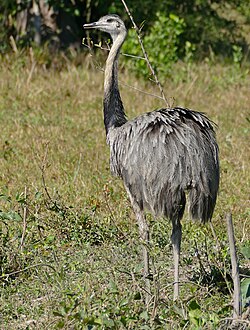
| Greater rhea (Rhea americana) | |
Scientific classification 
| |
| Kingdom: | Animalia |
| Phylum: | Chordata |
| Class: | Aves |
| Infraclass: | Palaeognathae |
| Clade: | Notopalaeognathae |
| Order: | Rheiformes Forbes, 1884 |
| Subgroups2 | |
| |
Rheiformes is an order that contains the family Rheidae (rheas).3 It is in the infraclass Paleognathae, which contains all ratites. Extant members are found in South America. While the IOC World Bird List and the Clements Checklist categorise Rheiformes as its own order,34 the BirdLife Data Zone includes rheas, along with ostriches, tinamous, cassowaries, emu, and kiwis, in the order Struthioniformes.5 Of the two extant species of rheas recognized by the IUCN Red List, as of 2022, Rhea americana is listed as near threatened,6 while Rhea pennata is listed as least concern.7 From 2014 to 2022, the IUCN recognised Rhea tarapacensis as a separate species, and listed it as near threatened in its last assessment in 2020;8 in 2022, it was again recognised as a subspecies of R. pennata.7: Taxonomy
Today, the order is represented by the sole living genus Rhea, though it contains 4-5 genera in total depending on the affiliation of the extinct genus Diogenornis. The taxonomy of the order is as follows:9
Order Rheiformes (Forbes, 1884) Furbringer, 1888 [Rheimorphae Bonaparte, 1849; Rheae Forbes 1884]1011121314
- Family Rheidae (Bonaparte 1849) Bonaparte, 1853
- ? Genus †Diogenornis de Alvarenga 1983 (Late Paleocene) – possibly a member of Casuariiformes instead.29
- Genus †Heterorhea Rovereto 1914 (Pliocene)
- Genus †Hinasuri Tambussi 1995 (Miocene-Pliocene)
- Genus †Opisthodactylus Ameghino 1895 (Miocene)
- Genus Rhea Brisson 1760 (Miocene-Recent)
Extant species summary
The IOC World Bird List (version 15.1) recognizes 2 species of Rheiformes.15 As of January 2026, IUCN/BirdLife International have assessed both species within the order, but neither have a global population estimate.
| Common name | Binomial name | Population | Status | Trend | Notes | Image |
|---|---|---|---|---|---|---|
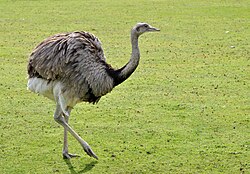
| Greater rhea | Rhea americana | unknown6 | NT6 |  6 6
|
| |
| Lesser rhea
(Darwin's rhea) |
Rhea pennata | unknown7 | LC7 | 7
|
The populations of subspecies R. p. tarapacensis and R. p. garleppi are estimated to total 1,000-2,499 mature individuals. The population of the nominate subspecies, R. p. pennata, is expected to be much larger but has not been quantified.7 | 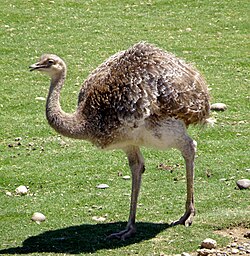
|
References
References
- Kirwan, Guy M.; Korthals, Arne; Hodes, Carly E. (2 April 2021). "Greater Rhea (Rhea americana), version 2.0". In Keeney, B. K. (ed.). Birds of the World. Ithaca, New York, United States: Cornell Lab of Ornithology. doi:10.2173/bow.grerhe1.02.
- Tambussi, Claudia; Dregange, Federico; de Mendoza, Ricardo (2023). ""The present state of knowledge of the Cenozoic birds of Argentina" by Tonni 1980: four decades after". Publicación Electrónica de la Asociación Paleontológica Argentina. doi:10.5710/peapa.13.08.2022.418. ISSN 2469-0228.
- Gill, Frank; Donsker, David; Rasmussen, Pamela, eds. (11 August 2022). "Ratites: Ostriches to tinamous". IOC World Bird List (version 12.2 ed.). Retrieved 29 November 2022.
- Clements, James F.; Schulenberg, Thomas S.; Iliff, Marshall J.; Fredericks, Thomas A.; Gerbracht, Jeff A.; LePage, Denis; Billerman, Shawn M.; Sullivan, Brian L.; Wood, Christopher L. (25 October 2022). "The eBird/Clements checklist of Birds of the World" (v2022 ed.). Ithaca, New York, United States: Cornell Lab of Ornithology. Retrieved 29 November 2022.
- "HBW and BirdLife Taxonomic Checklist". BirdLife Data Zone (version 6.0b ed.). BirdLife International. July 2022. Retrieved 29 November 2022.
- BirdLife International. (2022). "Rhea americana". IUCN Red List of Threatened Species. 2022 e.T22678073A219615764. doi:10.2305/IUCN.UK.2022-2.RLTS.T22678073A219615764.en. Retrieved 7 July 2024.
- BirdLife International. (2022). "Rhea pennata". IUCN Red List of Threatened Species. 2022 e.T22678081A217016710. doi:10.2305/IUCN.UK.2022-2.RLTS.T22678081A217016710.en. Retrieved 7 July 2024.
- BirdLife International. (2020). "Rhea tarapacensis". IUCN Red List of Threatened Species. 2020 e.T22728206A177987446. doi:10.2305/IUCN.UK.2020-3.RLTS.T22728206A177987446.en. Retrieved 7 July 2024.
- Picasso, Mariana B.J.; Hospitaleche, Carolina Acosta; Mosto, María C. (2022). "An overview and update of South American and Antarctic fossil rheidae and putative ratitae (Aves, Palaeognathae)". Journal of South American Earth Sciences. 115 103731. doi:10.1016/j.jsames.2022.103731. ISSN 0895-9811.
- Haaramo, Mikko (2007). "Paleognathia - paleognathous modern birds". Mikko's Phylogeny Archive. Retrieved 30 December 2015.
- "Taxonomic lists - Aves". Paleofile.com (net, info). Retrieved 30 December 2015.
- "Part 7 - Vertebrates". Collection of genus-group names in a systematic arrangement. Archived from the original on 5 October 2016. Retrieved 30 June 2016.
- Çınar, Ümüt (November 2015). "01 → Pᴀʟᴇᴏɢɴᴀᴛʜᴀᴇ: Sᴛʀᴜᴛʜɪᴏɴɪfᴏʀᴍᴇs, Rʜᴇɪfᴏʀᴍᴇs, Cᴀsᴜᴀʀɪɪfᴏʀᴍᴇs, Aᴘᴛᴇʀʏɢɪfᴏʀᴍᴇs, Aᴇᴘʏᴏʀɴɪᴛʜɪfᴏʀᴍᴇs, Dɪɴᴏʀɴɪᴛʜɪfᴏʀᴍᴇs, Lɪᴛʜᴏʀɴɪᴛʜɪfᴏʀᴍᴇs, Tɪɴᴀᴍɪfᴏʀᴍᴇs & Rᴇfᴇʀᴇɴᴄᴇs". English Names of Birds. Archived from the original on 3 November 2015. Retrieved 30 December 2015.
- Brodkob, Pierce (1963). "1- Archaeopterygiformes through Ardeiformes". Biological sciences. Catalogue of fossil birds. 7 (4). Bulletin of the Florida State Museum: 180–293. Retrieved 30 December 2015.
- "Ratites: Ostriches to tinamous – IOC World Bird List". www.worldbirdnames.org. Retrieved 7 January 2026.