 People protesting for the return of their birth names | |
| Date | December 1984–December 1989 |
|---|---|
| Location | |
| Type | Assimilation campaign |
| Target | Bulgarian Turksa |
| Perpetrators | |
| Outcome |
|
| Deaths | Various estimatese |
| Injuries | Several thousandc |
| Arrests | Several thousandd |
The Revival Process (Bulgarian: Възродителен процес, romanized: Vazroditelen protses) was a government-enforced assimilation campaign in the People's Republic of Bulgaria.1 It began on Gregorian Christmas 1984 and continued until December 1989.2 The state imposed new Bulgarian names on about 850,000 people, banned public use of the Turkish language, and restricted religious and cultural practices.3 The government declared the forced renaming complete on March 31, 1985, but restrictions on language, religion, and cultural practice remained until December 1989.4 In 1989, state pressure led more than 300,000 Bulgarian Turks to leave in a migration that began on May 29, 1989.f5 After party leaders removed Todor Zhivkov on November 10, 1989, the new government under Petar Mladenov restored the right to hold Turkish names and eased religious and cultural restrictions on December 29.6
Officials argued that Bulgarian Turks were descendants of Bulgarians who had been forcibly converted to Islam and Turkish culture, and presented the campaign as a restoration of Bulgarian origins.7 Authorities implemented the renaming campaign by surrounding Turkish villages with security forces and military vehicles, while employers carried out some name changes at official direction.8 Language, religious, and cultural restrictions were enforced through fines, surveillance, detention, and internal exile.9 Deaths occurred during state suppression of protests and opposition to the campaign and in prison camps such as the Belene labor camp, though death toll estimates vary among sources.g10
The campaign drew criticism from Turkish and Western officials and media outlets, human-rights organizations, and international bodies.11 After 1989, the Revival Process was condemned by Bulgarian political, religious, and civic institutions.12 Following the fall of communism in Bulgaria, legal mechanisms for name restoration were established and Bulgaria undertook minority-rights reforms.13 On January 11, 2012, the National Assembly of Bulgaria formally condemned the Revival Process.14
Terminology
The Revival Process
Scholars describe the term "Revival Process" as a euphemism, but economist Rumen Avramov writes that its use has become difficult to avoid.15161718 The term was first used at a Bulgarian Communist Party (BCP) Politburo meeting on January 18, 1985 by Georgi Atanasov.192021 The term was not widely used at first, but became more common.17 The policy has been described as an assimilation campaign.15192223
Bulgarian Turks
In communist Bulgaria, Muslim communities overlapped, and some Slavophone Muslims and Muslim Roma identified as Turks, with the latter sometimes doing so to avoid stigma.242526 In Bulgaria, group identity often combined religion and ethnicity;2728 Slavophone Muslims living mainly among Turks tended to emphasize their Bulgarianness, while those living mainly among Bulgarians more often emphasized their Turkishness.2629 Officials used disputed ethnic categories, affecting people who did not fit official labels.3031 Turks and Pomaks were sometimes confused with each other by the state – deliberately or otherwise.32
Forced assimilation
Background
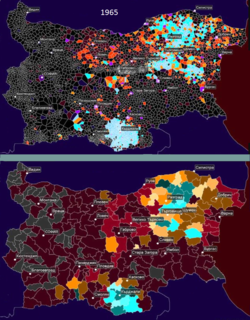
Lighter shades indicate higher population density, while darker shades indicate lower population density. source ↗
Turkey's 1980 military coup led the nation to move away from some elements of Kemalism and undermined Turkey's "democratic credentials" internationally.343536 Turkey launched a military intervention in Cyprus in 1974, and the Turkish Republic of Northern Cyprus was proclaimed in 1983. The BCP leadership treated these developments as security concerns, though sources do not find evidence that the Bulgarian government expected a near-term invasion of Bulgaria.34373839 Before the Revival Process, Turkey also faced Kurdish unrest and foreign-policy disputes with Greece, Iran, and the European Economic Community.4041 Turkey also restricted some minority groups and naming practices.3742 In 1981, Yugoslavia experienced unrest among its Muslim-majority Albanian minority.3743 Avramov writes that the final pre-campaign discussion of the "Turkish Problem" focused on security.37 The Turkish minority also had a higher birth-rate than Slavic Bulgarians.44454647 Laber reported contemporary projections suggesting that, if then-current trends continued, Turks could outnumber Slavs in the 21st century.44
By late 1984, communist Bulgaria belonged to organizations and treaties that protected minority rights, while continuing to implement assimilation policies in breach of those obligations.4849 The government was concerned about potential backlash from Turkey and Western nations, and it sometimes avoided extending previous measures to Turks.5051 According to the 1975 census, Turks made up about 8.4 percent of Bulgaria's population.3352 Turks lived mainly in northeastern and southern Bulgaria, notably Kardzhali Province.5354
Scholars date Islam's introduction to Bulgaria to the 14th century, after the Ottoman conquest.5556 Two theories explain the emergence of Turks in Bulgaria.57 One theory traces the Turkish community to migration from Asia Minor, while the second rejects such migration.5758 The Bulgarian communist government said any members of the Turkish minority who felt connected with Turkey emigrated to Turkey under a limited migration treaty between Bulgaria and Turkey in effect from 1969 to 1979.596061 It also said those who remained were Bulgarians Turkified in language and religion.62636465 Bulgarian officials also cited physical-anthropological claims, including phrenological arguments, to assert that the studied Bulgarian Turks were morphologically Bulgarian.6667 The BCP framed the policy as part of building "real" communism and a classless society, both internally and in discussions with Soviet Union (USSR) officials.6865
Soviet stances on Bulgarian minority policy also influenced Bulgaria.2269 Academic Vesselin Dimitrov linked the timing of the Revival Process to changes in the Soviet Union in the early 1980s that reduced external constraints on Bulgarian domestic policy.70 The renaming campaign coincided with a renewed phase of the Cold War, weakened Soviet leadership, and Konstantin Chernenko's extended illness.7071 Avramov further refers to the USSR's invasion of Afghanistan in 1979 and changes in power in the USSR from 1982 to 1985.72 Bulgaria's consistently pro-Soviet foreign policy gave the Zhivkov government more room to pursue assimilation measures than other Soviet satellite countries had.7073 Academic Bojkov writes that Mikhail Gorbachev also gave tacit approval to Bulgarian minority policies.74 Despite this, Bulgarian leaders denied Moscow's direct involvement in the Revival Process.75
Academic İbrahim Karahasan-Çınar identifies several theorists of the campaign besides Zhivkov:76
- Milko Balev - Central Committee secretary
- Georgi Atanasov - Central Committee secretary
- Pencho Kubadinski - Central Committee secretary
- Stoyan Mihaylov - Central Committee secretary
- Aleksandar Lilovh - Central Committee secretary
- Dimitar Stoyanov (internal affairs minister) - Internal Affairs minister
- Petar Mladenov - Foreign minister
- Georgi Tanev - Kardzhali District Committee (Bulgarian: Окръжен комитет, romanized: Okrazhen Komitet) first secretary19
Georgi Tanev said Bulgarian Turks had a strong group identity expressed through "language, tradition and customs", and that their social environment separated Turks from the body of the Bulgarian nation.19 He submitted proposals to the BCP Politburo on how to address this situation, provided justification of grassroots support for renaming, and later rose through the communist state hierarchy.1978 Tanev later became internal affairs minister and received the Hero of the People's Republic of Bulgaria award, though his receipt of the award was not publicized.197879
Karahasan-Çınar does not list Lyudmila Zhivkova, the daughter of Todor Zhivkov.76 She had been a member of the BCP's Central Committee from the mid-1970s until her death.i3080 Zhivkova championed Bulgarian culture and policies aimed at cultural revival.30 Although she promoted a cultural revival that emphasized foreign ties, some figures around her favored a narrower understanding of Bulgarian culture.308182 After Zhivkova's death, many of her ideas and projects faded and her close associates were disfavored by the BCP.8384 Dimitrov writes that this helped non-inclusive ideas of cultural revival become dominant.30
Shortly before the Revival Process, the Bulgarian government introduced a new, unified identity system under the Unified System for Civil Registration and Administrative Services for the Population within the Ministry of Regional Development and Public Works of Bulgaria.8586 The government tied the unified system to the planned mass issue of new documents by 1985.85 State identification cards were required for access to banks, healthcare, and wages.87 Those without identification cards bearing Bulgarian names were eventually prohibited from registering births or marriages as well.87
Shortly before the renaming began, Internal Affairs Minister Dimitar Stoyanov stated the Bulgarian government's intentions:88
The winter months must be used and the work must be basically completed within the specified time frame... I will mention a number that should remain between us. We are talking about several tens of thousands of people who we need to separate from the Bulgarian Turks, i.e. to reduce the so-called population of Bulgarian Turks in Bulgaria by 10-12 percent.
Initial campaigns
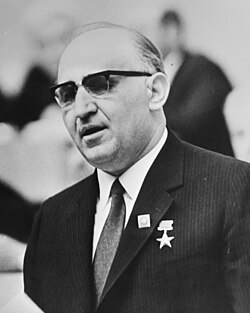
From 1950 to 1951, the communist government expelled around 150,000 ethnic Turks from the country.8990 From 1962, the government barred Slavophone Muslims from attending Turkish-language schools, and in 1972, it banned Turkish-language schools.9192 The government forced many Muslims to change their names; by 1974, around 150,000 Slavophone Muslims and 200,000 Turks had been forced to adopt new names.939495
In 1971, the government adopted a new constitution that supported assimilation policies and weakened minority protections, though it still guaranteed rights relevant to the Revival Process.189697 Officials replaced the term "national minorities" with "citizens of non-Bulgarian origin", and their discourse framed minority identities as compatible with eventual assimilation.189899100
In 1978, the government tried to replace traditional and religious observances with approved socialist ones.101102 It sent officials to Islamic funerals to ensure participants carried out approved socialist rites and prayed in the Bulgarian language.101 The prescribed rituals combined Bulgarian Christian elements with Marxist-Leninist atheism.103
In the period leading up to the Revival Process, the state intensified its assimilationist education policies by promoting mixed marriages and subjected Turkish-minority teachers to ideological training.60104 Between 1981 and 1983, authorities forced around 100,000 people, mainly Muslim Roma, to change their names.105106 It then extended the measure to Crimean Tatars and Alians, a Bulgaria-based Shia group, shortly before the Revival Process began in 1984.105107 The government also resolved to issue around 250,000 identity papers bearing new Bulgarian names to Muslim Roma.10885 Before it was implemented, many people already felt the government was moving toward a campaign like the Revival Process.109110
Start of the Revival Process
The BCP resolved on June 19, 1984, to carry out a "unification" campaign, and informed leaders of regions with substantial Muslim populations that autumn.41 Orders to begin preparations for the implementation of the Revival Process were issued on December 10, 1984.41111112 The Revival Process began on Gregorian Christmas 1984.j40113 A Central Committee plenum in mid-February 1985k endorsed the campaign after Zhivkov had already extended it nationwide.64114
Approved name lists
After disputes over which names should count as Bulgarian, officials compiled a list of approved names.115116117 The list included many Christian names, including names linked to Eastern Orthodox saints and the church calendar, though it also included "neutral" names.115118 This list was originally meant for people in mixed marriages, but it later expanded in scope.110116 Officials did not complete the "Classifier of Bulgarian Names" before the start of the Revival Process, but the state provided indices from which people were required to choose their new names.116 Officials accepted some names of foreign origin, including Turkish, Armenian, and Arabic names, if they could be written in Bulgarian.116 In addition, some Bulgarian family names were of Turkish origin, which presented a dilemma to the state.116 The same body also sought to create an acceptable foreign-name classifier.116
Renaming
By late 1984, Bulgarian authorities had already renamed many non-Turkish Muslims, and then extended the policy to Turks.119111 Officials summoned individuals in their villages and required them to replace their Turkish names with Bulgarian ones chosen from approved lists.115 Officials enforced the name changes through intimidation, which was often backed by security forces and military vehicles.120121119122 Employers also renamed Turks at the direction of officials.123124 The government required municipalities to enforce the use of the new names in public and private life.125 Some Turks who accepted name changes were later labeled as "collaborators" by other Turks.126 The government described the renaming as voluntary, although human rights groups and later scholarship described it as coerced.127128129
At first, authorities required only Turks living in or from the Rhodopes to change their names.1241130131 Around 310,000 people in Haskovo and Kardzhali provinces had been renamed by January 18, 1985.4064132 After receiving reports on the initial renaming actions, the BCP's Politburo ordered the expansion of the campaign.64133 Authorities implemented the order in February 1985, and on March 31 that year, the Bulgarian government declared the process completed and issued new identity documents to those affected.119134 The government seized the old identity documents and planned a census that year using the new documents.135136137 Authorities conducted the census from December 4 to 12 and gradually released the results until the end of 1987.138 They did not publish the final census results until 1988.138139 "Turks" and "Muslims" disappeared as categories in this census.140 Despite the census data, sources differ on the number of people renamed:
| Number renamed | Time frame / scope | Notes |
|---|---|---|
| 800,00012111 | Christmas 1984–January or February 198512111 | — |
| 822,588141 | Revival Process up to June 1985141 | — |
| 850,00014214365144 | Late 1984–Early 198514214365144 | — |
| 850,000–1,100,000145 | Revival Process145 | — |
| Nearly 1 million50 | December 1984–January 198550 | — |
| 1,306,000141 | 1984–1985141 | According to the source, this estimate might combine totals for Turks, Gypsies, and Pomaks, including name changes from mixed marriages.141 |
Other policies
The Bulgarian government banned the use of the Turkish and Romani languages in public, although up to 70 percent of the Turkish minority could not speak Bulgarian.146147148 The government extended the prohibition to Turkic Christian communities and banned public use of their language.149 Signs warning it was "forbidden to speak" either "French"l or "in a foreign language" were posted in public spaces in the majority Turkish areas.151 Authorities fined people who spoke Turkish in public five leva or more, and sometimes imprisoned or exiled them.12115241153 One Turk was imprisoned for five years for persistently using Turkish, and another was exiled from Bulgaria for two years.152
The government had already banned visible markers of Muslim identity, such as religious clothing, so people used substitutes.154 For example, dark raincoats became substitutes for veils.154 During the Revival Process, officials barred Islamic burials and traditional headstone shapes.155 Washing the dead before burial was also outlawed.156 The state further pressured Muslims to deface Islamic symbols and Arabic inscriptions on graves.157 At times, Turkish families buried their deceased under headstones with only a photograph because religious symbols were prohibited and they did not wish to use the assigned "Bulgarian" name.158 Local authorities ordered the defacement of the Turkish names of 2,000 individuals on gravestones near Pavel.159 The graves of prominent Turkish-language writers in Bulgaria were destroyed in 1985.160 Similarly, authorities occasionally had crescents that adorned minarets removed because the symbol is associated with Turkish symbols.161162163
Authorities also barred stores and restaurants from serving women in traditional Islamic dress.164 In some areas, the wearing of fez hats and traditional Turkish pants were banned.165166167168 Authorities also destroyed Turkish-language books and other Turkish cultural items.157 Officials inspected the mail of Bulgarian Turks, and sometimes demanded the translation of mail written in Turkish for inspection.169 Turkish-language music was also banned.170171172 Authorities additionally sought to promote traditional Slavic gatherings of young people (Bulgarian: седянки, romanized: sedyanki) among the policy's targets.173 With respect to Roma specifically, semi-nomadic Mahala settlements were hidden behind concrete walls.174
Authorities strictly enforced the ban on circumcision and required Muslim parents to sign documents promising not to circumcise their child.175176 Officials inspected boys for compliance;153 parents and those who performed the circumcision faced punishment for violations.164177 In 1987, Amnesty International reported the state imprisoned four women for between six and eight months because they circumcised their sons or grandsons.148 The maximum allowed punishment for violators was a fine of up to 1,000 leva or three years' imprisonment.178
Communist Bulgaria appointed a chief mufti and regional muftis during the Revival Process.164179180 The government chose these religious officials for their loyalty rather than for their religious training.164179 The state-appointed chief mufti said authorities did not prevent Muslims from performing rites and declared support for the renaming policy.164179 The national religious body for Muslims in Bulgaria at the time was known as the Supreme Spiritual Council of the Muslim Faith.179181
State media and propaganda
The Bulgarian government controlled most of the country's media outlets, and many journalists came from politically acceptable backgrounds or were members of the ruling party.182183 In January 1985, Todor Zhivkov told the Communist Party's Central Committee the party should remain silent in the press and not issue information to particular groups to avoid speculation.19 In subsequent years, the media echoed official narratives of the essential Bulgarian origin of the Turkish minority.121 The press published the involuntary declarations of thousands of Turks affirming a Bulgarian identity, and it insisted that Bulgarian Turks, who were referred to as "New Bulgarians", approved of the renaming program.121184 Opinion polling indicated indifference among the general public toward the nation's Turkish minority. According to Dimitrov, opposition to the campaign among ethnic Bulgarians was limited since the Turkish minority was heavily concentrated in two regions of the country. The government largely refrained from mobilizing ethnic Bulgarians in support of the Revival Process.185
Reaction and resistance
Many targets of the policy continued to perform circumcision and speak Turkish at home.121186 However, public resistance was often limited and uncoordinated.121 Some individuals tried to avoid the renaming campaign by hiding in remote areas, but submitted after a few days.41 Those who attempted to escape the renaming were punished by being assigned names most closely associated with the Christian religion.187
Turkish National Liberation Movement
One group was the "Turkish National Liberation Movement in Bulgaria", founded in Varna on December 8, 1985.188 Among the organization's early members were Ahmed Doganm and future co-founder and later chairman of the Movement for Rights and Freedoms (MRF) Kasim Dal.n Ahmed Dogan played a leading role as the organization's political theorist;192 he said the organization never sought secession or to undermine state sovereignty.193 The movement also sought official recognition of Bulgaria's Turkish minority.194
Dogan's role in the organization later became controversial; sources agree he was connected to the Committee for State Security (DS), the Bulgarian equivalent of the Soviet Committee for State Security, but they differ on whether he was among its founders or later assumed leadership.195196197 Some scholars also say the DS played an active role in the Turkish National Liberation Movement in Bulgaria's creation and development.197 In 1992, former senior intelligence officer Radoslav Raykov stated Dogan was infiltrated into the organization and convicted along with other leaders to build a legend for him.198 According to Alexei Kalyonski, the term "Liberation Movement" suggests a connection to the DS.199
Most of the organization's membership was arrested by mid-1986.200 Around 200 of its members were arrested and 18 stood trial.199 Ahmed Dogan received a ten-year sentence.199
Armed resistance
While acts of political violence and sabotage were committed in Bulgaria during the Revival Process, observers have described resistance by Bulgarian Turks as mostly peaceful rather than as organized armed resistance.201202 Rumen Avramov, who was an economic advisor to Bulgaria's first non-communist president Zhelyu Zhelev, said the scale of state repression prevented the development of organized armed opposition.201 The Bulgarian government undertook rearmament aimed at strengthening its internal security forces.203
Unorganized armed resistance occurred throughout the Revival Process.169 Authorities reported more than 600 incidents they described as "terrorism", and attributed these to Turks and opposition groups, though the attribution and details of many cases are disputed.201 For example, on March 9, 1985, an attack killed seven people in Bunovo when a train carriage reserved for mothers on a route between Burgas and Sofia was blown up.o204205206 A court sentenced the attack's perpetrators to death and the executions were carried out in late 1988.205207 The government used such attacks to justify tightened security measures.207208
Belene labor camp
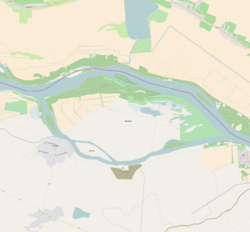
During the Revival Process, the Bulgarian authorities reactivated the Belene labor camp, situated on an island in the Danube River, to detain people whom they arrested for resisting the campaign.209210 The BCP used Belene as a labor camp until 1959, when it was converted into a prison.209211 Authorities typically held Turks who resisted in Belene for two-to-three months, though they held some for much longer.111 In 1985, authorities incarcerated more than 500 Turks there for resistance to the renaming measures.209211 Authorities often held detainees without judicial sentences at Belene.212 In April 1986, prisoners in Belene began a hunger strike that lasted around 30 days.209211 In May 1986, authorities released most of the prisoners and then exiled them to different regions of Bulgaria.209211 Authorities released the remaining detainees in early 1987 in districts populated by ethnic Bulgarians.213
Casualties
On December 26, 1984, in Mogilyane, security forces opened fire on demonstrators during protests against the forced replacement of Turkish names with Bulgarian ones, killing three people, including the young child Türkan Feyzullah.214 Security forces shot Türkan while her mother carried the child on her back.215 Mogilyane residents later erected a monument in her memory.214
Some Bulgarian Turks were killed, injured, or detained at protests, like the one in Mogilyane in 1984, in opposition to official policies.216120217 Others died in prison camps associated with the Revival Process, such as Belene.217 Estimates of the number of people killed, injured, and arrested during the Revival Process varied:
| Number killed | Number injured | Number arrested | Time frame / scopep | Notes |
|---|---|---|---|---|
| 800–2,500217 | — | — | November 1984–February 1985217 | This estimate covers those killed, injured, or arrested in opposition to the initial wave of name changes owing to the use of the military to facilitate the campaign.217 |
| 1,000+217 | — | — | November 1984–February 1985217 | This estimate covers those killed, injured, or arrested in opposition to the initial wave of name changes. The source notes that the 1,000+ estimate may be higher if deaths from neglect or suicide in Belene are included as death certificates in Belene were regularly falsified.217 |
| 300–1,500216 | Several thousand216 | Several thousand216 | Late 1984–early 1985216 | This estimate covers those killed, injured, or arrested in opposition to the initial wave of name changes.216 |
| 300–1,000120 | Several thousand120 | Several thousand120 | Late 1984–early 1985120 | This estimate covers those killed, injured, or arrested in opposition to the initial wave of name changes.120 |
International reaction
Turkish president Kenan Evren discussed minority and emigration issues with Todor Zhivkov in 1982; Bulgarian officials interpreted the talks as closing the emigration question and treating ethnic policy as an internal matter.19218 Zhivkov denied the claims, as Bulgarian authorities did at first.19129 Following the start of the Revival Process, Turkish diplomatic responses were restrained.19219 Evren first formally protested the Revival Process in January 1985, sending Zhivkov a message asking that the forced assignment of Bulgarian names be stopped.220221 Despite official restraint, some Turkish and Western media described the Revival Process with terms such as "genocide" and "state crime" or used specific sensational headlines.23222
Bulgarian Turkish children left behind after their parents fled to Turkey drew particular concern from the Turkish public.223224 The street outside the Bulgarian embassy in Ankara was temporarily renamed after one of these children.225 In 1987, Turkish state television aired a dramatization titled To Be Reborn (Turkish: Yeniden Doğmak) about families separated by events in Bulgaria, prompting a sharp response from the Bulgarian government.226224 Often, Bulgaria responded to these denunciations with comparisons to the Kurdish issue in Turkey.227228 In line with the Helsinki Accords, the Bulgarian government reduced efforts to obstruct the reception of critical Western and Turkish broadcasts to Bulgaria, though jamming of Turkish-language broadcasts in particular did not cease completely.229230 During the media dispute, Bulgaria promoted the film Time of Violence, a nearly five-hour historical epic about forced conversions to Islam under Ottoman rule.226231 Subsequent diplomatic negotiations between Bulgaria and Turkey concerned the broadcast of Time of Violence and the Turkish film Belene, which documented the Belene labor camp.232
Turkey also raised the Revival Process before several international bodies.233234 The Conference on Security and Co-operation in Europe (CSCE), predecessor to the Organization for Security and Co-operation in Europe, tabled the issue in both its May 7–June 17, 1985 and October 15–November 25 meetings.233235 The United Nations Educational, Scientific and Cultural Organization did the same at its October 8–November 12, 1985, meeting.233 The Council of Europe (CoE) adopted Resolution 846, calling on Bulgaria to end violations of the social, cultural, and religious rights of the affected minorities.233236
In 1987, the Islamic Conference, a predecessor to the Organization of Islamic Cooperation, sent a delegation to Bulgaria.148237 Following this visit, the organization published a report that was critical of Bulgaria.148238 Other international organizations echoed this condemnation, including the United Nations, whose Commission on Human Rights Special Rapporteur on Religious Intolerance listed Bulgaria among countries preventing the peaceful practice of religion.220239240
Bulgarian authorities publicized supportive visits by Muslim clerics, including the chief muftis of eastern-aligned Syria and communist South Yemen in 1986 and the chief mufti of Ghana the next year.19241 The Soviet Union considered the treatment of Bulgaria's Turkish minority an internal Bulgarian issue, and the Soviet press remained silent on the subject.74242 Only Greece supported Bulgaria among the nations of the European Community, despite Greek membership in the North Atlantic Treaty Organization (NATO) alongside Turkey.234
Second wave of resistance
In the late 1980s, ranking members of the Bulgarian government expressed internal concern about the shortcomings of the Revival Process and the ineffectiveness of the assimilation policies.243 The government undertook limited resettlement of Turks to western and northwestern Bulgaria, and the placement of Turkish children in assimilatory boarding schools.244 Minister Pencho Kubadinski suggested people from the Soviet Union should be settled in place of resettled Turks.244
A second wave of organized popular resistance emerged and shaped open civil opposition to the communist government.192245 Most of the groups openly declaring opposition to the Revival Process, such as the Independent Society for the Protection of Human Rights, the independent trade union Podkrepa, the Club for Support of Glasnost and Perestroika, and Ecoglasnost formed in the context of Perestroika.246 On November 13, 1988, the Democratic League for the Protection of Human Rights in Bulgaria was established with Mustafa Yumer as chairman and grew to include several thousand members.199247 In April 1989, the Support Society–Vienna 89 was founded in the town of Djebel.210
These associations were at the heart of the "May Events" (Bulgarian: Майските събития, romanized: Maiiskite subitiya) from May 19–27, 1989.248249 Demonstrators, estimated at 30,000–53,000, carried out hunger strikes and mass protests, and at times clashed with police.197 They aimed to attract the attention of the world community, especially the CSCE symposium "Freedom of the Spirit and the Human Dimension in Europe", which was held from May 30–June 23, 1989q in Paris, France.158250 From May 19–27, 1989, between 25,000 and 30,000 demonstrators took to the streets in northeastern Bulgaria.251 Some demonstrations involved violence.199
Bulgaria became isolated from its Eastern bloc allies during the Revolutions of 1989.199252 Diplomatic pressure on Bulgaria from Turkey also increased; Turkey raised the issue in a number of international forums.199 The president of France, François Mitterrand, visited Bulgaria in January 1989 and held meetings with dissidents at the French embassy in Sofia.253
The Bulgarian government responded to the protests by sending soldiers, fire brigades, and the national police (then styled as the people's militias) against the demonstrators.199254 Soldiers were loaded into trucks covered with opaque tarps, without prior information about their assigned task.254 Riot-control methods, including tear gas and occasionally firearms, were used.199255 Sources differ on the number of protesters killed; Alexei Kalyonski estimated between seven and ten protesters were killed, and that hundreds were injured.199 Tomasz Kamusella estimated that 30–102 protesters were killed and hundreds were injured.158 Bulgarian authorities reported seven deaths.158 Opposition leaders were subsequently removed from Bulgaria;199255 Mustafa Yumer, for example, was expelled to Turkey.199
1989 expulsion
The Bulgarian government concluded that part of the Muslim population could not be assimilated and shifted toward promoting emigration.119 At the end of May 1989, after prominent dissidents were removed, authorities enabled mass departures by loosening travel restrictions, intimidating individuals, and later opening the border with Turkey.256257 Authorities framed the departures as temporary tourist travel, and propaganda referred to the episode as the "Big Excursion".257
From May 29 to August 1989, over 300,000 people left Bulgaria for Turkey under state pressure.5 In August 1989, Turkey temporarily closed the border with Bulgaria, ending the forced migration.258
Economic effects
In the 1980s, Bulgaria entered economic decline, and its government undertook reforms in response.259 As early as 1987, Bulgarian state media discussed a possible near-term financial insolvency of the country. The events of 1989 intensified the crisis.260 Avramov writes that these events revealed economic costs associated with the Revival Process.261
Aftermath
On November 10, 1989, party leaders forced Todor Zhivkov to resign.119262 The new Bulgarian government restored the right of Bulgarian citizens to have Turkish names on December 29 that year.6262 The new government condemned the Revival Process as a "deviation from 'Leninist' norms".263 By 1991, Bulgaria had allowed religious instruction and Turkish-language instruction to resume, and adopted a new national constitution guaranteeing freedom of religion.264262
Restoration of original names
Although the legal right to use Turkish names was restored, those affected still faced obstacles when restoring their previous names.265 In March 1990, Bulgaria adopted legislation enabling that restoration, but its early implementation was burdensome, requiring a court procedure and two supporting witnesses.266267 The law required people who restored their names to keep Bulgarian suffixes, such as "-ov" and "-ova".265268 A 1990 Helsinki Watch report said fewer than one-third of Turks had restored their names nationwide.265 For example, academic Yelis Erolova restored her Turkish name only after 1990.269 In some areas, older Bulgarian Turks more commonly restored their names than younger people.270 On November 16, 1990, the government adopted a reform that replaced the court procedure with an administrative process.268271
Strengthening of Turkish identity
The Revival Process strengthened Turkish self-identification among the targeted minority, with many placing greater emphasis on Turkish identity than on Bulgarian identity.121272273 This was tied to Islamic religious traditions that marked differences between Turks and ethnic Bulgarians, and was associated with increased contact with people and groups from Muslim-majority countries.272274 People described themselves as "Turks of Bulgaria" rather than "Bulgarian Turks".273 Gruev and Kalyonski said these changes also strengthened distinctions between Turkish and Bulgarian identities.275 According to Yelis Erolova, her family made her think of Turkey as her "mother nation".269
Nationalist backlash
Post-communist reforms also produced nationalist opposition, especially over the restoration of Turkish names and the teaching of Turkish in schools.276277 In Razgrad, nationalist protesters proclaimed a "Bulgarian Republic of Razgrad", and it later came to encompass a number of municipalities and became known as the "Association of Free Bulgarian Cities".278 The Razgrad municipal authorities also decided not to teach Turkish in local schools after nationalist pressure.276 On October 25, 1990, the MRF club in Shumen was bombed.276 All of this engendered a response among the Turkish population, including a boycott of schools in southeastern Bulgaria by ethnic-Turks.276
Nationalist protest also accompanied parliamentary debate over the restoration of Turkish names; around 200 people demonstrated outside the National Assembly during discussion of related measures.276 Post-communist prime minister Andrey Lukanov expressed concern that Turkish-language education might be extended "unconstitutionally" to Pomaks.276 His successor, Dimitar Iliev Popov, similarly warned against what he called "Muslim aggression".276
Impact on the Cold War
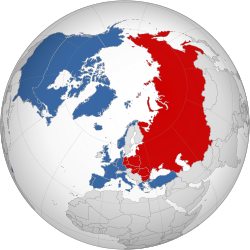
The Eastern Bloc, including Bulgaria, is depicted in red, while the Western Bloc, including Turkey, is in blue. source ↗
Prior to the start of the Revival Process, relations between the People's Republic of Bulgaria and Turkey were good.45234 Todor Zhivkov had visited Turkey in 1983.234 Although the Revival Process was addressed in Cold War diplomatic exchanges, bilateral contacts initially continued through diplomatic channels.159234 The campaign strained relations and drew condemnation from NATO and other international actors.233227234 The Turkish ambassador to Bulgaria, Ömer Engin Lütem, described the most difficult phase of relations during this period as a "war of notes".19 Because relevant Russian and U.S. records remain inaccessible and scholarship is limited, the campaign's late-Cold-War effects remain unclear, but academic Tomasz Kamusuella suggests these facts point to some sort of secret negotiation between NATO and the Warsaw Pact to prevent the justification of war.279
Relations deteriorated further in 1989.234 In August of that year, the United States recalled its ambassador to Bulgaria.255280 The issue was also raised in the United States Congress.255 International actors organized fact-finding activity concerning human rights conditions in Bulgaria.255281 The Soviet Union refused to mediate between Bulgaria and Turkey when official tensions grew, although it engaged in shuttle diplomacy through its diplomatic mission in Ankara.281282 According to Dimitrov, the failure of these efforts convinced the Soviet leadership that Zhivkov had "outlived his usefulness" and led it to support an anti-Zhivkov faction within the Bulgarian government led by foreign minister Petar Mladenov.283
Legal aftermath
In 1990, Bulgaria implemented an amnesty for those convicted of political crimes.284 Authorities released 31 of 81 Turks imprisoned for resistance, but kept 50 convicted under the criminal code in prison.284 Similar legal distinctions between "political" and "criminal" offenses existed in other states where dissidents faced criminal charges.285
On January 18, 1990, authorities issued a warrant for Zhivkov's arrest, and he was held under house arrest.r286287288 While formally under house arrest, he was reportedly allowed to travel around Bulgaria.289 Prosecutors charged a number of defendants for abuses associated with the Belene camp, and Zhivkov faced additional charges unrelated to the Revival Process.286290 Some perpetrators of the Revival Process were never charged.290 Although legal proceedings began in 1991, they were still ongoing when Zhivkov died in 1998.291 In 2022, prosecutors dropped the remaining charges after the final defendant, Georgi Atanasov, died.292 The case was initially terminated after Atanasov's death, but after protests from families of Belene camp victims, the Sofia Court of Appeal ordered the Military Prosecutor's Office to continue the investigation.292293 The court ruled that the procedural rights of people affected by the Revival Process were not respected and that the case could not be terminated without a declaration from the Prosecutor's Office as to what crime it alleged that the defendants had committed.293
Legacy
Domestic

Kutlay writes that the reversal of the Revival Process, together with moderation by both the new government and the Bulgarian Turkish community, contributed to Bulgaria's democratic transition.294 Bulgaria's first democratically elected president, Zhelyu Zhelev, treated the Turkish political movement as a political ally and defended the nascent Movement for Rights and Freedoms (MRF) against a legal challenge from nationalists and the post-communist Bulgarian Socialist Party that could have led to its dissolution.294295 According to Kutlay, MRF leader Ahmed Dogan worked to marginalize "ultra-nationalist" elements within the Turkish community and refrained from calling for autonomy or independence.294 The MRF later joined many of early post-communist Bulgaria's governing coalitions, though Korkmaz writes that many of the Turkish minority's problems remained unresolved.296 Kutlay further writes that the prospect of European Union (EU) membership had a moderating influence and contributed to the reintegration of Turks into Bulgarian society.297 In 2000, the EU adopted the Race Equality Directive and later formally requested Bulgaria's compliance with it.298 Similarly, Korkmaz writes that Bulgaria's efforts to join NATO and the EU encouraged rapid reforms aimed at reintegrating Turks and addressing the communist past.296
In November 2002, the Bulgarian Orthodox Church described victims of the Revival Process, including non-Christians, as "martyrs".12 On January 11, 2012, the Bulgarian National Assembly officially condemned the Revival Process, although according to Tomasz Kamusella, scholars largely ignored the parliamentary recognition.14279 Kamusella also described continued public commemorations of Todor Zhivkov in Bulgaria, including statements by national political figures praising him.299 After the National Assembly's declaration, the political party Ataka, described by sources as "far-right", introduced a bill contesting it.300301302303 According to the bill's authors, the declaration represented a boost for separatists; Kamusella interprets that reference as referring to Bulgarian Turks and Muslims.303 Ataka's leader, Volen Siderov, said the declaration could expose Bulgaria to substantial compensation claims and raised the possibility that the country would be described as having carried out policies of "genocide" and "ethnic cleansing".304 Parliament rejected the bill.304 In a similar vein, Academic Natalya Lunkova notes that an anthology of memoirs by people targeted in the renaming campaign received mixed reactions in Bulgaria.305 Nationalists associated with the party Revival criticized the choice of topic and said attention should instead have been paid to transgressions carried out by Turks during the Ottoman occupation of Bulgaria.305
The Revival Process also had lasting social and cultural effects. It affected Turkish language use in Bulgaria, and Bulgarian Turkish communities exhibit a large degree of codeswitching.306 During the Revival Process, knowledge of Bulgarian among younger generations became nearly universal.46 Academic Trupia writes that, as part of the collective trauma of the Revival Process, some Bulgarians of Muslim origin were left to wonder what their names would have been but for it.307 Trupia treats the renaming campaign not as a closed historical episode, but as a trauma whose effects have been passed down within families and carried into everyday life.308 Every year, Bulgarian Turkish groups commemorate the official end of the Revival Process – December 29 – as "Liberation Day" (Turkish: Kurtuluş Bayramı).309 In 2013, the Movement for Rights and Freedoms called for information about the Revival Process to be included in schoolbooks.310
International
In Turkey, a number of dissident and migrant organizations were formed by people targeted by the Revival Process and the 1989 migration.311 Book-length works published in Turkey have often focused on individual accounts of the 1989 events and have usually appeared in limited numbers.312 Turkish media praised the 2012 Bulgarian National Assembly's parliamentary declaration condemning the events.313
Throughout the Revival Process, many targeted people sought refuge in countries other than Turkey, especially Austria, Germany, and Sweden.314 Many found refuge in Australia, Canada, the United Kingdom, and the United States.314315
Responsibility
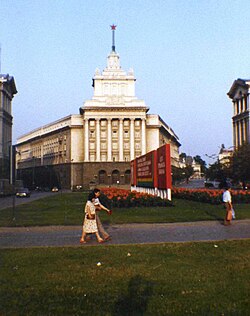
The red star on its spire remained at the time of the 1990 fire.316 source ↗
The ruling communist party later placed personal blame on Todor Zhivkov.317 The 2012 parliamentary declaration attributed the Revival Process to the "totalitarian" communist government as a whole.14 A 1994 study found that 29 percent of ethnic Bulgarians described the Revival Process as not criminal.318 The same study found that Bulgarian Turks generally blamed Todor Zhivkov and his "circle", while only 2 percent blamed ethnic Bulgarians generally.318
On August 26, 1990, a fire broke out at the Party House in central Sofia, then the headquarters of the Bulgarian Socialist Party (BSP), successor to the BCP.316319320 Different sources estimated the fire burned for between four-and-seven hours, destroying forty rooms and several documents.319320 Academic Kamusella wrote that records related to the Revival Process may have been destroyed in the fire, though the extent of any such loss was unclear.319320 Accounts of responsibility for the fire varied.320 Former National Assembly member and Sofia municipal councillor Vili Lilkov later stated in the first months after 1989, DS officers had been tasked with destroying or appropriating archives, and that many Ministry of Internal Affairs records had been stored in the Party House.316
In popular culture
Naim Süleymanoğlu (Bulgarian: Наим Сюлейманоглу) was an ethnically Turkish Olympic weightlifter born in Bulgaria in 1967 as Naim Suleimanov (Bulgarian: Наим Сюлейманов).321 During the Revival Process, authorities forced Süleymanoğlu to change his name to Naum Shalamanov (Bulgarian: Наум Шаламанов), under which he first became a world champion representing Bulgaria.322323 He later defected to Turkey and gave speeches about the Revival Process, bringing attention to the campaign.323 Bulgaria asserted that "Turkish secret services" had kidnapped Süleymanoğlu.324 Laber notes that he subsequently lived freely in Turkey.324 Süleymanoğlu competed for Turkey in international weightlifting competitions thereafter.322323 Following his defection, Süleymanoğlu won the gold medal in his weight class at the Summer Olympic Games in 1988, 1992, and 1996, representing Turkey.325 The story of Naim's life up to his defection and subsequent 1988 Olympic performance is depicted in the film Pocket Hercules: Naim Suleymanoglu.326
The Turkish television presenter Gülhan Şen (Bulgarian: Гюлхан Шен), who was born in Bulgaria in 1978, was also affected by the policy.327 In 1985, authorities forced her to change her name to Galina Hristova Mihailova (Bulgarian: Галина Христова Михайлова), and in 1989 she moved to Turkey.327 The 2005 film Stolen Eyes depicts a romance between a Bulgarian Turkish woman and a non-Muslim man during the Revival Process.328 In 2004, author Hristo Kyuchukov published the children's book My Name Was Hussein in the United States, covering the events of the Revival Process from the point of view of a young Muslim Roma boy who is forcibly renamed.329
Notes
Notes
- Turkish identity in Bulgaria was complicated at the time. See the "Bulgarian Turks" section for further clarification.
- See the "Renaming" section for various estimates.
- See the "Casualties" section.
- See the "Casualties" section.
- See the "Casualties" section for various estimates.
- See the "1989 forced migration" section.
- See the "Casualties" section for various estimates.
- Lilov was removed from power in September 1983. He later returned and delivered the Mladenov government's official denunciation of the Revival Process in December 1989.77
- Sources differ on the exact date that Zhivkova held certain positions from.3080
- Sources differ as to whether the campaign began on the 24th or the 25th.40113
- Some sources give the date of the plenum as February 13–14, while others give February 18.64114
- The authorities sought not to refer to the Turkish language directly.150
- Also referred to at this time as Medi Doganov.189190
- Also referred to at this time as Diman Sabinov Kisimov.191
- Some sources instead give the number of victims as six.204205206
- These estimates exclude events such as the 1989 unrest and expulsion.
- This conference was held after the forced expulsion began, an eventuality unknown to protesters at the time.
- Sources disagree on whether Zhivkov was immediately placed under house arrest or subsequently moved to it.286287288
References
References
- Dimitrov (2000), pp. 14–16; Tahir (2013), pp. 113–114.
- Gruev & Kalyonski (2008), pp. 139, 142; Zang Jr. (1990), pp. 1–3.
- Zang Jr. (1990), pp. 1–3; Gruev & Kalyonski (2008), pp. 33–34; Borden (2001), pp. 283–284; Eminov (1997a), p. 228.
- Gruev & Kalyonski (2008), pp. 139, 142; Dimitrov (2000), pp. 13, 17.
- Kamusella 2019, p. 1.
- United Nations High Commissioner for Refugees 2004.
- Dimitrov (2000), pp. 2–3, 8; Bulgarian Helsinki Committee (2003), p. 89.
- Dimitrov (2000), p. 15; Laber (1987), pp. 13–14; Erolova (2025), p. 13; Poulton (1991), p. 131.
- Dimitrov (2000), p. 15; Bulgarian Helsinki Committee (2003), p. 88.
- Vaksberg (2014); Kutlay (2017), p. 18.
- Bulgarian Helsinki Committee (2003), pp. 91, 95; Borden (2001), pp. 144–145; Kuzay (1986), p. 2; Hoyer (1989).
- Trupia 2022, p. 49.
- United Nations High Commissioner for Refugees (2004); Korkmaz (2022), p. 92.
- Bulgarian National Assembly 2012.
- Avramov 2016, pp. 22–23.
- Trupia 2022, p. 48.
- Gruev & Kalyonski 2008, p. 10.
- Kutlay 2017, p. 10.
- Kalyonski 2009a.
- Ministry of Foreign Affairs 2007.
- Bulgarian National Television 2015.
- Dimitrov 2000, p. 5.
- Bulgarian Helsinki Committee 2003, p. 91.
- Bulgarian Helsinki Committee 2003, pp. 3–4.
- Mayuhtar-May 2014, p. 98.
- Eminov 2007, p. 15.
- Mayuhtar-May 2014, p. 108.
- Eminov 2007, pp. 14–16.
- Mayuhtar-May 2014, p. 109.
- Dimitrov 2000, p. 8.
- Kamusella 2019, p. 21.
- Poulton 1991, p. 129.
- National Statistical Office 2011.
- Dimitrov 2000, p. 12.
- Banik 2023, p. 33.
- Oprea 2014, p. 131.
- Avramov 2016, pp. 87–89.
- Gruev & Kalyonski 2008, pp. 123, 135.
- Ivanov & Önsoy 2022, pp. 45–46.
- Dimitrov 2000, p. 13.
- Maeva 2022.
- Aslan 2009, pp. 3–5.
- Arhsien & Howells 1981, p. 419.
- Laber 1987, p. 30.
- Curtis 1993, p. 56.
- Dimitrov 2000, p. 6.
- Sevim & Aydın Sevim 2022, p. 330.
- Bulgarian Helsinki Committee 2003, p. 86.
- United States Department of State 1984.
- Dimitrov 2000, p. 2.
- Mayuhtar-May 2014, p. 135.
- Marušiakova & Popov 2000, p. 45.
- Eminov 1997a, p. 213.
- Marušiakova & Popov 2000, p. 46.
- Marušiakova & Popov 2000, p. 1.
- Elchinova 2001, p. 1.
- Marušiakova & Popov 2000, pp. 1–2.
- Borden 2001, p. 258.
- Eminov 1986, p. 508.
- Ivanov & Önsoy 2022, p. 44.
- Bulgarian Helsinki Committee 2003, p. 9.
- Bulgarian Helsinki Committee 2003, p. 89.
- Dimitrov 2000, pp. 2–3, 8.
- Marušiakova & Popov 2000, p. 22.
- Korkmaz 2022, p. 89.
- Poulton 1991, p. 150.
- Tahir 2013, p. 113.
- Tahir 2013, pp. 113–114.
- Petkova 2002, p. 49.
- Dimitrov 2000, p. 11.
- Baeva 2012, p. 13.
- Avramov 2016, p. 87.
- Gruev & Kalyonski 2008, p. 150.
- Bojkov 2004, p. 357.
- Avramov 2016, pp. 89–90.
- Karahasan-Çınar 2005, pp. 213–214.
- Gruev & Kalyonski 2008, p. 136.
- Stoyanov 1998, p. 162.
- 168 Chasa 2021.
- Atanasova 2004, p. 288.
- Ivanova 2022, pp. 563, 570.
- Atanasova 2004, p. 296.
- Ivanova 2022, p. 574.
- Atanasova 2004, p. 314.
- Gruev & Kalyonski 2008, p. 129.
- Council of Ministers 1977.
- Laber 1987, p. 20.
- Avramov 2016, p. 104.
- Bulgarian Helsinki Committee 2003, p. 10.
- Petkova 2002, pp. 44–45.
- Kamusella 2019, p. 7.
- Marušiakova & Popov 2000, pp. 15–16.
- Eminov 2007, p. 7.
- Mayuhtar-May 2014, pp. 100, 133–136.
- Şimşir 1988, p. 274.
- Bulgarian Helsinki Committee 2003, p. 43.
- Eminov 1986, p. 512.
- Bulgarian Helsinki Committee 2003, p. 44.
- Dimitrov 2000, p. 3.
- Ivanov & Önsoy 2022, p. 39.
- Eminov 1997a, p. 227.
- Marušiakova & Popov 2000, pp. 18–19.
- Mayuhtar-May 2014, p. 103.
- Bulgarian Helsinki Committee 2003, p. 87.
- Şimşir 1988, p. 275.
- Pashova 2009, p. 108.
- Eminov 1997a, p. 232.
- Bulgarian Helsinki Committee 2003, p. 85.
- Vachkov 2018, p. 193.
- Tahir 2013, p. 112.
- Gruev & Kalyonski 2008, p. 139.
- Ivanov & Önsoy 2022, p. 46.
- Gruev & Kalyonski 2008, pp. 139, 142.
- Dimitrov 2000, p. 14.
- Gruev & Kalyonski 2008, p. 69.
- Kalinova & Baeva 2009, pp. 175–184.
- Tahir 2013, p. 114.
- Kalinova & Baeva 2009, p. 178.
- Vaksberg 2014.
- Zang Jr. 1990, p. 2.
- Dimitrov 2000, p. 15.
- Laber 1987, pp. 13–14.
- Erolova 2025, p. 13.
- Poulton 1991, p. 131.
- Bulgarian Helsinki Committee 2003, p. 94.
- Trupia 2022, pp. 57–58.
- Laber 1987, pp. 12–13.
- Erolova 2025, p. 10.
- Kuzay 1986, p. 1.
- Marušiakova & Popov 2000, p. 21.
- Tahir 2013, pp. 114, 116.
- Gruev & Kalyonski 2008, p. 142.
- Dimitrov 2000, p. 13–14.
- Eminov 1997b, p. 87.
- Gruev & Kalyonski 2008, pp. 139–140.
- Poulton 1991, p. 127.
- Eminov 1986, p. 514.
- Foreign Broadcast Information Service 1986, p. 1.
- Central Statistical Office 1988.
- Kamusella 2019, pp. 141, 143.
- Avramov 2016, p. 110.
- Büchsenschütz 2000, p. 104.
- Kalinova 2016, p. 125.
- Tahir 2013, p. 116.
- Kamusella 2019, p. 12.
- Zang Jr. 1990, pp. 2–3.
- Kamusella 2019, p. 143.
- Hoyer 1989.
- Gruev & Kalyonski 2008, pp. 160–161.
- Kamusella 2019, p. 46.
- Kamusella 2019, pp. 45–46.
- Bulgarian Helsinki Committee 2003, p. 88.
- Borden 2001, p. 283.
- Gruev & Kalyonski 2008, pp. 33–34.
- Mayuhtar-May 2014, p. 104.
- Poulton 1991, p. 136.
- Avramov 2016, pp. 665–669.
- Kamusella 2019, p. 44.
- Gruev & Kalyonski 2008, pp. 143–144.
- Eminov 1989, p. 12.
- Borden 2001, p. 284.
- Poulton 1991, p. 132.
- Mahon 1999, p. 157.
- Eminov 1997a, p. 228.
- Zang Jr. 1990, p. 3.
- Gruev & Kalyonski 2008, p. 159.
- Marušiakova & Popov 2000, p. 18.
- Poulton 1991, p. 137.
- Borden 2001, p. 285.
- Maeva 2017, p. 99.
- Poulton 1991, pp. 136–137.
- Öz 2024, p. 204.
- Erolova 2025, p. 11.
- Marušiakova & Popov 2000, p. 6.
- Dayıoğlu 2012, p. 8.
- Öz 2024, pp. 204–205.
- Poulton 1991, pp. 135–136.
- Poulton 1991, p. 135.
- Grand Mufti's Office.
- Öz 2024, p. 205.
- Kamusella 2019, p. 48.
- Borden 2001, p. 289.
- Trifonova Price 2022, p. 2.
- Borden 2001, p. 286.
- Dimitrov 2000, p. 10.
- Zafer 2010.
- Bojkov 2004, p. 358.
- Angelov 2009, p. 16.
- Gruev & Kalyonski 2008, p. 148.
- Angelov 2009, p. 155.
- Angelov 2009, p. 156.
- Gorcheva 2009.
- Angelov 2009, p. 46.
- Angelov 2009, pp. 248–249.
- Angelov 2009, pp. 5–7, 155.
- Hristov 2012.
- Gruev & Kalyonski 2008, p. 179.
- Capital 1997.
- Kalyonski 2009b.
- Angelov 2009, p. 258.
- Kamusella 2019, p. 35.
- Dechev 2024.
- Avramov 2016, p. 177.
- Kamusella 2019, p. 36.
- Bulgarian National Radio 2016.
- Gruev & Kalyonski 2008, p. 138.
- Büchsenschütz 2000, p. 105.
- Curtis 1993, p. xxxvii.
- Belene Island Foundation, History.
- Mediapool 2009.
- Pametbg.
- Erolova 2025, p. 3.
- Kutlay 2017, p. 28.
- Bulgarian National Radio 2023.
- Kırcaali Haber 2018.
- Laber 1987, pp. 3–4.
- Kamusella 2019, p. 34.
- Avramov 2016, p. 71.
- Central Intelligence Agency 1985.
- Borden 2001, p. 287.
- Demirhan 2019, p. 265.
- Sevim & Aydın Sevim 2022, p. 329.
- Gruev & Kalyonski 2008, pp. 146.
- Sevim & Aydın Sevim 2022, p. 328.
- Gruev & Kalyonski 2008, pp. 146–147.
- Kamusella 2019, p. 41.
- Gruev & Kalyonski 2008, p. 144.
- Forestier-Peyrat 2021, p. 183.
- Bulgarian Helsinki Committee 2003, pp. 47, 97.
- United States Commission on Security and Cooperation in Europe 1988, p. 81.
- Yolcu 2021, p. 79.
- Ragaru 2023, pp. 66–67.
- Kuzay 1986, p. 2.
- Petkova 2002, p. 47.
- United States Commission on Security and Cooperation in Europe 1985, pp. 53, 182–183.
- Parliamentary Assembly of the Council of Europe 1985.
- Kamberi, Rexhepi & Kamberi 2024, pp. 64–66.
- Kamberi, Rexhepi & Kamberi 2024, pp. 66–67.
- Bulgarian Helsinki Committee 2003, p. 95.
- United Nations Commission on Human Rights 1988, pp. 1–2.
- Stoyanov 1998, p. 195.
- Petkova 2002, p. 48.
- Gruev & Kalyonski 2008, pp. 163–166.
- Gruev & Kalyonski 2008, pp. 164–165.
- Elchinova 2001.
- Gruev & Kalyonski 2008, p. 176.
- Gruev & Kalyonski 2008, p. 180.
- Gruev & Kalyonski 2008, pp. 180–182.
- Kalaitzaki 2001, pp. 273–274.
- Kalaitzaki 2001, p. 274.
- Ivanova 2024.
- Lévesque 1997, p. 170.
- Bulgarian National Radio 2019.
- Hristov 2014.
- Human Rights Watch 1989.
- Kamusella 2019, pp. 46, 47–49.
- Martino 2009.
- Kamusella 2019, p. 3.
- Avramov 2016, pp. 314–315.
- Avramov 2016, p. 315.
- Avramov 2016, p. 317.
- Malakchiev 2025.
- Dimitrov 2000, p. 17.
- Kutlay 2017, p. 18.
- Zang Jr. 1990, pp. 5–6.
- Zang Jr. 1990, p. 5.
- Trupia 2022, p. 54.
- Dayıoğlu 2007, p. 94.
- Erolova 2025, p. 14.
- Salifova 2002.
- Human Rights Watch 1991.
- Maeva 2008, pp. 100–108.
- Trupia 2022, p. 59.
- Eminov 2007, p. 17.
- Gruev & Kalyonski 2008, p. 157.
- Poulton 1991, p. 170.
- Vassilev 2010, p. 302.
- Vassilev 2010, p. 301.
- Kamusella 2020, p. 2.
- Bulgarian Helsinki Committee 2003, p. 101.
- Kamusella 2019, p. 68.
- Dimitrov 2000, p. 16.
- Dimitrov 2000, pp. 16–17.
- Zang Jr. 1990, p. 4.
- Human Rights Watch 1994.
- Kolev 2015.
- Marica 2020.
- United Press International 1990.
- Kamusella 2019, p. 151.
- Vaksberg 2010.
- Mediapool 2003.
- Сега 2022.
- Bulgarian National Radio 2022.
- Kutlay 2017, pp. 16–21.
- Dimitrov 2000, pp. 18–19.
- Korkmaz 2022, p. 92.
- Kutlay 2017, pp. 21–24.
- Kutlay 2017, p. 23.
- Kamusella 2018.
- Meznik & Thieme 2012, pp. 205–207.
- Katsikas 2011, p. 64.
- Rensmann 2011, p. 133.
- Kamusella 2019, p. 117.
- Martinova 2012.
- Lunkova 2019, p. 220.
- Rudin & Eminov 1990, p. 158.
- Trupia 2022, p. 56.
- Trupia 2022, pp. 47–49, 51–53.
- Sofia Globe 2018.
- Standart 2013.
- Korkmaz 2022, p. 93.
- Kamusella 2020, p. 10.
- Kamusella 2019, p. 115.
- Maeva 2008, pp. 227–229.
- Hillgren 2009.
- Kolev 2020.
- Büchsenschütz 2000, p. 106.
- Popova & Hajdinjak 2006, p. 113.
- Kamusella 2019, p. 145.
- Vladimirova 2023.
- Oliver 2017.
- Socrates Dergi.
- Korkmaz 2022, p. 90.
- Laber 1987, p. 32.
- International Olympic Committee.
- NTV 2022.
- Haber61 2019.
- Bulgarian National Film Archive 2026.
- Kyuchukov 2004.
Bibliography
Bibliography
- "По 1500 лв. взема "Герой на НРБ", Живков е 2 пъти" [“Hero of the People's Republic of Bulgaria” receives 1,500 leva; Zhivkov is twice one]. 168 Chasa (in Bulgarian). October 26, 2021. Retrieved May 1, 2026.
- Angelov, Vesselin (2009). Борба без оръжие! Турско националноосвободително движение в България (1985–1986). Документи [Struggle without weapons! Turkish National Liberation Movement in Bulgaria (1985–1986). Documents] (in Bulgarian). Sofia: Liberal Integration Foundation. ISBN 978-954-617-085-9. Archived from the original on February 28, 2026. Retrieved February 9, 2026.
- Arhsien, Patrick F. R.; Howells, R. A. (1981). "Yugoslavia, Albania and the Kosovo Riots". The World Today. 37 (11): 419–427. JSTOR 40395240. Retrieved April 20, 2026.
- Aslan, Senem (2009). "Incoherent State: The Controversy over Kurdish Naming in Turkey". European Journal of Turkish Studies (10). doi:10.4000/ejts.4142. Retrieved April 20, 2026.
- Atanasova, Ivanka Nedeva (2004). "Lyudmila Zhivkova and the Paradox of Ideology and Identity in Communist Bulgaria". East European Politics and Societies. 18 (2): 278–315. doi:10.1177/0888325404263413. Retrieved April 20, 2026.
- Avramov, Rumen (2016). Икономика на Възродителния процес [The Economics of the Revival Process] (PDF) (in Bulgarian). Sofia: Centre for Advanced Study. ISBN 978-954-320-582-0. Archived (PDF) from the original on June 16, 2024. Retrieved January 18, 2026.
- Baeva, Iskra (2012). "The Day Before the Crash: Bulgarian-Soviet Relations in the Nineteen Eighties" (PDF). Studia z Dziejów Rosji i Europy Środkowo-Wschodniej. 47 (Special Issue): 7–22. Retrieved May 1, 2026.
- Banik, Sajib Kumar (2023). "Turkey's Paradigm Shifting since 1980s: A Historic Transformation from Kemalist Secularism to Islamist Politics" (PDF). The Dhaka University Studies. 80 (1–2): 31–48. doi:10.62296/DUS8020222024003. Retrieved April 30, 2026.
- "History". Belene Island Foundation. September 25, 2023. Archived from the original on November 9, 2025. Retrieved January 25, 2026.
- Bojkov, Victor D. (2004). "Bulgaria's Turks in the 1980s: A Minority Endangered". Journal of Genocide Research. 6 (3): 343–369. doi:10.1080/1462352042000265846.
- Borden, Milena Savova-Mahon (2001). The Politics of Nationalism under Communism in Bulgaria: Myths, Memories, and Minorities (PDF) (PhD thesis). London: University of London, School of Slavonic and East European Studies. Archived (PDF) from the original on September 27, 2025. Retrieved January 31, 2026.
- The Human Rights of Muslims in Bulgaria in Law and Politics since 1878 (Report). Bulgarian Helsinki Committee. 2003. Archived from the original on April 16, 2024. Retrieved January 28, 2026.
- "Declaration condemning the attempted forcible assimilation of Bulgarian Muslims" (in Bulgarian). Bulgarian National Assembly. January 11, 2012. Archived from the original on February 3, 2023. Retrieved January 25, 2026.
- "Откраднати очи" [Stolen eyes]. Odeon (in Bulgarian). Bulgarian National Film Archive. Retrieved February 26, 2026.
- "31 years after the attack at Bunovo station". Bulgarian National Radio. September 3, 2016. Archived from the original on December 25, 2024. Retrieved January 11, 2025.
- "30 Years since the Historical Visit to Bulgaria by Francois Mitterrand". Bulgarian National Radio. January 18, 2019. Archived from the original on February 25, 2026. Retrieved February 13, 2026.
- "Appellate Court-Sofia Reopens the "Revival Process" Case". Bulgarian National Radio. December 27, 2022.
- "Victims of so-called "Revival Process" honored near Mogilyane". Bulgarian National Radio. December 26, 2023. Archived from the original on February 25, 2026. Retrieved January 25, 2026.
- Bulgarian National Television (January 18, 2015). "На днешния ден преди 30 години - появява се формулировката "възродителен процес"" [On this day 30 years ago – the formulation "Revival Process" appears]. BNT News (in Bulgarian). Bulgarian National Television. Retrieved April 30, 2026.
- Büchsenschütz, Ulrich (2000). Малцинствената политика в България. Политиката на БКП към евреи, роми, помаци и турци (1944-1989) [Minority policy in Bulgaria. The policy of the BCP towards Jews, Roma, Pomaks and Turks (1944-1989).] (PDF) (in Bulgarian). International Center for Minority Studies and Intercultural Relations. ISBN 954-8872-24-2. Archived from the original (PDF) on September 26, 2007.
- "Доган – пет години по-рано" [Dogan – five years earlier]. Capital (in Bulgarian). October 25, 1997. Archived from the original on December 19, 2024. Retrieved February 9, 2026.
- Central Intelligence Agency (1985). European Review (Report). Central Intelligence Agency. Retrieved May 1, 2026.
- Population and Housing Census in the People's Republic of Bulgaria Held on the 4-th of December 1985: Methodology and main results. Central Statistical Office. 1988. OCLC 1341991513. Retrieved February 17, 2026 – via Google Books.
- "Съдът: Делото за "Възродителния процес" е прекратено неправилно" [Court: The case for the Revival process has been terminated incorrectly]. Sega (in Bulgarian). December 27, 2022. Archived from the original on February 28, 2026. Retrieved February 27, 2026.
- "Постановление № 15 на Министерския съвет от 1977 г.: Внедряване на единна система за гражданска регистрация и административно обслужване на населението (ЕСГРАОН)" [Decree No. 15 of the Council of Ministers (1977): Introduction of a unified system for civil registration and administrative services for the population (ESGRAON)]. Public consultation portal (in Bulgarian). March 11, 1977. Archived from the original on December 11, 2025. Retrieved February 24, 2026.
- Curtis, Glenn E., ed. (1993). Bulgaria: A Country Study (PDF). Area handbook series (2nd ed.). Federal Research Division, Library of Congress. ISBN 0-8444-0751-8. Archived (PDF) from the original on September 6, 2025. Retrieved January 25, 2026.
- Dayıoğlu, Ali (2007). "Minority Policy in Bulgaria After 1989: The Case of the Muslim-Turkish Minority" (PDF). Minority Issues in the Balkans and the EU. Foundation for Middle East and Balkan Studies: 91–112. Retrieved May 1, 2026.
- Dayıoğlu, Ali (April 2012). "Muslim-Turkish Minority's Freedom of Religion and Conscience and the Problem of Head Muftiate in Bulgaria Between 1989 and 2011" (PDF). Journal of Social Sciences. 5 (1). Near East University: 2–33.
- Dechev, Stefan (December 27, 2024). ""Да знаем всяко село как замръква". Защо смяната на имената не е "случайно хрумване"" ["To know how every village ends and begins the day". Why the name changes were not a "random whim"]. Svobodna Europa (in Bulgarian). Retrieved May 1, 2026.
- Demirhan, Hasan (2019). "Bulgaristan Türklerine uygulanan zorla isim değiştirme kampanyası ve Türk basını (Aralık 1984-Mart 1985)" [The forced name-change campaign applied to Turks in Bulgaria and the Turkish press (December 1984-March 1985)]. RumeliDE Dil ve Edebiyat Araştırmaları Dergisi (in Turkish) (17): 252–272. doi:10.29000/rumelide.656753.
- Dimitrov, Vesselin (December 23, 2000). In Search of a Homogeneous Nation: The Assimilation of Bulgaria's Turkish Minority, 1984–1985 (PDF) (Report). European Centre for Minority Issues. Archived (PDF) from the original on February 23, 2026. Retrieved January 24, 2026.
- Elchinova, Magdalena (2001). "Ethnic Discourse and Group Presentation in Modern Bulgarian Society". Development and Society. 30 (1). Institute for Social Development and Policy Research: 51–78. Retrieved February 8, 2026 – via JSTOR.
- Eminov, Ali (1986). "Are Turkish-speakers in Bulgaria of Ethnic Bulgarian Origin?". Journal of the Institute of Muslim Minority Affairs. 7 (2): 503–518. doi:10.1080/13602008608715999. Retrieved January 31, 2026.
- Eminov, Ali (November 1989). The Elimination of Turkish Language Instruction in Bulgaria (PDF) (Report). Educational Resources Information Center.
- Eminov, Ali (1997). "Islam and Muslims in Bulgaria: A Brief History". Islamic Studies. 36 (2/3): 209–241. JSTOR 23076195. Retrieved February 25, 2023 – via JSTOR.
- Eminov, Ali (1997). Turkish and Other Muslim Minorities in Bulgaria. Psychology Press. ISBN 978-0-415-91976-0 – via Google Books.
- Eminov, Ali (July 1, 2007). "Social Construction of Identities: Pomaks in Bulgaria" (PDF). Journal on Ethnopolitics and Minority Issues in Europe. 6 (2). European Centre for Minority Issues: 1–25. Archived (PDF) from the original on May 17, 2025. Retrieved January 25, 2026.
- Erolova, Yelis (July 26, 2025). "Bulgarian Forced Assimilation Policy and the So-Called "Revival Process" Towards Turks and Muslims in Bulgaria 40 Years Later: Documents, Studies and Memories". Histories. 5 (3) 33. doi:10.3390/histories5030033.
- East Europe Report: Basic Results from the 1985 Bulgarian Census (PDF) (Report). Foreign Broadcast Information Service. October 28, 1986. Archived from the original (PDF) on January 4, 2026. Retrieved February 17, 2026 – via Defense Technical Information Center.
- Forestier-Peyrat, Etienne (2021). "Communist Europe and the Kurdish Question During the Cold War (1940s–1980s)". Kurdish Studies. 9 (2): 175–187. doi:10.33182/ks.v9i2.568. Retrieved May 1, 2026.
- Gorcheva, Daniela (March 4, 2009). "Съпротивата на турците бе катализатор и за нашите меки интелигентски акции" [The resistance of the Turks was also a catalyst for our gentle intellectual actions]. Mediapool.bg (in Bulgarian). Retrieved February 8, 2026.
- "History". Grand Mufti's Office of the Republic of Bulgaria Muslim Denomination. Archived from the original on March 5, 2024. Retrieved April 20, 2026.
- Gruev, Mihail; Kalyonski, Aleksey (2008). Възродителният процес: Мюсюлманските общности и комунистическият режим: политики, реакции и последици [The Revival Process: The Muslim Communities and the Communist Regime: Policies, Reactions and Consequences] (in Bulgarian). Sofia: Ciela. ISBN 978-954-28-0291-4. Retrieved January 28, 2026 – via Internet Archive.
- "Gülhan Şen kimdir?" [Who is Gülhan Şen?]. Haber61 (in Turkish). August 29, 2019. Archived from the original on February 27, 2026. Retrieved January 25, 2026.
- Hillgren, Johanna (2009). "20 år sedan bulgarienturkarna kom" [20 years since the Bulgarian Turks came]. Hallands Nyheter (in Swedish). Archived from the original on June 4, 2023. Retrieved May 8, 2021.
- Hoyer, Steny (March 2, 1989). "Bulgaria Stamps Out a Minority". The Christian Science Monitor. Archived from the original on February 13, 2025. Retrieved January 28, 2026.
- Hristov, Hristo (September 29, 2012). "За първи път: Досието на Ахмед Доган онлайн. Част 5.1: За преименуването в Кърджали и Хасково през 1984 г." [For the first time: Ahmed Dogan's file online. Part 5.1: On the renaming of Kardzhali and Haskovo in 1984.]. desebg.com (in Bulgarian). Archived from the original on May 20, 2013. Retrieved January 28, 2026.
- Hristov, Hristo (May 20, 2014). "Президентът Росен Плевнелиев: Комунистическият режим потъпка българския национален идеал" [President Rosen Plevneliev: The communist regime trampled on the Bulgarian national ideal]. desebg.com (in Bulgarian). Archived from the original on January 15, 2026. Retrieved July 26, 2014.
- Human Rights Watch (1989). "Human Rights Watch World Report 1989 - Bulgaria". Human Rights Watch. Archived from the original on December 26, 2024. Retrieved January 24, 2026.
- Human Rights Watch (January 1, 1991). "Human Rights Watch World Report 1990 - Bulgaria". Refworld. United Nations High Commissioner for Refugees. Retrieved May 1, 2026.
- Human Rights Watch (1994). China: Use of Criminal Charges Against Political Dissidents (PDF) (Report). Human Rights Watch. Archived (PDF) from the original on December 15, 2021. Retrieved January 25, 2026.
- Ivanov, Ivo Kirilov; Önsoy, Murat (2022). "From Integration to Assimilation and Forced Migration: An Evaluation of the Bulgarian Communist Party's Turkish Minority Policy" (PDF). bilig (103): 31–58. Retrieved April 20, 2026.
- Ivanova, Veneta T. (2022). "Socialism with an Occult Face: Aesthetics, Spirituality, and Utopia in Late Socialist Bulgaria". East European Politics and Societies. 36 (2): 558–581. doi:10.1177/0888325420961159. hdl:1814/70020. Retrieved April 20, 2026.
- Ivanova, Diana (May 29, 2024). "Без име и език, а накрая без дом и държава. Как преди 35 години бяха изгонени българските турци" [Without a name and language, and finally without a home and state: How Bulgarian Turks were expelled 35 years ago]. Свободна Европа (in Bulgarian). Retrieved May 20, 2026.
- Kalaitzaki, Theodora (2001). "Turkey and Bulgaria in the post-Cold War Era: a success story". Balkan Studies. 42 (2): 267–290. Retrieved May 1, 2026.
- Kalinova, Evgenia; Baeva, Iskra (2009). Baeva, Iskra; Kalinova, Evgenia (eds.). "Възродителният процес". Том I – Българската държава и българските турци (средата на 30-те – началото на 90-те години на ХХ век) ["The Revival Process". Volume I – The Bulgarian State and the Bulgarian Turks (mid-1930s – early 1990s)]. Sofia: Държавна агенция "Архиви". pp. 5–42. ISBN 978-954-9800-80-7.
- Kalinova, Evgenia (2016). "Изселнически практики и политиката на България (края на XIX – края на XX век)" [Emigration practices and Bulgaria's policy (late 19th–late 20th century)]. In Mihneva, Rumyana; Baeva, Iskra; Grozev, Kostadin (eds.). Миграциите: Европа между историческия опит и страховете на съвременността [Migrations: Europe Between Historical Experience and the Fears of the Present] (in Bulgarian). Sofia: Kameya Grup OOD. pp. 111–136.
- Kalyonski, Aleksey (August 6, 2009). "„Възродителният процес" от 1984 – 1989 г. Част 1" [The "Revival Process" 1984–1989. Part 1]. Liberal Review (in Bulgarian). Archived from the original on February 28, 2026. Retrieved February 9, 2026.
- Kalyonski, Aleksey (December 31, 2009). "1989 – Майските събития и „Голямата екскурзия"" [1989 – The May Events and the "Big Excursion"]. Liberal Review (in Bulgarian). Archived from the original on February 28, 2026. Retrieved February 19, 2026.
- Kamberi, Drenusha; Rexhepi, Hava; Kamberi, Gojart (2024). "Discrimination Policies That Lead to Forced Migration: The Question of the Bulgarian Turks Within United Nations (1988–1989)" (PDF). Philosophica. 11 (22–23): 59–70. doi:10.62792/ut.philosophica.v11.i22-23.p272260. Retrieved May 1, 2026.
- Kamusella, Tomasz (September 7, 2018). "Bulgaria: an unlikely personality cult". New Eastern Europe. Archived from the original on February 25, 2026. Retrieved January 25, 2026.
- Kamusella, Tomasz (2019). Ethnic Cleansing During the Cold War: The Forgotten 1989 Expulsion of Turks from Communist Bulgaria. London: Routledge. ISBN 978-1138480520. Retrieved January 30, 2026.
- Kamusella, Tomasz (2020). "Between Politics and Objectivity: The Non-Remembrance of the 1989 Ethnic Cleansing of Turks in Communist Bulgaria". Journal of Genocide Research. 22 (4): 515–532. doi:10.1080/14623528.2020.1726649. hdl:10023/23778.
- Karahasan-Çınar, İbrahim (2005). Етнически малцинства в България [Ethnic Minorities in Bulgaria] (in Bulgarian). Sofia: LIK. ISBN 954-607-678-3. Archived from the original on February 28, 2026. Retrieved January 23, 2026 – via Regional library catalog.
- Katsikas, Stefanos (2011). Negotiating Diplomacy in the New Europe: Foreign Policy in Post-Communist Bulgaria. I.B. Tauris. ISBN 978-1845118853. Retrieved January 30, 2026.
- "Türkân Bebek kaç aylıktı?" [How old was baby Türkan?]. Kırcaali Haber (in Turkish). January 16, 2018. Archived from the original on September 17, 2019. Retrieved August 28, 2019.
- Kolev, Yoan (August 29, 2015). "1998: Todor Zhivkov – death of a dictator". Bulgarian National Radio. Archived from the original on February 28, 2026. Retrieved February 27, 2026.
- Kolev, Yoan (August 26, 2020). "30 години след палежа, бившият Партиен дом отново е свидетел на протести" [30 years after the arson, the former Party House is once again witnessing protests]. Bulgarian National Radio (in Bulgarian). Retrieved February 27, 2026.
- Korkmaz, Nuri (2022). "Being Identified as a Double Threat to Communism and Nationalism: Dissidents from the Turkish Minority in Bulgaria During 1984–1990's and the Archival Resources". Matériaux pour l’histoire de notre temps (145–146): 87–94. doi:10.3917/mate.145.0087.
- Kutlay, Muzaffer (2017). "The Turks of Bulgaria: An Outlier Case of Forced Migration and Voluntary Return" (PDF). International Migration. 55 (5). University of Kent. doi:10.1111/imig.12381. Archived (PDF) from the original on February 25, 2026. Retrieved January 25, 2026 – via Kent Academic Repository.
- Kuzay, Tuncer M. (March 1986). Oppression and Persecution of the Turkish Minority in Bulgaria (Report). Wheaton, Illinois: United Turkish Americans.
- Kyuchukov, Hristo (April 1, 2004). My Name Was Hussein. Illustrated by Allan Eitzen. Boyds Mills Press. ISBN 978-0-613-78874-8. Retrieved February 27, 2026.
- Laber, Jeri (1987). Destroying Ethnic Identity: The Turks of Bulgaria. Human Rights Watch. ISBN 978-0-938579-66-3 – via Google Books.
- Lévesque, Jacques (1997). The Enigma of 1989: The USSR and the Liberation of Eastern Europe. University of California Press. Retrieved May 1, 2026.
- Lunkova, Natalya A. (2019). "«Когда у меня отняли имя»: об одном болгарско-турецком научном проекте" ["When my name was taken from me": on a Bulgarian–Turkish scholarly project]. The Slavic World in the Third Millennium (in Russian). 14 (3–4). Moscow: Institute of Slavic Studies: 214–222. doi:10.31168/2412-6446.2019.14.3-4.15. Archived from the original on February 25, 2026. Retrieved February 9, 2026.
- Maeva, Mila (2008). "Modern Migration Waves of Bulgarian Turks". In Marushiakova, Elena (ed.). Dynamics of National Identity and Transnational Identities in the Process of European Integration. Newcastle upon Tyne: Cambridge Scholars Publishing. ISBN 9781847184719.
- Maeva, Mila (2017). "Turkish Religious Identity in Bulgaria in the Last Twenty-Four Years (1989–2013)". In Anastasova, Ekaterina; Kõiva, Mare (eds.). Balkan and Balticum: Current Studies in the Postsocialist Space (PDF). Sator. Vol. 18. Tartu: Eesti Kirjandusmuuseumi Teaduskirjastus. pp. 94–117. doi:10.7592/Sator.2017.18.05.
- Maeva, Mila (October 1, 2022). "„Възродителният процес" (1984–1989 г.)" [The Revival Process (1984–1989)]. Либерален преглед (in Bulgarian). Retrieved April 24, 2024.
- Mahon, Milena (1999). "The Turkish Minority under Communist Bulgaria—Politics of Ethnicity and Power". Journal of Southern Europe and the Balkans. 1 (2): 149–162. doi:10.1080/14613199908413996. Retrieved April 30, 2026.
- Malakchiev, Atanas (December 29, 2025). "December 29, 1989: "Revival Process" Officially Ends". BTA. Bulgarian News Agency. Retrieved May 1, 2026.
- "Арестуват Тодор Живков на този ден преди 30 години" [Todor Zhivkov was arrested on this day 30 years ago]. marica.bg (in Bulgarian). January 18, 2020. Retrieved May 5, 2026.
- Martino, Francesco (November 4, 2009). "The Big Excursion of Bulgarian Turks". OBC Transeuropa. Archived from the original on February 25, 2026. Retrieved February 16, 2023.
- Martinova, Elitsa (June 6, 2012). "Волен не успя да защити "Възродителния процес"" [Volen failed to defend the "Revival Process"]. OFFNews (in Bulgarian). Retrieved February 27, 2026.
- Marušiakova, Elena; Popov, Veselin (2000). "The Bulgarian Gypsies – Searching Their Place in the Society" (PDF). Balkanologie. 4 (2). doi:10.4000/balkanologie.323.
- Mayuhtar-May, Fatme (2014). Identity, Nationalism, and Cultural Heritage under Siege: Five Narratives of Pomak Heritage: From Forced Renaming to Weddings (PDF). Balkan Studies Library. Leiden: Brill. doi:10.1163/9789004272088. ISBN 978-90-04-27207-1. Retrieved January 30, 2026.
- "Справка на Главна прокуратура за делото по "Възродителния" процес" [Report of the Chief Prosecutor's Office on the case concerning the "Revival Process"]. Mediapool.bg (in Bulgarian). July 3, 2003. Retrieved November 30, 2010.
- "За тези събития трябва да пише в учебниците" [These Events Need to be Discussed in the History Textbooks]. Mediapool.bg (in Bulgarian). 2009. Retrieved May 26, 2012.
- Meznik, Michael; Thieme, Tom (2012). "Against all Expectations: Right-Wing Extremism in Romania and Bulgaria". In Backes, Uwe; Moreau, Patrick (eds.). The Extreme Right in Europe: Current Trends and Perspectives. Göttingen: Vandenhoeck & Ruprecht. pp. 195–214. ISBN 978-3-525-36922-7.
- "СОЦИАЛИЗЪМ. Хронологична таблица" [Socialism. Chronological table] (in Bulgarian). Bulgarian Ministry of Foreign Affairs. June 20, 2007. Archived from the original on June 30, 2007. Retrieved January 23, 2026.
- "Население по местоживеене, пол и етническа група" [Population by place of residence, sex and ethnic group] (in Bulgarian). Bulgarian National Statistical Institute. Archived from the original on May 30, 2017. Retrieved January 27, 2012.
- "Cep Herkülü: Naim Süleymanoğlu'nun yönetmeni Özer Feyzioğlu: Kendini feda etme öyküsünü anlatıyoruz". NTV (in Turkish). Retrieved May 1, 2022.
- Oliver, Brian (December 3, 2017). "Naim Süleymanoğlu obituary". The Guardian. London. Archived from the original on February 25, 2025. Retrieved January 24, 2026.
- "Naim Süleymanoğlu". Olympics.com. International Olympic Committee. Archived from the original on February 25, 2026. Retrieved January 24, 2026.
- Oprea, Iulia Alexandra (2014). "State-Led Islamization: The Turkish-Islamic Synthesis". Studia Universitatis Petru Maior. Historia. 14 (1): 131–139. Retrieved April 30, 2026.
- Öz, Yunus (2024). Muslims of Central Eurasia in the 21st Century: Challenges, Opportunities, and Prospects (PDF). IKI Academy. Retrieved April 30, 2026.
- "Belene Concentration Camp". Pametbg.com. Retrieved May 1, 2026.
- Parliamentary Assembly of the Council of Europe (September 26, 1985). Situation of ethnic and Muslim minorities in Bulgaria (Resolution 846). Council of Europe. Retrieved May 1, 2026.
- Petkova, Lilia (June 2002). "The Ethnic Turks in Bulgaria: Social Integration and Impact on Bulgarian–Turkish Relations, 1947–2000" (PDF). The Global Review of Ethnopolitics. 1 (4): 42–59.
- Pashova, Anastasya (2009). "The Muslim Roma - an "Inconvenient" for the Communist Regime Minority". In Popova, Kristina; Piskova, Marijana; Lanzinger, Margareth; Langreiter, Nikola; Vodenicharov, Petar (eds.). Women and Minorities: Ways of Archiving. Women and Minorities Archives. Vol. 1. Sofia; Vienna: Semarsh. ISBN 9549590038. Retrieved April 30, 2026.
- Poulton, Hugh (1991). Balkans: Minorities and States in Conflict (PDF). London: Minority Rights Group. ISBN 1873194404. Archived from the original (PDF) on July 1, 2025. Retrieved January 30, 2026.
- Popova, Ekaterina; Hajdinjak, Marko, eds. (2006). Forced Ethnic Migrations on the Balkans: Consequences and Rebuilding of Societies (PDF). Conference Proceedings, 22–23 February 2005. Sofia; Tokyo: International Centre for Minority Studies and Intercultural Relations; Meiji University. ISBN 978-954-8872-61-4.
- Ragaru, Nadège (2023). "Symbolic Time(s) of Violence in Late Socialist Bulgaria" (PDF). Slavic Review. 82 (1): 48–68.
- Rensmann, Lars (2011). ""Against Globalism": Counter-Cosmopolitan Discontent and Antisemitism in Mobilizations of European Extreme Right Parties". Politics and Resentment: Antisemitism and Counter-Cosmopolitanism in the European Union. Brill: 117–146. doi:10.1163/9789004190474_004. ISBN 978-90-04-19047-4.
- Rudin, Catherine; Eminov, Ali (Spring–Summer 1990). "Bulgarian Turkish: The Linguistic Effects of Recent Nationality Policy". Anthropological Linguistics. 32 (1/2): 149–162. JSTOR 30028144. Retrieved May 13, 2026.
- Salifova, Fikrie (February 14, 2002). "Скандал около погребение разбуни духовете в Завоя" [A funeral scandal has stirred up spirits in Zavoya]. Bgnews.bg (in Bulgarian). Archived from the original on July 6, 2011. Retrieved August 27, 2016.
- Sevim, Seçkin; Aydın Sevim, Bilgen (October 15, 2022). ""Sizler de Unutmayın Beni Türkiye'deki Kardeşlerim": Yeniden Doğmak Dizisi ve Duygu Politikası" ["Do Not Forget Me, My Brothers and Sisters in Turkey": The Series Yeniden Doğmak and the Politics of Emotion]. Akademik İncelemeler Dergisi [Journal of Academic Inquiries] (in Turkish). 17 (2): 327–345. doi:10.17550/akademikincelemeler.1152589. Retrieved May 1, 2026.
- Şimşir, Bilâl (1988). The Turks of Bulgaria (1878-1985). Nicosia: K. Rustem and Brother. ISBN 978-9963-565-10-8.
- "The Revival Process and Naim Süleymanoğlu". Socrates Dergi (in Turkish). 2015. Archived from the original on November 25, 2020. Retrieved January 21, 2021.
- "Bulgaria's MRF, Other Ethnic Turkish Parties Commemorate Victims of Communist-era 'Revival Process'". The Sofia Globe. December 26, 2018.
- "ДПС иска Възродителния процес в учебниците" [DPS wants the Revival Process in textbooks]. Стандарт (in Bulgarian). Агенция Стандарт. March 17, 2013. Retrieved April 28, 2026.
- Stoyanov, Valeri (1998). Турското население в България между полюсите на етническата политика [The Turkish Population in Bulgaria Between the Poles of Ethnic Policy] (in Bulgarian). Sofia: LIK. ISBN 954-607-121-8.
- Tahir, Nevzat Ali (2013). Minority Rights in Bulgaria and Greece, and the Impact of European Integration (PDF) (PhD thesis). University of Trieste. Retrieved May 1, 2026.
- Trifonova Price, Lada (2022). "Between a rock and a hard place: continued struggle of media and journalism in Bulgaria's media system" (PDF). In Iordanidou, Sofia; Dagoula, Chrysi (eds.). 6+1 Proposals for Journalism: Safeguarding the Field in the Digital Era. Bristol: Intellect. pp. 90–104. Retrieved May 1, 2026.
- Trupia, Francesco (2022). "What would have been my name? The Post-Memory of the "Generation After" the Revival Process in Bulgaria" (PDF). Contemporary Southeastern Europe. 9 (1): 47–64. doi:10.25364/02.9:2022.1.4. Archived (PDF) from the original on February 25, 2026. Retrieved February 26, 2023 – via Central European University.
- United Nations Commission on Human Rights (January 6, 1988). Report submitted by Mr. Angelo Vidal d'Almeida Ribeiro, Special Rapporteur appointed in accordance with resolution 1986/20 of the Commission on Human Rights (Report). United Nations. E/CN.4/1988/45. Retrieved May 1, 2026.
- "Minorities at Risk Project, Chronology for Turks in Bulgaria". Refworld. United Nations High Commissioner for Refugees. 2004. Archived from the original on September 15, 2023. Retrieved April 18, 2021.
- "Bulgaria's Zhivkov Under House Arrest, Will Face Charges". Los Angeles Times. United Press International. January 19, 1990. Retrieved May 5, 2026.
- United States Commission on Security and Cooperation in Europe (1985). Implementation of the Helsinki Accords: The Ottawa Human Rights Experts Meeting and the Future of the Helsinki Process: Hearing Before the Commission on Security and Cooperation in Europe, Ninety-ninth Congress, First Session (PDF). Washington, D.C.: U.S. Government Printing Office. Retrieved May 1, 2026.
- United States Commission on Security and Cooperation in Europe (December 1988). Reform and Human Rights in Eastern Europe (PDF) (Report). Washington, D.C.: U.S. Government Printing Office. Retrieved May 1, 2026.
- United States Department of State (November 28, 1984). Seventeenth Semiannual Report by the President to the Commission on Security and Cooperation in Europe on the Implementation of the Helsinki Final Act: April 1, 1984 – October 1, 1984 (PDF) (Report). Ronald Reagan Presidential Library. Retrieved May 1, 2026.
- Vachkov, Daniel (2018). Аварии и катастрофи. Хроника на социалистическата индустриализация [Accidents and Catastrophes: A Chronicle of Socialist Industrialization] (PDF) (in Bulgarian). Sofia: Siela. ISBN 978-954-28-2486-2.
- Vaksberg, Tatiana (November 19, 2010). "Сякаш не е имало Възродителен процес..." [As if there was no Revival process...]. Deutsche Welle (in Bulgarian). Archived from the original on March 28, 2023. Retrieved January 23, 2026.
- Vaksberg, Tatiana (2014). "Recalling the fate of Bulgaria's Turkish minority". Deutsche Welle. Archived from the original on February 25, 2026. Retrieved February 15, 2023.
- Vassilev, Rossen (2010). "Restoring the Ethnolinguistic Rights of Bulgaria's Turkish Minority". Ethnopolitics. 9 (3): 295–309. doi:10.1080/17449050903551859.
- Vladimirova, Svetlana (August 26, 2023). "Имало ли е сглобка за подпалването на Партийния дом?" [Was there a set-up behind the arson of the Party House?]. Standart (in Bulgarian). Retrieved February 27, 2026.
- Yolcu, Cengiz (December 2021). ""Kölelerin İsyanı"nı Bastırmak: Bulgaristan'da Yasaklanan Bir Film ve Türkiye" [Suppressing "The Slave Revolt": A Film Banned in Bulgaria and Turkey]. Journal of Balkan and Black Sea Studies (in Turkish) (7): 55–82. Retrieved May 1, 2026.
- Zang Jr., Theodore (1990). News from Bulgaria: Deep Tensions Continue in Turkish Provinces, Despite Some Human Rights Improvements (PDF) (Report). Helsinki Watch (Human Rights Watch). Archived (PDF) from the original on February 25, 2026. Retrieved January 24, 2026.
- Zafer, Zeynep (2010). "Bulgaristan Türklerinin 1984-1989 Eritme Politikasına Karşı Direnişi" [Bulgarian Turks' Resistance Against 1984–1989 Melting Pot Policy] (PDF). Gazi Academic Perspective (in Turkish). 3 (6): 27–44.