 | |
| Clinical data | |
|---|---|
| Trade names | Resatorvid |
| Identifiers | |
| |
| CAS Number | |
| PubChem CID | |
| DrugBank | |
| ChemSpider | |
| UNII | |
| ChEMBL | |
| CompTox Dashboard (EPA) | |
| Chemical and physical data | |
| Formula | C15H17ClFNO4S |
| Molar mass | 361.81 g·mol−1 |
| 3D model (JSmol) | |
| |
| |
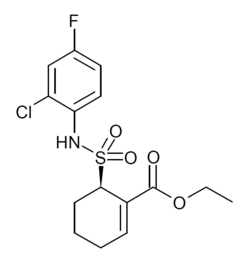
Resatorvid (TAK-242) is a cyclohexane derivative that was invented by scientists at Takeda in a drug discovery campaign to identify inhibitors of the receptor TLR4.1 It binds directly to cysteine residue 7471 intracellularly, preventing TLR4 binding with TIRAP and thus preventing downstream signal transduction.2
A randomized, double-blinded Phase III trial of resatorvid in sepsis was halted early due to lack of efficacy, and the compound has become a widely used tool compound in biological research.1
It has antiinflammatory and neuroprotective effects in preclinical models.3 It has been explored in preclinical studies of several forms of cancer, including multiple myeloma, breast cancer, and ovarian cancer,4 and has been suggested for study in skin cancers.5
Efforts have been made to improve resatorvid by making prodrugs and deuterated derivatives.3
References
References
- Wang X, Smith C, Yin H (June 2013). "Targeting Toll-like receptors with small molecule agents". Chemical Society Reviews. 42 (12): 4859–4866. doi:10.1039/c3cs60039d. PMC 3665707. PMID 23503527.
- Karimy JK, Reeves BC, Kahle KT (June 2020). "Targeting TLR4-dependent inflammation in post-hemorrhagic brain injury". Expert Opinion on Therapeutic Targets. 24 (6): 525–533. doi:10.1080/14728222.2020.1752182. PMC 8104018. PMID 32249624.
- Miller S, Blanco MJ (June 2021). "Small molecule therapeutics for neuroinflammation-mediated neurodegenerative disorders". RSC Medicinal Chemistry. 12 (6): 871–886. doi:10.1039/d1md00036e. PMC 8221257. PMID 34223157.
- Innao V, Rizzo V, Allegra AG, Musolino C, Allegra A (February 2021). "Promising Anti-Mitochondrial Agents for Overcoming Acquired Drug Resistance in Multiple Myeloma". Cells. 10 (2): 439. doi:10.3390/cells10020439. PMC 7922387. PMID 33669515.
- Dickinson SE, Wondrak GT (2018). "TLR4-directed Molecular Strategies Targeting Skin Photodamage and Carcinogenesis". Current Medicinal Chemistry. 25 (40): 5487–5502. doi:10.2174/0929867324666170828125328. PMID 28847267. S2CID 670318.
Further reading
Further reading
- Matsunaga N, Tsuchimori N, Matsumoto T, Ii M (January 2011). "TAK-242 (resatorvid), a small-molecule inhibitor of Toll-like receptor (TLR) 4 signaling, binds selectively to TLR4 and interferes with interactions between TLR4 and its adaptor molecules". Molecular Pharmacology. 79 (1): 34–41. doi:10.1124/mol.110.068064. PMID 20881006. S2CID 7818996.
- Samarpita S, Kim JY, Rasool MK, Kim KS (January 2020). "Investigation of toll-like receptor (TLR) 4 inhibitor TAK-242 as a new potential anti-rheumatoid arthritis drug". Arthritis Research & Therapy. 22 (1): 16. doi:10.1186/s13075-020-2097-2. PMC 6979396. PMID 31973752.
- Feng Y, Gao J, Cui Y, Li M, Li R, Cui C, Cui J (January 2017). "Neuroprotective Effects of Resatorvid Against Traumatic Brain Injury in Rat: Involvement of Neuronal Autophagy and TLR4 Signaling Pathway". Cellular and Molecular Neurobiology. 37 (1): 155–168. doi:10.1007/s10571-016-0356-1. PMC 11482083. PMID 26961544. S2CID 21583205.
- Dickinson SE, Wondrak GT (2019). "TLR4-directed Molecular Strategies Targeting Skin Photodamage and Carcinogenesis". Current Medicinal Chemistry. 25 (40): 5487–5502. doi:10.2174/0929867324666170828125328. PMID 28847267. S2CID 670318.
- Kashani B, Zandi Z, Karimzadeh MR, Bashash D, Nasrollahzadeh A, Ghaffari SH (December 2019). "Blockade of TLR4 using TAK-242 (resatorvid) enhances anti-cancer effects of chemotherapeutic agents: a novel synergistic approach for breast and ovarian cancers". Immunologic Research. 67 (6): 505–516. doi:10.1007/s12026-019-09113-8. PMID 32026322. S2CID 211048929.
- Zandi Z, Kashani B, Bashash D, Poursani EM, Mousavi SA, Chahardoli B, Ghaffari SH (February 2020). "The anticancer effect of the TLR4 inhibition using TAK-242 (resatorvid) either as a single agent or in combination with chemotherapy: A novel therapeutic potential for breast cancer". Journal of Cellular Biochemistry. 121 (2): 1623–1634. doi:10.1002/jcb.29397. PMID 31535397. S2CID 202689986.