In two-dimensional works of art, such as painting, printmaking, photography or bas-relief, repoussoir (French: [ʁəpuswaʁ], pushing back) is a figure or object along the right or left foreground that directs the viewer's eye into the composition by bracketing (framing) the edge and creating a greater sense of depth.1
It became popular with Mannerist and Baroque artists, and is found frequently in Dutch seventeenth-century landscape paintings. Jacob van Ruisdael, for example, often included a tree along one side to enclose the scene (see illustration). Figures are also commonly employed as repoussoir devices by artists such as Paolo Veronese, Peter Paul Rubens and Impressionists such as Gustave Caillebotte.2
- Examples of repoussoir
-
 Jacob Isaaksz. van Ruisdael, The Jewish Cemetery (1655–60, oil on canvas, 141 x 182.9 cm). The tree in the right-foreground of Ruisdael's painting is an example of repoussoir that pushes the viewer's eye into the composition.
 -
 The Four Philosophers (c. 1615. Oil on panel; 167 x 143 cm, Pitti Palace, Florence). In his friendship portrait of himself, his brother Philip Rubens, Justus Lipsius and Jan van den Wouwer (left to right), the Flemish painter Peter Paul Rubens's self-portrait on the left is an example of a figural repoussoir that is further accentuated by the flowing red curtain.
 -
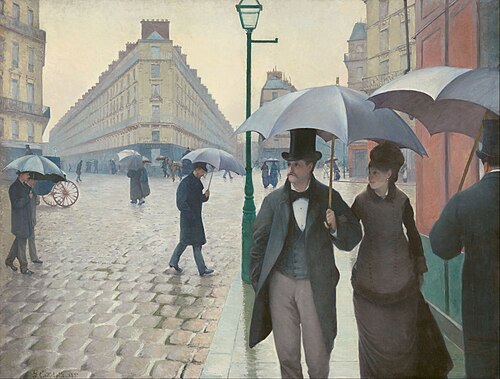 Gustave Caillebotte. Paris Street; Rainy Day (1877, Art Institute of Chicago). The rear-facing man on the right with the tilted umbrella is an example of repoussoir figure leading the viewer's gaze into the composition.
 -
![Georges Seurat, Gray Weather, Grande Jatte (1888, 71 × 66 cm, oil on canvas, Metropolitan Museum of Art). In a similar manner to the van Ruisdael piece, the tree that takes up the entire right edge of this work is an example of repoussoir.[3]](/weird-wikipedia/img/c/a7/a706141e50e94985.jpg) Georges Seurat, Gray Weather, Grande Jatte (1888, 71 × 66 cm, oil on canvas, Metropolitan Museum of Art). In a similar manner to the van Ruisdael piece, the tree that takes up the entire right edge of this work is an example of repoussoir.3
Georges Seurat, Gray Weather, Grande Jatte (1888, 71 × 66 cm, oil on canvas, Metropolitan Museum of Art). In a similar manner to the van Ruisdael piece, the tree that takes up the entire right edge of this work is an example of repoussoir.3
References
References
- Chilvers, Ian (2015). "Repoussoir". The Oxford Dictionary of Art and Artists (5th ed.). Oxford University Press.
- Wind, Edgar (October 1938). "The revolution of history painting". Journal of the Warburg Institute. 2 (2): 117. doi:10.2307/750085. JSTOR 750085. S2CID 195030759.
He fulfils the function of a 'repoussoir', and by leading the imagination into a distant land, effectively offsets the shock of seeing the hero die in a modern uniform.
- Foa, Michelle; Seurat, Georges (2015). Georges Seurat: The Art of Vision. New Haven, Conn.: Yale University Press. pp. 105–107. ISBN 978-0-300-20835-1.