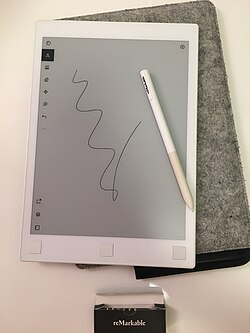
 First generation reMarkable tablet with sleeve and pen | |
| Manufacturer | reMarkable |
|---|---|
| Type | e-reader |
| Display | E-Ink |
| Website | remarkable |
reMarkable is a range of E Ink writing tablet for reading documents and textbooks, sketching and note-taking that attempts to fully replicate paper writing.1 Developed by a Norwegian startup company of the same name, the devices are geared towards students, academics and professionals.23
reMarkable uses electronic paper reading displays and tablet computer writing system.4
Writing Tablets
Current
Paper Pure
Medium sized device with greyscale display. Replaces Remarkable 2.
Paper Pro
Large format colour device with reading light5
Paper Pro Move
Smallest tablet in the range, featuring a colour display and front light6
Discontinued
ReMarkable 2
An iteration on its predecessor, it was marketed as the 'World's Thinnest Tablet' 7
ReMarkable
The original product. Features greyscale display.
| Legend: | Unsupported | Discontinued | Current |
|---|
| Name | Model | Display | Storage | CPU | RAM | Connectivity | Stylus | Dimensions | Weight | Battery | Released | ||
|---|---|---|---|---|---|---|---|---|---|---|---|---|---|
| Type | Size | Resolution | Internal | Make and model | USB + | H x W x D | |||||||
| ReMarkable | RM100 | E-ink | 10.3" | 1872 × 1404 | 8 GB | 1 GHz ARM A9 | 512 MB | USB microB | Unpowered | 256 × 177 x 6.7 mm | 350 g | 3000 mAh | Late 2017 |
| ReMarkable 2 | RM110 | E-ink | 10.3" | 1872 × 1404 | 8 GB | 1.2 GHz Dual Core ARM A9 | 1 GB | USB-C | Unpowered | 246 x 187 x 4.7 mm | 403 g | 3000 mAh | March 2020 |
| Paper Pure | E-ink | 10.3" | 1872 × 1404 | 32 GB | 1.7 GHz Dual Core ARM A55 | 2 GB | USB-C | 228 x 187 x 6 mm | 360 g | 3820 mAh | May 2026 | ||
| Paper Pro | E-ink Kaliedo | 11.8" | 2160 x 1620 | 64 GB | 1.8 GHz quad-core Cortex A53 | 2 GB | USB-C | 274.1 x 196.6 x 5.1 mm | 525 g | 5030 mAh | September 2024 | ||
| Paper Pro Move | E-ink Kaliedo | 7.3" | 1696 x 954 | 64 GB | 1.7 GHz Dual Core ARM A55 | 2 GB | USB-C | 195.6 x 107.8 x 6.5 mm | 230 g | 2334 mAh | September 2025 | ||
Operating system
ReMarkable uses its own operating system, named Codex. Codex is based on Linux and is optimized for electronic paper display technology.8
Community support
As Codex is based on Linux and an open source ecosystem, it has gained community projects and 3rd party software for it. The device is accessible through SSH, allowing the installation of 3rd party software.9 Many packages are accessible through Toltec, a community-maintained free software repository.10 The Cloud system has been reverse engineered and an open source alternative has been created.11
Alternative operating systems
An alternative free operating system, Parabola-rM, has been made to replace Codex.12 Parabola-rM aims to turn the device into a full-fledged computer, allowing typical desktop Linux applications to be run,13 with the caveat that this is not a supported configuration.14
Reception
Of the first generation of the tablet, Remarkable 1 (or ReMarkable RM100 as known by its model number), launched in late 2017, suffered some criticism due to sluggishness when loading and unloading files.15
The Bad Voltage podcast stated, the lack of integrations with other software limits the device's usefulness for taking notes for some users,16 and there is no official third-party app ecosystem, but the ability to add software via unofficial hacks offers interesting possibilities.1718
The second generation Remarkable 2 was released in May 2020, and a review by Wired, stated it "excels at taking your handwritten notes, but it doesn't do much else well."19 Other media outlets have seen the lack of a distraction or ability to do much else as positives.20
-
 A PDF file on the reMarkable annotated with the passive pen
 -
 Size of the reMarkable tablet compared to A4 and A5 sheets of paper
 -
 Second generation reMarkable 2 with Wikipedia Article about reMarkable
References
References
- Hands on with the reMarkable, the closest thing to paper since paper
- reMarkable paper tablet for sketching, writing: PHOTOS - Business Insider
- "Review: ReMarkable 2 tablet a fine business tool".
- Gartenberg, Chaim (2020-08-27). "The reMarkable 2 is the latest attempt to turn your paper notepad digital". The Verge. Retrieved 2023-01-31.
- reMarkable (2024-09-04). reMarkable Paper Pro | Launch event. Retrieved 2024-09-08 – via YouTube.
- "reMarkable Paper Pro Move". remarkable.com. Retrieved 2025-12-18.
- Chris Taylor (27 August 2020). "ReMarkable 2 review: A magic legal pad from the future". mashable.com. Retrieved 21 December 2020.
- Henry T. Casey (15 September 2017). "reMarkable Tablet Review". Laptop Magazine. Retrieved 8 June 2019.
reMarkable uses Codex, its own OS. This is a custom version of Linux that's optimized for low-latency e-paper.
- "tech:ssh [reMarkableWiki]". remarkablewiki.com. Retrieved 2022-10-10.
- "Toltec". 2022-10-10.
- Känel, Dobrin von (2022-10-10), rmfakecloud, retrieved 2022-10-10
- "Parabola-rM". 2022-10-10.
- Linder, Brad (2022-10-10). "Turn the Remarkable ePaper tablet into a Linux PC with Parabola rM".
- Remmel, Davis (2020). Parabola on reMarkable: A Guide (PDF).
- Liszewski, Andrew. "The reMarkable E Ink Tablet Is Way Too Good For Its Software (and Price)". Gizmodo. Retrieved 2 June 2014.
- Langridge, Stuart; Bacon, Jono; Garcia, Jeremy (21 January 2021). "Poetry in Notion". Bad Voltage. 5 minutes in. Retrieved 21 January 2021.
- Langridge, Stuart; Bacon, Jono; Garcia, Jeremy (21 January 2021). "Poetry in Notion". Bad Voltage. 36 minutes in. Retrieved 21 January 2021.
- "remarkable-hacks". rM Hacks on Github. Retrieved 2 August 2021.
- Louryn Strampe (9 September 2020). "Review: reMarkable 2". wired.com. Retrieved 21 December 2020.
- "ReMarkable 2 Review: No-frills productivity and creativity without distractions". Daily Mirror. 24 January 2023.
