| Red serow1 | |
|---|---|
| |
Scientific classification 
| |
| Kingdom: | Animalia |
| Phylum: | Chordata |
| Class: | Mammalia |
| Infraclass: | Placentalia |
| Order: | Artiodactyla |
| Family: | Bovidae |
| Subfamily: | Caprinae |
| Genus: | Capricornis |
| Species: | C. rubidus
|
| Binomial name | |
| Capricornis rubidus (Blyth, 1863)
| |
| |
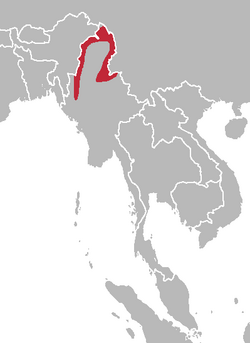
| Distribution of red serow | |
| Synonyms | |
| |
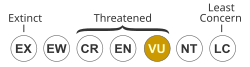
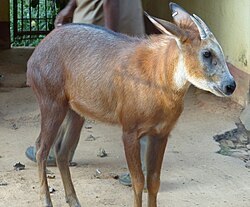
The red serow (Capricornis rubidus), also called the Burmese red serow,2 is a goat-antelope thought to be native to southern Bangladesh and northern Myanmar.1 It sometimes has been considered a subspecies of C. sumatraensis.1 In the northeastern part of India, the red serow occurs widely in the hills south of the Brahmaputra river.45 although the IUCN states that this species is recorded with certainty only from Myanmar, in Kachin State, and that records in India refer to the Himalayan serow.2Serow in South and Southeast Asia are threatened by habitat destruction, poaching, and disease transmission from domestic livestock. Myanmar and India face severe poaching issues despite legal protections.6
In December 2023, a red serow was found in Sunamganj District of Sylhet Forest Division in north-eastern Bangladesh.7
References
References
- Grubb, P. (2005). Wilson, D. E.; Reeder, D. M. (eds.). Mammal Species of the World: A Taxonomic and Geographic Reference (3rd ed.). Baltimore, MD: Johns Hopkins University Press. p. 704. ISBN 0-8018-8221-4. OCLC 62265494.
- Shepard, C. (2022) [amended version of 2021 assessment]. "Capricornis rubidus". IUCN Red List of Threatened Species. 2022 e.T3815A214430673. doi:10.2305/IUCN.UK.2022-1.RLTS.T3815A214430673.en. Retrieved 31 August 2022.
- "Appendices | CITES". cites.org. Retrieved 2022-01-14.
- Choudhury, A.U. (1997). Checklist of the mammals of Assam (Revised 2nd ed.). Guwahati, India: Gibbon Books & Assam Science Technology & Environment Council. pp. 103pp. ISBN 81-900866-0-X.
- Choudhury, A.U (2003). "Status of serow (Capricornis sumatraensis) in Assam" (PDF). Tigerpaper. 30 (2): 1–2.
- "Redlist - Burmese Red Serow".
- Deshwara, Mintu (2023-12-27). "Rare red serow rescued in Sunamganj". The Daily Star. Retrieved 2023-12-28.