Article · Wikipedia archive · Last revised Jun 6, 2026

Rectangular mask short-time Fourier transform

In mathematics and Fourier analysis, a rectangular mask short-time Fourier transform (rec-STFT) is a simplified form of the short-time Fourier transform which is used to analyze how a signal's frequency content changes over time. In rec-STFT, a rectangular window is used to isolate short time segments of the signal. Other types of the STFT may require more computation time than the rec-STFT.

Last revised
Jun 6, 2026
Read time
≈ 4 min
Length
979 w
Citations
Source

In mathematics and Fourier analysis, a rectangular mask short-time Fourier transform (rec-STFT) is a simplified form of the short-time Fourier transform which is used to analyze how a signal's frequency content changes over time. In rec-STFT, a rectangular window (a simple on/off time-limiting function) is used to isolate short time segments of the signal. Other types of the STFT may require more computation time ( refers to the amount of time it takes a computer or algorithm to perform a calculation or complete a task) than the rec-STFT.

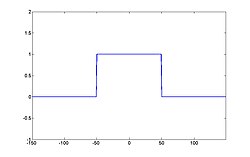
The rectangular mask function can be defined for some bound (B) over time (t) as

w ( t ) = {   1 ; | t | B   0 ; | t | > B {\displaystyle w(t)={\begin{cases}\ 1;&|t|\leq B\\\ 0;&|t|>B\end{cases}}}
B = 50, x-axis (sec) source ↗

We can change B for different tradeoffs between desired time resolution and frequency resolution.

Rec-STFT

X ( t , f ) = t B t + B x ( τ ) e j 2 π f τ d τ {\displaystyle X(t,f)=\int _{t-B}^{t+B}x(\tau )e^{-j2\pi f\tau }\,d\tau }

Inverse form

x ( t ) = X ( t 1 , f ) e j 2 π f t d f  where  t B < t 1 < t + B {\displaystyle x(t)=\int _{-\infty }^{\infty }X(t_{1},f)e^{j2\pi ft}\,df{\text{ where }}t-B<t_{1}<t+B}

Property

Rec-STFT has similar properties with Fourier transform

  • Integration

(a)

X ( t , f ) d f = t B t + B x ( τ ) e j 2 π f τ d f d τ = t B t + B x ( τ ) δ ( τ ) d τ = {   x ( 0 ) ; | t | < B   0 ; otherwise {\displaystyle \int _{-\infty }^{\infty }X(t,f)\,df=\int _{t-B}^{t+B}x(\tau )\int _{-\infty }^{\infty }e^{-j2\pi f\tau }\,df\,d\tau =\int _{t-B}^{t+B}x(\tau )\delta (\tau )\,d\tau ={\begin{cases}\ x(0);&|t|<B\\\ 0;&{\text{otherwise}}\end{cases}}}

(b)

X ( t , f ) e j 2 π f v d f = {   x ( v ) ; v B < t < v + B   0 ; otherwise {\displaystyle \int _{-\infty }^{\infty }X(t,f)e^{-j2\pi fv}\,df={\begin{cases}\ x(v);&v-B<t<v+B\\\ 0;&{\text{otherwise}}\end{cases}}}
  • Shifting property (shift along x-axis)
t B t + B x ( τ + τ 0 ) e j 2 π f τ d τ = X ( t + τ 0 , f ) e j 2 π f τ 0 {\displaystyle \int _{t-B}^{t+B}x(\tau +\tau _{0})e^{-j2\pi f\tau }\,d\tau =X(t+\tau _{0},f)e^{j2\pi f\tau _{0}}}
  • Modulation property (shift along y-axis)
t B t + B [ x ( τ ) e j 2 π f 0 τ ] d τ = X ( t , f f 0 ) {\displaystyle \int _{t-B}^{t+B}[x(\tau )e^{j2\pi f_{0}\tau }]d\tau =X(t,f-f_{0})}
  • special input
  1. When x ( t ) = δ ( t ) , X ( t , f ) = {   1 ; | t | < B   0 ; otherwise {\displaystyle x(t)=\delta (t),X(t,f)={\begin{cases}\ 1;&|t|<B\\\ 0;&{\text{otherwise}}\end{cases}}}
  2. When x ( t ) = 1 , X ( t , f ) = 2 B sinc ( 2 B f ) e j 2 π f t {\displaystyle x(t)=1,X(t,f)=2B\operatorname {sinc} (2Bf)e^{j2\pi ft}}
  • Linearity property

If h ( t ) = α x ( t ) + β y ( t ) {\displaystyle h(t)=\alpha x(t)+\beta y(t)\,} , H ( t , f ) , X ( t , f ) , {\displaystyle H(t,f),X(t,f),} and Y ( t , f ) {\displaystyle Y(t,f)\,} are their rec-STFTs, then

H ( t , f ) = α X ( t , f ) + β Y ( t , f ) . {\displaystyle H(t,f)=\alpha X(t,f)+\beta Y(t,f).}
  • Power integration property
| X ( t , f ) | 2 d f = t B t + B | x ( τ ) | 2 d τ {\displaystyle \int _{-\infty }^{\infty }|X(t,f)|^{2}\,df=\int _{t-B}^{t+B}|x(\tau )|^{2}\,d\tau }
| X ( t , f ) | 2 d f d t = 2 B | x ( τ ) | 2 d τ {\displaystyle \int _{-\infty }^{\infty }\int _{-\infty }^{\infty }|X(t,f)|^{2}\,df\,dt=2B\int _{-\infty }^{\infty }|x(\tau )|^{2}\,d\tau }
X ( t , f ) Y ( t , f ) d f = t B t + B x ( τ ) y ( τ ) d τ {\displaystyle \int _{-\infty }^{\infty }X(t,f)Y^{*}(t,f)\,df=\int _{t-B}^{t+B}x(\tau )y^{*}(\tau )\,d\tau }
X ( t , f ) Y ( t , f ) d f d t = 2 B x ( τ ) y ( τ ) d τ {\displaystyle \int _{-\infty }^{\infty }\int _{-\infty }^{\infty }X(t,f)Y^{*}(t,f)\,df\,dt=2B\int _{-\infty }^{\infty }x(\tau )y^{*}(\tau )\,d\tau }

Example of tradeoff with different B

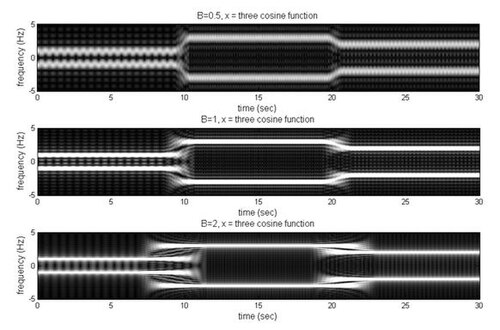
Spectrograms produced from applying a rec-STFT on a function consisting of 3 consecutive cosine waves. (top spectrogram uses smaller B of 0.5, middle uses B of 1, and bottom uses larger B of 2.) source ↗

From the image, when B is smaller, the time resolution is better. Otherwise, when B is larger, the frequency resolution is better.

Advantage and disadvantage

Compared with the Fourier transform:

  • Advantage: The instantaneous frequency can be observed.
  • Disadvantage: Higher complexity of computation.

Compared with other types of time-frequency analysis:

  • Advantage: Least computation time for digital implementation.
  • Disadvantage: Quality is worse than other types of time-frequency analysis. The jump discontinuity of the edges of the rectangular mask results in Gibbs ringing artifacts in the frequency domain, which can be alleviated with smoother windows.
See also

See also

References

References

  1. Jian-Jiun Ding (2014) Time-frequency analysis and wavelet transform