Article · Wikipedia archive · Last revised Jul 3, 2026

Reciprocal distribution

In probability and statistics, the reciprocal distribution, also known as the log-uniform distribution, is a continuous probability distribution. It is characterised by its probability density function, within the support of the distribution, being proportional to the reciprocal of the variable.

Last revised
Jul 3, 2026
Read time
≈ 3 min
Length
622 w
Citations
1
Source
Reciprocal
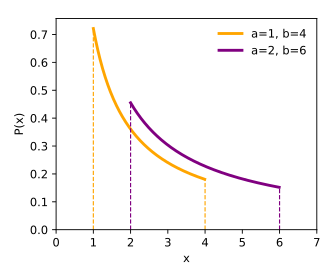
Probability density function
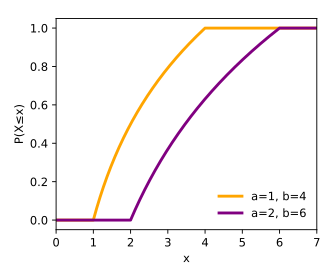
Cumulative distribution function
Parameters 0 < a < b , a , b R {\displaystyle 0<a<b,a,b\in \mathbb {R} }
Support [ a , b ] {\displaystyle [a,b]}
PDF 1 x ln b a {\displaystyle {\frac {1}{x\ln {\frac {b}{a}}}}}
CDF ln x a ln b a {\displaystyle {\frac {\ln {\frac {x}{a}}}{\ln {\frac {b}{a}}}}}
Mean b a ln b a {\displaystyle {\frac {b-a}{\ln {\frac {b}{a}}}}}
Median a b {\displaystyle {\sqrt {ab}}}
Mode a {\displaystyle a}
Variance b 2 a 2 2 ln b a ( b a ln b a ) 2 {\displaystyle {\frac {b^{2}-a^{2}}{2\ln {\frac {b}{a}}}}-\left({\frac {b-a}{\ln {\frac {b}{a}}}}\right)^{2}}
Entropy ln ( ln ( b a ) ) + ln ( b ) 2 ln ( a ) 2 2 ln ( b a ) {\displaystyle \ln \left(\ln \left({\frac {b}{a}}\right)\right)+{\frac {\ln \left(b\right)^{2}-\ln \left(a\right)^{2}}{2\ln \left({\frac {b}{a}}\right)}}}
MGF E i ( b t ) E i ( a t ) ln ( b ) ln ( a ) {\displaystyle {\frac {{\rm {Ei}}(bt)-{\rm {Ei}}(at)}{\ln \left(b\right)-\ln \left(a\right)}}}
CF E i ( i b t ) E i ( i a t ) ln ( b ) ln ( a ) {\displaystyle {\frac {{\rm {Ei}}(ibt)-{\rm {Ei}}(iat)}{\ln \left(b\right)-\ln \left(a\right)}}}

In probability and statistics, the reciprocal distribution, also known as the log-uniform distribution, is a continuous probability distribution. It is characterised by its probability density function, within the support of the distribution, being proportional to the reciprocal of the variable.

The reciprocal distribution is an example of an inverse distribution, and the reciprocal (inverse) of a random variable with a reciprocal distribution itself has a reciprocal distribution.

Definition

The probability density function (pdf) of the reciprocal distribution is

f ( x ; a , b ) = 1 x [ ln ( b ) ln ( a ) ]  for  a x b  and  a > 0. {\displaystyle f(x;a,b)={\frac {1}{x[\ln(b)-\ln(a)]}}\quad {\text{ for }}a\leq x\leq b{\text{ and }}a>0.}

Here, a {\displaystyle a} and b {\displaystyle b} are the parameters of the distribution, which are the lower and upper bounds of the support, and ln {\displaystyle \ln } is the natural log. The cumulative distribution function is

F ( x ; a , b ) = ln ( x ) ln ( a ) ln ( b ) ln ( a )  for  a x b . {\displaystyle F(x;a,b)={\frac {\ln(x)-\ln(a)}{\ln(b)-\ln(a)}}\quad {\text{ for }}a\leq x\leq b.}

Characterization

Relationship between the log-uniform and the uniform distribution
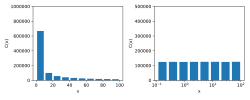
Histogram and log-histogram of random deviates from the reciprocal distribution source ↗

A positive random variable X is log-uniformly distributed if the logarithm of X is uniform distributed,

ln ( X ) U ( ln ( a ) , ln ( b ) ) . {\displaystyle \ln(X)\sim {\mathcal {U}}(\ln(a),\ln(b)).}

This relationship is true regardless of the base of the logarithmic or exponential function. If log a ( Y ) {\displaystyle \log _{a}(Y)} is uniform distributed, then so is log b ( Y ) {\displaystyle \log _{b}(Y)} , for any two positive numbers a , b 1 {\displaystyle a,b\neq 1} . Likewise, if e X {\displaystyle e^{X}} is log-uniform distributed, then so is a X {\displaystyle a^{X}} , where 0 < a 1 {\displaystyle 0<a\neq 1} .

Applications

The reciprocal distribution is of considerable importance in numerical analysis, because a computer’s arithmetic operations, in particular, repeated multiplications and/or divisions, transform mantissas with initial arbitrary distributions into the reciprocal distribution as a limiting distribution.1

References

References

  1. Hamming R. W. (1970) "On the distribution of numbers", The Bell System Technical Journal 49(8) 1609–1625