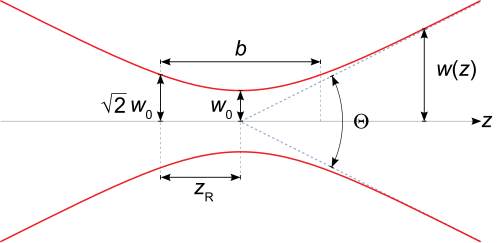
In optics and especially laser science, the Rayleigh length or Rayleigh range, , is the distance along the propagation direction of a beam from the waist to the place where the area of the cross section is doubled.1 A related parameter is the confocal parameter, b, which is twice the Rayleigh length.2 The Rayleigh length is particularly important when beams are modeled as Gaussian beams.
Explanation
For a Gaussian beam propagating in free space along the axis with wave number , the Rayleigh length is given by2
where is the wavelength (the vacuum wavelength divided by , the index of refraction) and is the beam waist, the radial size of the beam at its narrowest point. This equation and those that follow assume that the waist is not extraordinarily small; .3
The radius of the beam at a distance from the waist is4
The minimum value of occurs at , by definition. At distance from the beam waist, the beam radius is increased by a factor and the cross sectional area by 2.
Related quantities
The total angular spread of a Gaussian beam in radians is related to the Rayleigh length by1
The diameter of the beam at its waist (focus spot size) is given by
- .
These equations are valid within the limits of the paraxial approximation. For beams with much larger divergence the Gaussian beam model is no longer accurate and a physical optics analysis is required.
See also
See also
References
References
- Siegman, A. E. (1986). Lasers. University Science Books. pp. 664–669. ISBN 0-935702-11-3.
- Damask, Jay N. (2004). Polarization Optics in Telecommunications. Springer. pp. 221–223. ISBN 0-387-22493-9.
- Siegman (1986) p. 630.
- Meschede, Dieter (2007). Optics, Light and Lasers: The Practical Approach to Modern Aspects of Photonics and Laser Physics. Wiley-VCH. pp. 46–48. ISBN 978-3-527-40628-9.
- Rayleigh length RP Photonics Encyclopedia of Optics