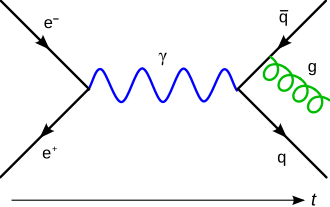
In particle physics, a radiative process refers to one elementary particle emitting another and continuing to exist.1 This typically happens when a fermion emits a boson such as a gluon or photon.
References
References
- Rouan, Daniel (2011), Gargaud, Muriel; Amils, Ricardo; Quintanilla, José Cernicharo; Cleaves, Henderson James (Jim) (eds.), "Radiative Processes", Encyclopedia of Astrobiology, Berlin, Heidelberg: Springer, pp. 1407–1410, doi:10.1007/978-3-642-11274-4, ISBN 978-3-642-11274-4, retrieved 2024-11-05
{{citation}}: CS1 maint: work parameter with ISBN (link)