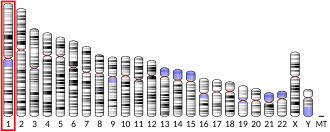



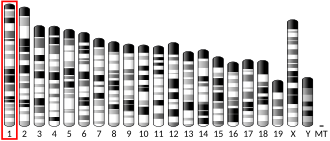

Ras-related protein Rab-7b is a protein that in humans is encoded by the RAB7B gene.5
Function
Rab7 is a small GTPase that plays a role in the transport and degradation of proteins in endosomes and lysosomes in mammalian cells. Rab7b, is localized to lysosome-associated compartments and is selectively expressed in monocytic cells.6 By promoting the degradation of toll-like receptor 4, RAB7B can negatively regulate the inflammatory activation of macrophages.6
References
References
- GRCh38: Ensembl release 89: ENSG00000276600 – Ensembl, May 2017
- GRCm38: Ensembl release 89: ENSMUSG00000052688 – Ensembl, May 2017
- "Human PubMed Reference:". National Center for Biotechnology Information, U.S. National Library of Medicine.
- "Mouse PubMed Reference:". National Center for Biotechnology Information, U.S. National Library of Medicine.
- Yang M, Chen T, Han C, Li N, Wan T, Cao X (June 2004). "Rab7b, a novel lysosome-associated small GTPase, is involved in monocytic differentiation of human acute promyelocytic leukemia cells". Biochem. Biophys. Res. Commun. 318 (3): 792–9. doi:10.1016/j.bbrc.2004.04.115. PMID 15144907.
- Wang Y, Chen T, Han C, He D, Liu H, An H, Cai Z, Cao X (August 2007). "Lysosome-associated small Rab GTPase Rab7b negatively regulates TLR4 signaling in macrophages by promoting lysosomal degradation of TLR4". Blood. 110 (3): 962–71. doi:10.1182/blood-2007-01-066027. PMID 17395780. S2CID 28664736.
Further reading
Further reading
- Bonaldo MF, Lennon G, Soares MB (1996). "Normalization and subtraction: two approaches to facilitate gene discovery". Genome Res. 6 (9): 791–806. doi:10.1101/gr.6.9.791. PMID 8889548.
- Strausberg RL, Feingold EA, Grouse LH, et al. (2002). "Generation and initial analysis of more than 15,000 full-length human and mouse cDNA sequences". Proc. Natl. Acad. Sci. U.S.A. 99 (26): 16899–903. Bibcode:2002PNAS...9916899M. doi:10.1073/pnas.242603899. PMC 139241. PMID 12477932.
- Kimura K, Wakamatsu A, Suzuki Y, et al. (2006). "Diversification of transcriptional modulation: large-scale identification and characterization of putative alternative promoters of human genes". Genome Res. 16 (1): 55–65. doi:10.1101/gr.4039406. PMC 1356129. PMID 16344560.
- Gerhard DS, Wagner L, Feingold EA, et al. (2004). "The status, quality, and expansion of the NIH full-length cDNA project: the Mammalian Gene Collection (MGC)". Genome Res. 14 (10B): 2121–7. doi:10.1101/gr.2596504. PMC 528928. PMID 15489334.
- Ota T, Suzuki Y, Nishikawa T, et al. (2004). "Complete sequencing and characterization of 21,243 full-length human cDNAs". Nat. Genet. 36 (1): 40–5. doi:10.1038/ng1285. PMID 14702039.