 | |
Company type | Private company |
|---|---|
| Industry | Quantum Computing |
| Founded | 2018 (2018) |
| Founders |
|
| Headquarters | , United States |
Key people |
|
| Products |
|
| Website | www |
QuEra Computing Inc. is a quantum computing company based in Boston, Massachusetts. The company develops quantum computers using neutral atoms based on research conducted at both Harvard University and MIT. QuEra also develops software for simulating systems of Rydberg atoms12 and finding solutions to combinatorial optimization problems.3
History
QuEra Computing was founded by Mikhail Lukin, Vladan Vuletić, Markus Greiner, Dirk Englund, Nathan Gemelke, and John Pena in 2018.2
Prior to QuEra's founding, research into using and controlling neutral atoms had already started in 2015 at Harvard and MIT, culminating in a 51-qubit machine4 which later led to the development of a 256-qubit machine.5
On October 24, 2024, the Massachusetts Green High Performance Computing Center announced a $16 million expansion to its computing campus, planning to build a quantum computing complex. QuEra Computing was announced as a partner in the project.6
On June 3, 2025, QuEra opened a 3,500 sq. ft. flagship UK hub in Harwell Science and Innovation Campus’ Tech Foundry. This builds upon QuEra’s existing collaboration with the National Quantum Computing Centre (NQCC) and supports the company’s expansion through the UK and across Europe.7
On February 4, 2026, the National Energy Research Scientific Computing Center (NERSC) at Lawrence Berkeley National Lab (Berkeley Lab) called for proposals as part of its Quantum Computing Access at NERSC (QCAN) program to conduct research on QuEra’s Aquila and Gemini. Up to six projects will be selected for the three-month Stage A, to commence in April 2026 to demonstrate the potential to run on real hardware. Aquila teams will be allocated up to 12.5 hours of QPU usage each while Gemini teams will focus on simulation and workflow development instead of hardware usage. Aquila teams that advance to Stage B will be allocated up to 25 hours of additional QPU time each to complete their research, while Gemini teams will be allocated up to 10 hours of QPU time each. If any teams do not advance, their QPU time will be redistributed to advancing teams. Projects will be completed by December 31, 2026.8
Technology
System architecture and design
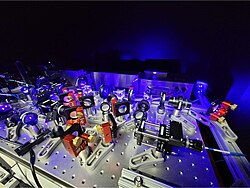
QuEra uses neutral atoms based on Rubidium which are controlled and trapped using lasers9 as its qubits. The company commercializes a neutral atom array developed in Mikhail Lukin’s lab through a licensing agreement with Harvard’s Office of Technology Development for the Lukin group’s patent portfolio. Ultra-cold, suspended rubidium atoms move about and can be entangled mid-computation to perform gates. Logical operations involve the parallel, multiplexed, laser control of the entire groups of atoms that constitute logical qubits.10
QuEra was selected by the Defense Advanced Research Projects Agency (DARPA) to participate in Stage B of the Quantum Benchmarking Initiative (QBI), joining ten other leading companies in the quantum computing industry.11 This selection follows QuEra's successful completion of Stage A, which required participants to outline a path to developing utility-scale quantum computers. The QBI program seeks to assess whether a practical, industrially useful quantum computer can be realized by 2033.
Analog computing mode
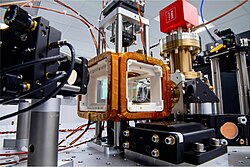
On November 1, 2022, QuEra released its 256-qubit machine Aquila, to the general public through the Amazon cloud service Braket.1213
QuEra currently supports an analog computing mode that relies on the Rydberg blockade phenomenon and the position of atoms to achieve superposition and entanglement. The analog mode could allow problems such as the Maximum Weight Independent set (graph theory) (MWIS) to be expressed and solved with research from the company to map other problems onto MWIS as well1415 QuEra actively conducts research in Condensed Matter Physics16 and combinatorial optimization.17 A QRC Tutorials repository was created on June 10, 2024, providing a set of tutorials for learning quantum reservoir computing (QRC).18
Digital computing mode
On January 9, 2024, QuEra published a three-year roadmap. It showed >256 atoms with 10 logical qubits and transversal gates in 2024, >3,000 atoms with 30 logical qubits and magic state distillation in 2025, and >10,000 atoms with 100 logical qubits in 2026. The logical qubits were defined as having lower error rates than their constituent physical qubits. A cloud-based logical qubit simulator was due in the first half of 2024.19
QuEra planned to offer a hybrid analog-digital quantum computer followed by a fully digital gate-based system.2 The analog Aquila is typically capable of three shots per second, while the digital Gemini is typically capable of one shot per second.20
Products and systems
Aquila
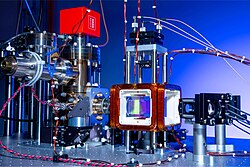
Aquila is a programmable quantum simulator that uses highly focused lasers to trap and precisely arrange individual ultracold rubidium atoms into two-dimensional arrays of up to 256 qubits. A spatial light modulator shapes an optical two-dimensional wavefront, which transforms light into optical tweezers. A first set of optical tweezers loads atoms into a random arrangement, then a second set moves them into a defect-free antiferromagnetic arrangement in which each atom has the opposite magnetic moment of its neighbors, and then coherent optical beams are used to excite the atoms into Rydberg states. Atomic interactions are used to perform Analog Hamiltonian Simulation (AHS).21
Gemini
Gemini is a 260-atom gate-model quantum computer using 87Rubidium with a dynamic qubit array (DQA™) that allows parallel operations and all-to-all connectivity with room temperature operation. There is a storage zone and an entanglement zone for gate operations. Single-qubit gate fidelity is >99.9% fidelity, two-qubit gate fidelity is >99.2%, and SPAM fidelity is 99.7%. The shot rate is one per second. “Gemini” has been used to demonstrate magic state distillation and is designed for hybrid computing with high-performance computing (HPC) and analog systems.22
Bloqade
Bloqade is QuEra's software stack. Bloqade.jl is an open-source Julia language package for analog quantum computation and simulation on QuEra’s “Aquila.” The repository was created on October 20, 2021. 23 Bloqade Analog is an open-source Python language software development kit (SDK) for “Aquila.” The repository was created on April 18, 2023. 24 Bloqade is an open-source Python language software development kit (SDK) for digital and analog neutral atom quantum computing. The repository was created on January 21, 2025.25 Bloqade Circuit is an open-source component package of Bloqade containing its circuit eDSLs. The repository was created on April 3, 2025.26
Kirin
Kirin is an open-source Kernel Intermediate Representation Infrastructure for building compilers for embedded domain-specific languages (eDSLs). The repository was created on October 5, 2024. 27
Research
Quantum error correction
On December 8, 2023, a Harvard team led by QuEra co-founder Mikhail Lukin published in Nature the demonstration of 48 logical qubits capable of executing hundreds of logical gate operations. The team included QuEra co-founder Markus Greiner and QuEra. The research was supported by the Defense Advanced Research Projects Agency’s (DARPA) Optimization with Noisy Intermediate-Scale Quantum devices program, the National Science Foundation Physics Frontiers Center’s Center for Ultracold Atoms, the Army Research Office, the joint Quantum Institute/NIST, and QuEra. 2829
On November 10, 2025, researchers from Harvard, CalTech, MIT, the Harvard-Smithsonian Center for Astrophysics, NIST/University of Maryland, College Park, and QuEra, published in Nature the demonstration of below-threshold error suppression, logical entanglement, and mid-circuit qubit reuse using surface codes with reconfigurable arrays of up to 448 neutral atoms encoded in up to 96 logical qubits.30
Neutral-atom system scaling
On September 15, 2025, researchers from Harvard and MIT, including QuEra co-founders Mikhail Lukin, Markus Greiner, and Vladan Vuletić published in Nature the demonstration of a coherent 3,000-qubit system with coherent storage and quantum information manipulation. A series of two optical lattice conveyor belts transport atom reservoirs into the science region, where atoms in spin-polarized or coherent superposition states are extracted into optical tweezers at a reloading rate of 300,000 atoms per second. The 30,000+ initialized qubits per second are used to assemble and maintain a 3,000+ atomic array for more than 2 hours. Nearby stored qubits are unaffected.31
Application and algorithm development
In May 2025, it was announced that two of the six research projects advancing to the final phase of Wellcome Leap's Quantum for Bio Challenge involved QuEra. One, in collaboration with Phasecraft and the University of Nottingham, concerns drug discovery targeting myotonic dystrophy. The other, in collaboration with Harvard University and MIT, concerns nuclear magnetic resonance and ligand-protein binding affinity estimation.32
On August 5, 2025, QuEra published in the National Library of Medicine “Robust Quantum Reservoir Learning for Molecular Property Prediction” with authors from Deloitte Consulting LLP, Amgen, Technical University of Darmstadt, and Merck Healthcare KGaA. Quantum reservoir computing (QRC) was applied to use molecular descriptors to predict the biological activity of potential drug molecules, finding advantages as dataset sizes decrease and better separability between active and inactive compounds in low-dimensional learned feature spaces.33
On September 11, 2025, following the NVentures investment in QuEra, the company’s collaborations with Nvidia were revealed to be: Gemini is integrated with Nvidia’s CUDA-Q software alongside ABCI-Q’s 2,000+ H100 GPUs; QuEra is a founding collaborator at Nvidia's Accelerated Quantum Center in Boston, coupling its hardware with GB200 NVL72 GPU clusters for large-scale simulation and decoder research; and the co-development of Nvidia-trained transformer models for quantum error correction (QEC).34
Deployments and partnerships
Unrelated to the aforementioned Quantum Benchmarking Initiative, on October 23, 2023, QuEra was awarded two Defense Advanced Research Projects Agency (DARPA) Imagining Practical Applications for a Quantum Tomorrow (IMPAQT) contracts for quantum algorithms. The first, “Quantum Reservoir Learning using Neutral Atoms and its Applications,” extended a previous quantum machine learning proof-of-concept involving the MNIST handwritten digit dataset. The second, “Error-Corrected Quantum Architectures Based on Transversal Logical Gates,” involved surface codes with the use of transversal logical entangling gates. Five of QuEra’s partners also received DARPA IMPAQT grants for their projects involving QuEra’s Aquila.35
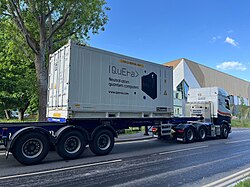
On February 5, 2024, QuEra announced that the UK’s National Quantum Computing Centre (NQCC) at Harwell, Oxfordshire, with support from the Small Business Research Initiative (SBRI) framework, would host a qubit shuttling and error correction testbed to be built by QuEra and UK-based collaborators in early 2025.36
On April 30, 2024, QuEra was awarded a JPY 6.5B (USD $42M) contract to deliver a computer to Japan’s National Institute of Advanced Industrial Science and Technology (AIST), where it would be installed in 2025 on-premises alongside the ABCI-Q supercomputer to develop a hybrid quantum-classical computing platform.37 Installation and integration were announced on May 29, 2025, also marking QuEra’s milestone first on-premises deployment.38
On August 30, 2024, E4 Computer Engineering announced that it was one of the founding members of the QuEra Quantum Alliance Partner Program.39 Other organizations have subsequently joined, including Algorithmiq in December 2024,40 Horizon Quantum in July 2025,41, Boston Consulting Group’s BCG X AI Science Institute in September 202542, and SDT in November 2025.43 At the time it joined in July 25, Horizon Quantum announced that it was joining more than 25 organizations then in the alliance.44
In February 2025, Deloitte Tohmatsu Group entered into a strategic collaboration with QuEra to accelerate the development of Japan’s quantum industry, including promoting awareness, developing human resources, conducting research, creating use cases, and nurturing startups. It included a capital alliance through Deloitte Tohmatsu Financial Advisory LLC.45
In March 2025, QuEra joined Nu Quantum’s Quantum Datacenter Alliance (QDA).46
At GTC2025, Nvidia announced that it would be building the Nvidia Accelerated Quantum Research Center (NVAQC) in Boston and that QuEra would be one of the collaborators there.47
On November 17, 2025, QuEra announced a collaboration with Dell Technologies to demonstrate a prototype of the integration of quantum computers into datacenters, hybrid classical-quantum computing (HQCC), secure data governance, and low latency at Supercomputing 2025 (SC25). The prototype demonstration would be a Greenberger–Horne–Zeilinger (GHZ) state.48
On February 2, 2026, QuEra and Roadrunner Venture Studios announced a $4M strategic partnership to build a quantum testbed with full-time, on-premises QuEra staff at the Roadrunner Quantum Lab (RQL) in Albuquerque, New Mexico. It will be QuEra’s second location in the United States.49
Funding
| Date | Round | Amount | Post-money valuation | Lead investors | Other investors | Notes |
|---|---|---|---|---|---|---|
| November 17, 2021 | – | $17 million | – | – | Rakuten, Day One Ventures, Frontiers Capital, Serguei Beloussov, Paul Maritz | Emerged from stealth with initial funding50 |
| February 11, 2025 | Series B | $230 million | $1 billion | SoftBank Vision Fund, Google Quantum AI | Valor Equity Partners, QVT Family Office, Safar Partners | Convertible note to convert in next equity round5152 |
| September 9, 2025 | Series B extension | – | – | NVentures (venture arm of Nvidia) | – | Extension of Series B round53 |
Leadership
QuEra was cofounded by Mikhail Lukin, Vladan Vuletić, Markus Greiner, Dirk Englund, Nathan Gemelke, and John Pena. 54
On July 15, 2024,55 QuEra announced that Alex Keesling would transition from CEO to an unnamed new role and that the Board of Directors had appointed board member Andy Ory to serve as the acting CEO while the board searched for a replacement.56 Andy Ory was previously the co-founder and CEO of 128 Technology. Before that, he was at Acme Packet, which was sold in 2013 to Oracle Corporation for $2.1 billion in 2013.57
The leadership team includes Andy Ory (chief executive officer), Takuya Kitagawa (president), Vladan Vuletić (chief technology officer), Mikhail Lukin (chief scientist), Ed Durkin (chief financial officer), Yuval Boger (chief commercial officer), Nathan Gemelke (chief technology strategist), and Dean Bogdanovic (SVP engineering).58 Takuya Kitagawa also serves as Representative Director and President of QuEra Computing Japan, Inc.59
References
References
- "QuEraComputing/Bloqade.jl". Github. Retrieved 18 July 2023.
- Russell, John (23 November 2022). "QuEra's Quest: Build a Flexible Neutral Atom-based Quantum Computer". HPCWire. Retrieved 18 July 2023.
- "QuEraComputing/GenericTensorNetworks.jl". Github. Retrieved 18 July 2023.
- Park, Kate (17 November 2021). "QuEra Computing emerges from stealth with $17M to launch quantum device". TechCrunch. Retrieved 18 July 2023.
- Sullivan, Mark (17 November 2021). "This quantum computing startup says it's ready to take on IBM and Google". Fast Company. Retrieved 18 July 2023.
- "'Another revolution about to start' with $16M quantum computing project in Mass". 24 October 2024.
- "QuEra Computing Opens UK Hub at Harwell Campus to Accelerate Quantum Expansion in Europe". Harwell Campus. June 3, 2025. Retrieved March 21, 2026.
- "NERSC Issues 2026 Call for Proposals for Neutral Atom-Based Quantum Computing". NERSC. 4 February 2026. Retrieved 7 March 2026.
- Hu, Charlotte (10 February 2023). "How neutral atoms could help power next-gen quantum computers". Popular Science. Retrieved 18 July 2023.
- Cho, Alexander (12 December 2023). "Researchers create first logical quantum processor". Harvard Gazette. Retrieved 6 March 2026.
- "DARPA Selects 11 Participants for Quantum Benchmarking Initiative Stage B". HPCwire. 2025-11-07.
- Bray, Hiawatha (2 November 2022). "Boston's QuEra Computing opens". Boston Globe. Retrieved 18 July 2023.
- Lee, Jane (2 November 2022). "Boston-based quantum computer QuEra joins Amazon's cloud for public access". Reuters. Retrieved 18 July 2023.
- Timmer, John (16 February 2023). "Grid of atoms is both a quantum computer and an optimization solver". Ars Technica. Retrieved 18 July 2023.
- Nguyen, Minh-Thi; Liu, Jin-Guo; Wurtz, Jonathan; Lukin, Mikhail D.; Wang, Sheng-Tao; Pichler, Hannes (Feb 14, 2023). "Quantum Optimization with Arbitrary Connectivity Using Rydberg Atom Arrays". PRX Quantum. 4 (1) 010316. arXiv:2209.03965. Bibcode:2023PRXQ....4a0316N. doi:10.1103/PRXQuantum.4.010316. Retrieved 18 July 2023.
- Semeghini, Giulia; Levine, Harry; Keesling, Alexander; Ebadi, Sepehr; Wang, Tout; Bluvstein, Dolev; Verresen, Ruben; Pichler, Hannes; Kalinowski, Marcin; Samajdar, Rhine; Omran, Ahmed; Sachdev, Subir; Vishwanath, Ashvin; Greiner, Markus; Vuletić, Vladan; Lukin, Mikhail (Dec 2, 2021). "Probing topological spin liquids on a programmable quantum simulator". Science. 374 (6572): 1242–1247. arXiv:2104.04119. Bibcode:2021Sci...374.1242S. doi:10.1126/science.abi8794. PMID 34855494. Retrieved 18 July 2023.
- Ebadi, Sepehr; Keesling, Alexander; Cain, Madelyn; Wang, Tout; Levine, Harry; Bluvstein, Dolev; Semeghini, Giulia; Omran, Ahmed; Liu, Jin-Guo; Samajdar, Rhine; Luo, Xiuzhe; Nash, Beatrice; Gao, Xun; Barak, Boaz; Farhi, Edward; Sachdev, Subir; Gemelke, Nathan; Zhou, Leo; Choi, Soonwon; Pichler, Hannes; Wang, Shengtao; Greiner, Markus; Vuletić, Vladan; Lukin, Mikhail (May 5, 2022). "Quantum optimization of maximum independent set using Rydberg atom arrays". Science. 376 (6598): 1209–1215. arXiv:2202.09372. Bibcode:2022Sci...376.1209E. doi:10.1126/science.abo6587. PMID 35511943.
- "QuEraComputing/QRC-tutorials". GitHub. Retrieved 2026-03-21.
- Russell, John (9 January 2024). "QuEra Debuts 3‑Year Roadmap to 10,000 Physical and 100 Logical Qubits". HPCwire. Retrieved 6 March 2026.
- "NERSC Issues 2026 Call for Proposals for Neutral Atom-Based Quantum Computing". NERSC. 4 February 2026. Retrieved 7 March 2026.
- Jarman, Sam (2021-07-22). "Highly programmable quantum simulator operates with up to 256 qubits". Physics World. Institute of Physics. Retrieved 2026-03-06.
- Quantum News (20 December 2025). "QuEra Launches 260‑Qubit Gemini Quantum Computer for Logic Experiments". Quantum Zeitgeist. Retrieved 9 March 2026.
- "QuEraComputing/Bloqade.jl". GitHub. Retrieved 2026-03-21.
- "QuEraComputing/bloqade-analog". GitHub. Retrieved 2026-03-21.
- "QuEraComputing/Bloqade". GitHub. Retrieved 2026-03-21.
- "QuEraComputing/bloqade-circuit". GitHub. Retrieved 2026-03-21.
- "QuEraComputing/kirin". GitHub. Retrieved 2026-03-21.
- Cho, Alexander (12 December 2023). "Researchers create first logical quantum processor". Harvard Gazette. Retrieved 6 March 2026.
- Bluvstein, D.; Evered, S. J.; Geim, A. A.; et al. (2023-12-08). "Logical quantum processor based on reconfigurable atom arrays". Nature. 626 (7997): 58–65. arXiv:2312.03982. doi:10.1038/s41586-023-06927-3.
- Bluvstein, D.; et al. (2026). "A fault-tolerant neutral-atom architecture for universal quantum computation". Nature. doi:10.1038/s41586-025-09848-5. Retrieved 2026-04-14.
- Chiu, Neng-Chun (2025). "Continuous operation of a coherent 3,000-qubit system". Nature. 646: 1075–1080. doi:10.1038/s41586-025-09596-6. PMC 12571880. Retrieved 6 March 2026.
- Baker, Berenice (2025-05-15). "Quantum Projects Advance in International Biology Challenge". IoT World Today. Retrieved 2026-03-27.
- Beaulieu, D.; Kornjača, M.; Krunic, Z.; Cerefice, M.; Ehmer, T.; Ghalbouni, J.; Ouerdane, H.; Guerreschi, G. G. (August 5, 2025). "Robust Quantum Reservoir Learning for Molecular Property Prediction". Journal of Chemical Information and Modeling. 65 (16). arXiv:2412.06758. doi:10.1021/acs.jcim.5c00958. PMID 40764018. Retrieved March 6, 2026.
- Baker, Berenice (September 11, 2025). "Nvidia Backs QuEra in Expanded $230M Financing Round". AI Business. Retrieved March 6, 2026.
- "Quantum News Briefs October 24: QuSecure expands quantum cybersecurity ecosystem with new global partner program, BlueQubit Inc. selected for DARPA's Imagining Practical Applications for a Quantum Tomorrow (IMPAQT) program". Inside Quantum Technology. 24 October 2023. Retrieved 6 March 2026.
- "Quantum News Briefs: February 6, 2024". Inside Quantum Technology. 6 February 2024. Retrieved 6 March 2026.
- "QuEra lands $42M deal to deploy quantum computer alongside supercomputer in Japan". Inside Quantum Technology. 30 April 2024. Retrieved 6 March 2026.
- Baker, Berenice (29 May 2025). "Japan Research Institute Receives First Quantum Computer". IoT World Today. Retrieved 6 March 2026.
- "Quantum News Briefs August 30: E4 Computer Engineering joins QuEra Quantum Alliance as founding member". Inside Quantum Technology. August 30, 2024. Retrieved March 27, 2026.
- Wood, Anna (December 16, 2024). "Algorithmiq joins QuEra Quantum Alliance to accelerate breakthroughs on neutral-atom quantum computers". Startups Magazine. Retrieved March 27, 2026.
- "Horizon Quantum Joins QuEra Quantum Alliance To Advance Neutral-Atom Quantum Computing". Bernama. Kuala Lumpur. Bernama. July 29, 2025. Retrieved March 27, 2026.
- Staff (September 30, 2025). "Quantum: BCG X and QuEra Join Forces". insideHPC. Retrieved March 6, 2026.
- "SDT Joins QuEra Quantum Alliance To Advance Neutral-Atom Quantum Computing". The Asia Business Daily. Seoul. November 13, 2025. Retrieved March 27, 2026.
- "Horizon Quantum Joins QuEra Quantum Alliance To Advance Neutral-Atom Quantum Computing". Bernama. Kuala Lumpur. Bernama. July 29, 2025. Retrieved March 27, 2026.
- "デロイト トーマツ、量子コンピュータ開発の米QuEraと日本における量子産業発展の加速を目指す戦略的協業を開始". Deloitte Japan. Deloitte Tohmatsu Group. 2025-02-25. Retrieved 2026-04-14.
- Haran, Julia (March 10, 2025). "Leading tech companies form alliance to accelerate quantum data centres". Silicon Republic. Retrieved March 27, 2026.
- Swain, Gyana (2025-03-21). "Nvidia launches research center to accelerate quantum computing breakthrough". Network World. Retrieved 2026-03-27.
- Staff (November 17, 2025). "QuEra Collaborates with Dell on Classical Integration". insideHPC. Retrieved March 6, 2026.
- García, Hannah (2 February 2026). "Roadrunner Venture Studios says QuEra will anchor its Downtown Albuquerque quantum lab". Albuquerque Journal. Retrieved 6 March 2026.
- Novet, Jordan (17 November 2021). "QuEra Computing emerges from stealth with $17M to launch quantum device". TechCrunch. TechCrunch. Retrieved 25 February 2026.
- "QuEra Computing Funding and Investors – Tracxn". Tracxn. Tracxn. Retrieved February 25, 2026.
- Lunden, Ingrid (11 February 2025). "Google-backed Boston quantum startup QuEra raises $230M debt round". TechCrunch. Retrieved 21 March 2026.
- "Quantum: QuEra Expands $230M Financing Round". Inside HPC & AI News. Inside HPC. September 9, 2025. Retrieved February 25, 2026.
- Swayne, Matt (17 November 2021). "QuEra Emerges From Stealth Raises $17 Million, Completes a 256-Qubit Neutral-Atom Quantum Computer". The Quantum Insider. Retrieved 6 March 2026.
- "QuEra Announces Leadership Transition as CEO Alex Keesling to Focus on High‑Volume Production and Technology Enhancements". QuEra. QuEra. July 15, 2024. Retrieved February 25, 2026.
- "Quantum News Briefs July 16: Infleqtion announces installation of first neutral atom quantum computer at NQCCC • IQM Quantum Computers qdvances quantum processor quality with new benchmarks • QuEra announces leadership change as Alex Keesling shifts role". Inside Quantum Technology. Inside Quantum Technology. July 16, 2024. Retrieved February 25, 2026.
- Jander, Mary (2020-10-19). "Juniper Builds on Software with $450M Deal for 128". Futuriom. Retrieved 2026-04-14.
- "About QuEra". QuEra. QuEra. Retrieved February 25, 2026.
- "PDF document" (PDF). IR Pocket. Retrieved 2026-04-14.