41°21′35″N 48°30′45″E / 41.35972°N 48.51250°E / 41.35972; 48.51250
Quba | |
|---|---|
City & Municipality | |
         | |
 Coat of arms | |
Quba | |
| Coordinates: 41°21′35″N 48°30′45″E / 41.35972°N 48.51250°E / 41.35972; 48.51250 | |
| Country |  Azerbaijan Azerbaijan |
| District | Quba |
| Region | Europe |
| Elevation | 600 m (2,000 ft) |
| Population (2023)1 | |
• Total | 47,200 |
| Time zone | UTC+4 (AZT) |
| Area code | +994 169 |
Quba (Azerbaijani pronunciation: [guba]) is a city and the administrative centre of the Quba District of Azerbaijan. The city lies on the northeastern slopes of Shahdag mountain, at an altitude of 600 metres (2,000 ft) above sea level, on the right bank of the Kudyal River. In 2023, the city's population was 47,200.
History

Quba was mentioned in works of various European geographers, in ancient Arabic and Albanian sources. The castle built by the ruler Anushiravan in the 11th century was called "Bade-Firuz Qubat", and in the Arabic sources of the 12th century Quba was mentioned as "Cuba". In the 13th century, in the Dictionary of Geographical names of Arabian scientist Hamabi, it was mentioned as Kubba, and in the sources of 16th century Quba was referred to as "Dome".
Guba (Quba) city originated from the riverside village of Gudial. In the mid-18th century, after moving his residence from Khudat, Hussain Ali became Quba's Khan (tribal Turkic Muslim ruler) and raised fortress walls around the city. He thereafter attempted to create a state separate from other Caucasian khanates. The position of the Quba khanate grew stronger during the reign of Fatali Khan (1758–1789), son of Hussain Ali Khan.2
Nevertheless, Quba Khanate, like other Transcaucasian khanates, was occupied by Czarist Russia in the early 19th century and formally annexed to the Russian Empire under the agreement of 1813. After the rehabilitation, Quba was included in the Derbent province in 1840 and then in the Kuba Uyezd of the Baku Governorate in 1860.2
Alexandre Dumas, Russian orientalist Berezin, the writer Bestuzhev-Marlinsky, the Norwegian scholar and adventurer Thor Heyerdahl visited Quba at the time.
Quba is a center of carpet weaving industry. The carpet "Golu Chichi" was woven in Quba in 1712; it has been exhibited at the Metropolitan Museum of Art in New York City.34
Climate
Quba has a humid subtropical climate (Cfa) according to the Köppen climate classification.
| Climate data for Quba5 | |||||||||||||
|---|---|---|---|---|---|---|---|---|---|---|---|---|---|
| Season | Autumn | Winter | Spring | Summer | Year | ||||||||
| Month | Sep | Oct | Nov | Dec | Jan | Feb | Mar | Apr | May | Jun | Jul | Aug | |
| Average high °C | 24 | 20 | 14 | 11 | 8 | 8 | 12 | 14 | 21 | 27 | 30 | 29 | 18 |
| Daily mean °C | 19 | 12 | 7 | 3 | 0 | 0 | 4 | 11 | 16 | 20 | 24 | 23 | 12 |
| Average low °C | 14 | 10 | 3 | 1 | −3 | −1 | 2 | 5 | 11 | 16 | 18 | 16 | 8 |
| Average precipitation mm | 49 | 59 | 43 | 36 | 29 | 31 | 37 | 45 | 47 | 29 | 26 | 29 | 460 |
| Day length hrs | 13 | 12 | 10 | 10 | 10 | 11 | 12 | 12 | 15 | 16 | 15 | 14 | 13 |
| Average relative humidity (%) | 69 | 77 | 72 | 74 | 78 | 82 | 77 | 69 | 66 | 60 | 58 | 61 | 70 |
| Wind speed km/h | 8 | 8 | 8 | 8 | 8 | 8 | 8 | 9 | 9 | 9 | 9 | 9 | 8 |
| Mean monthly sunshine hours | 230 | 199 | 160 | 149 | 153 | 157 | 184 | 194 | 238 | 258 | 270 | 259 | 2450 |
Demographics
The officially registered population of Quba in 2010 was 38,150.6 The majority of the population is Azerbaijanis, while Tats and Lezgians constitute other minorities. The city's suburb of Qırmızı Qəsəbə (formerly in Russian: Красная Слобода, Krasnaya Sloboda; literally "Red Town") is home to the country's largest community of Mountain Jews and one of the largest Jewish populations in the former Soviet Union.7
Economy

Quba has enjoyed strong economic growth over the last decade, much of it spurred by tourism and the construction industry.8
Education
There are 155 educational facilities in Quba: 135 schools, 15 preschools, and 5 out-of-school child education training facilities. Out of 135 schools, 27 are primary schools, 43 are high schools that provide nine years of education, and 65 provide eleven years of education. In January 2017 these schools hosted 24,620 students.9
Culture
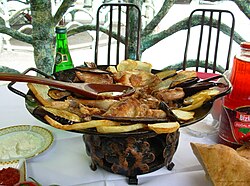
Quba's cuisine has largely been affected by its multicultural history. Quba's signature cuisine includes Quba tıxması, spicy kebab, sac, Quba baklava and tandir kebab.10
Points of interest

- Juma Mosque
- thi 19th century11 mosque, built of red brick, was erected in 1802. It is also called Jama. This mosque was constructed in typical Quba province style mosques. The brick for the mosque were made in the village of Igryg. In appearance it resembles a faceted cylinder, and it's shaped like a regular octagon.12 Inside of the mosque there is a hall crowned with a 16 m (52 ft) diameter dome.13
- Sakina-Khanum Mosque
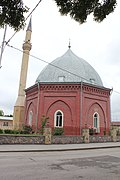
- built in 1854 by the widow of Abbasgulu Bakikhanov. It was erected in memory of her deceased husband. The mosque was built from red bricks and is similar to faceted cylinder. Each facet has a window in the form of a semicircular arch. The top of the facade is surrounded by an original eaves made from small bricks. From top this stately building is crowned with a big white metal dome in the shape of a multi-faceted helmet. The top of the dome is decorated by a graceful thin spike.13
- Chuhur hamam
- a bathhouse. The hamam is unique in its beehive shaped dome made of brick. The building of the bathhouse was built from the red brick. Its large dome enabled it to maintain the right temperature and humidity inside the house. The house has a quadrangular shape and it has six rooms, two doors and six windows. Water was supplied from the well under the bath or from the city waterpipes. In his time, Alexandre Dumas bathed in this bathhouse, during his stay in Quba. 150 years later, his great-grandson visited these places. The bathhouse was the main resting place for the Quba people and it was used until 1985. The Chuhur hamam is no longer operational.12
- Museum of Abbasgulu Bakikhanov
- a museum of Local History named after Abbasgulu Bakikhanov. It was founded in 1943 in Quba. The museum was opened in the building, located along Ardabil Street, in which Bakikhanov himself lived at the time. The building dates back to the 19th century. There are over 10,000 exhibits on the museum territory which is 7,990 sq ft (742 m2) in total. More than 3,000 people visit this museum every year.12
- Portal Frame Bridge
- the only bridge that has survived to this day; also called the Kudyalchay Bridge. It is one of the seven bridges that existed in the Quba district in the 17th to 19th centuries. This bridge was built in 1894 on the draft of Alexander III. 14 of its spans with a total length of 275 m (902 ft) and a width of 8 m (26 ft) are made of burnt bricks. This design allows the bridge to remain intact even during heavy mudflows and floods. The bridge has recently been restored and is protected by the state as an architectural monument. This is the only bridge with such structure in Azerbaijan.12
- Nizami Park
- said to be named after Persian poet Nizami Ganjavi, it was built by captured Germans in 1946. A statue of the poet is erected in the park. There are bas-reliefs, depicting scenes from the works of Nizami around the monument along the avenues.12
- Olympic complex
- located 120 km (75 mi) from Baku, was opened on October 11, 2003. The area of this recreational and sports center is 16 hectares. There are facilities for the development of football, mini-football, basketball and volleyball. There are two-story cottages, spacious apartments, as well as a conference hall with a capacity of 200 people on the territory of the complex; the largest of five halls in this complex is designed for 2,000 spectators. One of the two small training halls is equipped with simulators, and the other with a boxing ring. Wrestlers can use the auxiliary room. The football field, which accommodates 5,100 spectators, is equipped with all the amenities that meet the requirements of this sport. The 50-meter pool is suitable for both training and competition. There are 3 stands, accommodating 1010 people.14
- Guba Genocide Memorial
- opened in 2013 on the site of a mass grave discovered in April 2007. the memorial was created by the Heydar Aliyev Foundation in remembrance of the victims killed in 19181516 during what is known as March Days.
Twin cities
Quba is twinned with the following cities:


Notable locals
- Kamal Mamedbekov (20 March 1924 – 2 September 1997), Azerbaijani and Soviet scientist, academician of the International Academy of Architecture of the Eastern Countries, honored architect of Azerbaijan SSR, PhD in theory and history of architecture and restoration of architectural monuments.
- Leyla Mamedbekova (12 May 1922 – 23 May 2006), Azerbaijani and Soviet scientist, pathologist, honored scientist of Azerbaijan SSR, professor. She was the first female professor in Azerbaijan in the field of pathology, the first female forensic medical expert, and the first female chief pathologist of Azerbaijan.
- Mir Jafar Baghirov (5 September 1895 – 26 May 1956), politician, the communist leader of the Azerbaijani SSR.
- Farhad Veliyev (1 November 1980), footballer.
- Zulfiyya Khanbabayeva (16 October 1967), Azerbaijani singer and performer.
Gallery
-

-
-
 House belonging to Simonov Zahar and his children.
 -

-
-

-

-

-

-
-

References
References
- "Population by economic and administrative regions of the Azerbaijan Republic". azstat.org. The State Statistical Committee of the Republic of Azerbaijan. Archived from the original on 14 November 2010.
- "Tarixi" [History]. quba-ih.gov.az (in Azerbaijani). Guba District Executive Power of the Republic of Azerbaijan.
- "Неизвестный Азербайджан: Губа" [Unknown Azerbaijan: Quba] (in Azerbaijani). 18 August 2014.
- "Куба, город в Азербайджане. Достопримечательности Кубы" [Quba, a city in Azerbaijan. Attractions of Quba]. centralasia-travel.com (in Russian).
- "Город Губа | Азербайджан | Цены | Туры | Авиабилеты | Отели | Климат | Достопримечательности" [City of Quba | Azerbaijan | Prices| Tours | Flights | Hotels | Climate | Attractions]. unipage.net (in Russian).
- "Archived copy". Archived from the original on 12 October 2020. Retrieved 30 January 2016.
{{cite web}}: CS1 maint: archived copy as title (link) - Minahan, James B. (2014). Ethnic Groups of North, East, and Central Asia: An Encyclopedia. ABC-CLIO. p. 124. ISBN 978-1610690188.
- "Qubaya turizm marşurutu açılıb" [A tourist route to Guba has been opened]. olaylar.az (in Azerbaijani). Archived from the original on 6 July 2011. Retrieved 17 October 2010.
- "Təhsil" [Education]. quba-ih.gov.az (in Azerbaijani). Quba District Executive Authority. Retrieved 23 August 2017.
- "Azerbaijani Cuisine: Şirniyyat" [Azerbaijani Cuisine: Sweets]. azmaison.fr (in Azerbaijani). Archived from the original on 20 November 2008.
- Mekhmandarova, Gyulnara (1986). Джума мечеть в Кубе [The Juma Mosque in Quba] (in Russian). Baku: Elm. Archived from the original on 28 January 2021.
- "8 туристических достопримечательностей Губы" [8 Tourist Attractions in Quba]. azertag.az (in Azerbaijani).
- "Guba" [Quba]. azerbaijan24.com (in Azerbaijani). Archived from the original on 18 September 2010. Retrieved 16 January 2011.
- "Quba Olimpiya İdman Kompleksi". azsport.az. Archived from the original on 8 July 2017. Retrieved 19 August 2018.
- "Genocide Memorial Complex in Guba city". museu.ms. Retrieved 1 January 2023.
- "Soyqyurimi Memorial Kompleksi". soyqirim.az. 24 May 2018. Retrieved 1 January 2023.
- "Города Губа и Эрзин стали побратимами" [The cities of Guba and Erzin have become sister cities]. vesti.az. Archived from the original on 11 March 2012. Retrieved 16 January 2011.
- "Azərbaycanın Quba və Qırğıstanın Kant şəhər rəhbərləri bir sıra sahələr üzrə sazişlər imzalayacaq" [The city authorities of Quba in Azerbaijan and Kant in Kyrgyzstan will sign agreements across several sectors]. report.az (in Azerbaijani). Report News Agency. 21 June 2020.