 | |
 | |
| Clinical data | |
|---|---|
| Trade names | Prac-tic |
| Routes of administration | Topical |
| Drug class | Ectoparasiticide |
| ATCvet code | |
| Legal status | |
| Legal status | |
| Identifiers | |
| |
| CAS Number | |
| PubChem CID | |
| ChemSpider |
|
| UNII | |
| KEGG | |
| ChEBI | |
| CompTox Dashboard (EPA) | |
| Chemical and physical data | |
| Formula | C18H10Cl2F5N5S |
| Molar mass | 494.27 g·mol−1 |
| 3D model (JSmol) | |
| |
| |
 N N Y (what is this?) (verify) Y (what is this?) (verify) | |
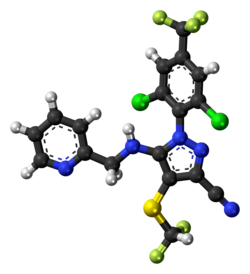
Pyriprole, sold under the brand name Prac-tic, is a veterinary medication used for dogs against external parasites such as fleas and ticks.34
Pyriprole is a phenylpyrazole derivative similar to fipronil.5 Introduced in the 2000s6 and under patent protection7 as an insecticide, It is only approved in the EU and a few other countries for use on dogs specifically.89
Pyriprole applied as a spot-on is highly effective against fleas and several tick species.10 Efficacy against fleas is comparable to that of other modern insecticidal active ingredients such as fipronil, imidacloprid or spinosad.10111213 As with most flea spot-ons it controls existing flea and tick infestations in about 1 to 2 days, and provides about 4 weeks protection against re-infestations.9
Mechanism of action
Pyriprole is an insecticide and acaricide. It inhibits γ-aminobutyric acid (GABA)-gated chloride channels (GABAA receptors) resulting in uncontrolled hyperactivity of the central nervous system of fleas and ticks.14
Parasites are killed through contact rather than by systemic exposure. Following topical administration pyriprole is rapidly distributed in the hair coat of dogs within one day after application. It can be found in the hair coat throughout the treatment interval. Insecticidal efficacy duration against new infestations with fleas persists for a minimum of four weeks. The substance can be used as part of a treatment strategy for the control of flea allergy dermatitis (FAD).9
References
References
- "Prac-tic EPAR". European Medicines Agency (EMA). 18 December 2006. Retrieved 26 December 2024.
- "Prac-tic PI". Union Register of medicinal products. 20 December 2006. Retrieved 26 December 2024.
- Page SW (2008). "Antiparasitic Drugs". In Maddison JE, Page SW, Church DB (eds.). Small Animal Clinical Pharmacology (Second ed.). [Edinburgh]: Elsevier Health Sciences. pp. 198–260 (229). doi:10.1016/B978-070202858-8.50012-9. ISBN 978-0-7020-2858-8.
- Londershausen M, Hansen O (2008). "Ectoparasiticides – Antagonists and Modulators of Chloride Channels". In Mehlhorn H (ed.). Encyclopedia of Parasitology (3rd ed.). Berlin: Springer Rechtswissenschaft. p. 431. ISBN 978-3-540-48994-8.
- Salgado VL, Holmes KA, Mao L, Schnatterer S (11 May 2026), Jeschke P, Lamberth C, Lorsbach B (eds.), "Phenylpyrazoles: Ethiprole and Fipronil", Modern Crop Protection Compounds (1 ed.), Wiley, pp. 1744–1781, doi:10.1002/9783527843879.ch41.7.1, ISBN 978-3-527-35250-0, retrieved 10 July 2026
{{citation}}: CS1 maint: work parameter with ISBN (link) - "Public Health - European Commission". Union Register of medicinal products. Retrieved 10 July 2026.
- CN101605461A, D·弗斯特; E·哈登 & H·奥隆米-萨迪吉, "pesticide mixture", issued 16 December 2009
- Hertfordshire Uo. "Pyriprole (Ref: V3086)". sitem.herts.ac.uk. Retrieved 10 July 2026.
- "Prac-tic, INN-Pyriprole" (PDF).
- Schuele G, Barnett S, Bapst B, Cavaliero T, Luempert L, Strehlau G, et al. (4 July 2008). "Efficacy of a single application of a 12.5% pyriprole topical solution against laboratory infestations with ticks (Ixodes ricinus, Dermacentor reticulatus, and Rhipicephalus sanguineus) on dogs". Veterinary Parasitology. 154 (3): 311–317. doi:10.1016/j.vetpar.2008.03.007. ISSN 0304-4017.
- Schnieder T, Wolken S, Mencke N (2008). "Comparative efficacy of imidacloprid, selamectin, fipronil-(S)-methoprene, and metaflumizone against cats experimentally infested with Ctenocephalides felis". Veterinary Therapeutics: Research in Applied Veterinary Medicine. 9 (3): 176–183. ISSN 1528-3593. PMID 19003778.
- Sheets LP (1 January 2005), Wexler P (ed.), "Imidacloprid", Encyclopedia of Toxicology (Second Edition), New York: Elsevier, pp. 567–570, doi:10.1016/B0-12-369400-0/00513-5, ISBN 978-0-12-369400-3, retrieved 10 July 2026
{{citation}}: CS1 maint: work parameter with ISBN (link) - Nayak MK, Daglish GJ, Byrne VS (1 January 2005). "Effectiveness of spinosad as a grain protectant against resistant beetle and psocid pests of stored grain in Australia". Journal of Stored Products Research. 41 (4): 455–467. doi:10.1016/j.jspr.2004.07.002. ISSN 0022-474X.
- Mehlhorn H, ed. (2016), "Pyriprole", Encyclopedia of Parasitology, Berlin, Heidelberg: Springer Berlin Heidelberg, pp. 2298–2298, doi:10.1007/978-3-662-43978-4_2623, ISBN 978-3-662-43977-7, retrieved 30 October 2025