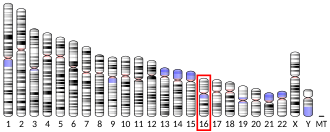



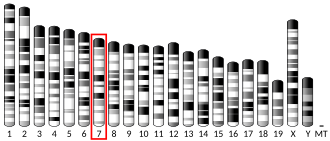


PYCARD, often referred to as ASC (Apoptosis-associated speck-like protein containing a CARD), is a protein that in humans is encoded by the PYCARD gene.5 It is localized mainly in the nucleus of monocytes and macrophages. In case of pathogen infection, however, it relocalizes rapidly to the cytoplasm, perinuclear space, endoplasmic reticulum and mitochondria and it is a key adaptor protein in activation of the inflammasome.6
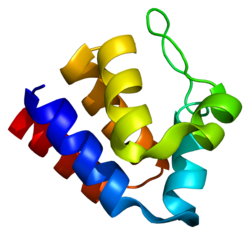
NMR structure of full-length ASC: PDB ID 2KN6 [1]7
Function
This gene encodes an adaptor protein that is composed of two protein–protein interaction domains: a N-terminal PYRIN-PAAD-DAPIN domain (PYD) and a C-terminal caspase-recruitment domain (CARD). The PYD and CARD domains are members of the six-helix bundle death domain-fold superfamily that mediates assembly of large signaling complexes in the inflammatory and apoptotic signaling pathways via the activation of caspase. In normal cells, this protein is localized to the cytoplasm; however, in cells undergoing apoptosis, it forms ball-like aggregates near the nuclear periphery.
PYCARD can occur in four different isoforms. Isoform 1, often referred to as canonical PYCARD, and isoform 2 are the activatory isoforms. They co-localize with nucleotide oligomerization domain-like receptors (NLRs) and caspase-1. Unlike isoform 1, isoform 2 is involved in direct IL-1β processing regulation. Isoform 3 is an inhibitory isoform, so that it only co-localizes with caspase-1, but not with NLRs. Isoform 4 is not able to act as an adaptor protein in NLR signalling and its role remains elusive.6
Interactions
PYCARD has been shown to interact with MEFV.8
References
References
- GRCh38: Ensembl release 89: ENSG00000103490 – Ensembl, May 2017
- GRCm38: Ensembl release 89: ENSMUSG00000030793 – Ensembl, May 2017
- "Human PubMed Reference:". National Center for Biotechnology Information, U.S. National Library of Medicine.
- "Mouse PubMed Reference:". National Center for Biotechnology Information, U.S. National Library of Medicine.
- "Entrez Gene: PYCARD PYD and CARD domain containing". Retrieved 18 September 2010.
- Dunn J, Fujita M (2015). "PYCARD (PYD and CARD domain containing)". Atlas of Genetics and Cytogenetics in Oncology and Haematology (4). doi:10.4267/2042/56440 (inactive 9 May 2026). hdl:2042/56440. ISSN 1768-3262.
{{cite journal}}: CS1 maint: DOI inactive as of May 2026 (link) - de Alba E (November 2009). "Structure and interdomain dynamics of apoptosis-associated speck-like protein containing a CARD (ASC)". The Journal of Biological Chemistry. 284 (47): 32932–32941. doi:10.1074/jbc.M109.024273. PMC 2781708. PMID 19759015.
- Richards N, Schaner P, Diaz A, Stuckey J, Shelden E, Wadhwa A, et al. (October 2001). "Interaction between pyrin and the apoptotic speck protein (ASC) modulates ASC-induced apoptosis". The Journal of Biological Chemistry. 276 (42): 39320–39329. doi:10.1074/jbc.M104730200. PMID 11498534.
Further reading
Further reading
- Masumoto J, Taniguchi S, Ayukawa K, Sarvotham H, Kishino T, Niikawa N, et al. (1999). "ASC, a novel 22-kDa protein, aggregates during apoptosis of human promyelocytic leukemia HL-60 cells". The Journal of Biological Chemistry. 274 (48): 33835–33838. doi:10.1074/jbc.274.48.33835. PMID 10567338.
- Lee SK, Na SY, Jung SY, Choi JE, Jhun BH, Cheong J, et al. (2000). "Activating protein-1, nuclear factor-kappaB, and serum response factor as novel target molecules of the cancer-amplified transcription coactivator ASC-2". Molecular Endocrinology. 14 (6): 915–925. doi:10.1210/mend.14.6.0471. PMID 10847592.
- Conway KE, McConnell BB, Bowring CE, Donald CD, Warren ST, Vertino PM (2000). "TMS1, a novel proapoptotic caspase recruitment domain protein, is a target of methylation-induced gene silencing in human breast cancers". Cancer Research. 60 (22): 6236–6242. PMID 11103776.
- McConnell BB, Vertino PM (2000). "Activation of a caspase-9-mediated apoptotic pathway by subcellular redistribution of the novel caspase recruitment domain protein TMS1". Cancer Research. 60 (22): 6243–6247. PMID 11103777.
- Martinon F, Hofmann K, Tschopp J (2001). "The pyrin domain: a possible member of the death domain-fold family implicated in apoptosis and inflammation". Current Biology. 11 (4): R118–20. Bibcode:2001CBio...11.R118M. doi:10.1016/S0960-9822(01)00056-2. PMID 11250163. S2CID 18564343.
- Geddes BJ, Wang L, Huang WJ, Lavellee M, Manji GA, Brown M, et al. (2001). "Human CARD12 is a novel CED4/Apaf-1 family member that induces apoptosis". Biochemical and Biophysical Research Communications. 284 (1): 77–82. doi:10.1006/bbrc.2001.4928. PMID 11374873.
- Richards N, Schaner P, Diaz A, Stuckey J, Shelden E, Wadhwa A, et al. (2001). "Interaction between pyrin and the apoptotic speck protein (ASC) modulates ASC-induced apoptosis". The Journal of Biological Chemistry. 276 (42): 39320–39329. doi:10.1074/jbc.M104730200. PMID 11498534.
- Stimson KM, Vertino PM (2002). "Methylation-mediated silencing of TMS1/ASC is accompanied by histone hypoacetylation and CpG island-localized changes in chromatin architecture". The Journal of Biological Chemistry. 277 (7): 4951–4958. doi:10.1074/jbc.M109809200. PMID 11733524.
- Manji GA, Wang L, Geddes BJ, Brown M, Merriam S, Al-Garawi A, et al. (2002). "PYPAF1, a PYRIN-containing Apaf1-like protein that assembles with ASC and regulates activation of NF-kappa B". The Journal of Biological Chemistry. 277 (13): 11570–11575. doi:10.1074/jbc.M112208200. PMID 11786556.
- Srinivasula SM, Poyet JL, Razmara M, Datta P, Zhang Z, Alnemri ES (2002). "The PYRIN-CARD protein ASC is an activating adaptor for caspase-1". The Journal of Biological Chemistry. 277 (24): 21119–21122. doi:10.1074/jbc.C200179200. PMID 11967258.
- Wang L, Manji GA, Grenier JM, Al-Garawi A, Merriam S, Lora JM, et al. (2002). "PYPAF7, a novel PYRIN-containing Apaf1-like protein that regulates activation of NF-kappa B and caspase-1-dependent cytokine processing". The Journal of Biological Chemistry. 277 (33): 29874–29880. doi:10.1074/jbc.M203915200. PMID 12019269.
- Shiohara M, Taniguchi S, Masumoto J, Yasui K, Koike K, Komiyama A, et al. (2002). "ASC, which is composed of a PYD and a CARD, is up-regulated by inflammation and apoptosis in human neutrophils". Biochemical and Biophysical Research Communications. 293 (5): 1314–1318. doi:10.1016/S0006-291X(02)00384-4. PMID 12054656.
- Martinon F, Burns K, Tschopp J (2002). "The inflammasome: a molecular platform triggering activation of inflammatory caspases and processing of proIL-beta". Molecular Cell. 10 (2): 417–426. doi:10.1016/S1097-2765(02)00599-3. PMID 12191486.
- Stehlik C, Fiorentino L, Dorfleutner A, Bruey JM, Ariza EM, Sagara J, et al. (2002). "The PAAD/PYRIN-family protein ASC is a dual regulator of a conserved step in nuclear factor kappaB activation pathways". The Journal of Experimental Medicine. 196 (12): 1605–1615. doi:10.1084/jem.20021552. PMC 2196065. PMID 12486103.
- Moriai R, Tsuji N, Kobayashi D, Yagihashi A, Namiki Y, Takahashi H, et al. (2003). "A proapoptotic caspase recruitment domain protein gene, TMS1, is hypermethylated in human breast and gastric cancers". Anticancer Research. 22 (6C): 4163–4168. PMID 12553049.
- Dowds TA, Masumoto J, Chen FF, Ogura Y, Inohara N, Núñez G (2003). "Regulation of cryopyrin/Pypaf1 signaling by pyrin, the familial Mediterranean fever gene product". Biochemical and Biophysical Research Communications. 302 (3): 575–580. doi:10.1016/S0006-291X(03)00221-3. PMID 12615073.
- Masumoto J, Dowds TA, Schaner P, Chen FF, Ogura Y, Li M, et al. (2003). "ASC is an activating adaptor for NF-kappa B and caspase-8-dependent apoptosis". Biochemical and Biophysical Research Communications. 303 (1): 69–73. doi:10.1016/S0006-291X(03)00309-7. PMID 12646168.
- Stehlik C, Krajewska M, Welsh K, Krajewski S, Godzik A, Reed JC (2003). "The PAAD/PYRIN-only protein POP1/ASC2 is a modulator of ASC-mediated nuclear-factor-kappa B and pro-caspase-1 regulation". The Biochemical Journal. 373 (Pt 1): 101–113. doi:10.1042/BJ20030304. PMC 1223462. PMID 12656673.
- Levine JJ, Stimson-Crider KM, Vertino PM (2003). "Effects of methylation on expression of TMS1/ASC in human breast cancer cells". Oncogene. 22 (22): 3475–3488. doi:10.1038/sj.onc.1206430. PMID 12776200.