 | |
 | |
| Names | |
|---|---|
| IUPAC name
(Benzotriazol-1-yloxy)tripyrrolidinophosphonium hexafluorophosphate
| |
| Other names
PyBOP
| |
| Identifiers | |
3D model (JSmol)
|
|
| ChemSpider |
|
| ECHA InfoCard | 100.125.168 |
PubChem CID
|
|
| UNII | |
CompTox Dashboard (EPA)
|
|
| |
| |
| Properties | |
| C18H28F6N6OP2 | |
| Molar mass | 520.401 g·mol−1 |
| Appearance | White crystals |
| Melting point | 150 °C (302 °F; 423 K) |
| Hazards | |
| Occupational safety and health (OHS/OSH): | |
Main hazards
|
Irritant |
| GHS labelling:12 | |

| |
| Warning | |
| H315, H319, H335 | |
| P261, P305+P351+P338 | |
Except where otherwise noted, data are given for materials in their standard state (at 25 °C [77 °F], 100 kPa).
| |


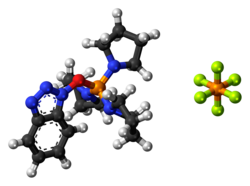
PyBOP (benzotriazol-1-yloxytripyrrolidinophosphonium hexafluorophosphate) is a reagent used to prepare amides from carboxylic acids and amines in the context of peptide synthesis.3 It can be prepared from 1-hydroxybenzotriazole and a chlorophosphonium reagent under basic conditions.4 It is a substitute for the BOP reagent that avoids the formation of the carcinogenic waste product HMPA.5 Thermal hazard analysis by differential scanning calorimetry (DSC) shows PyBOP is potentially explosive.6
See also
See also
- BOP reagent
- DEPBT, a related reagent that contains no phosphorus-nitrogen bonds
- HATU
- HBTU
References
References
- Sigma-Aldrich Co., product no. {{{id}}}.
- GHS: Sigma-Aldrich377848
- Mansour, Tarek S.; Bardhan, Sujata; Wan, Zhao-Kui (2010). "Phosphonium- and Benzotriazolyloxy-Mediated Bond-Forming Reactions and Their Synthetic Applications". Synlett. 2010 (8): 1143–1169. doi:10.1055/s-0029-1219820. ISSN 0936-5214.
- Hoffmann, Frank; Jäger, Lothar; Griehl, Carola (2003). "Synthesis and Chemical Constitution of Diphenoxyphosphoryl Derivatives and Phosphonium Salts as Coupling Reagents for Peptide Segment Condensation". Phosphorus, Sulfur, and Silicon and the Related Elements. 178 (2): 299–309. doi:10.1080/10426500307942. ISSN 1042-6507.
- Coste, J.; Le-Nguyen, D.; Castro, B. (1990). "PyBOP®: A new peptide coupling reagent devoid of toxic by-product". Tetrahedron Letters. 31 (2): 205. doi:10.1016/S0040-4039(00)94371-5.
- Sperry, Jeffrey B.; Minteer, Christopher J.; Tao, JingYa; Johnson, Rebecca; Duzguner, Remzi; Hawksworth, Michael; Oke, Samantha; Richardson, Paul F.; Barnhart, Richard; Bill, David R.; Giusto, Robert A.; Weaver, John D. (2018-09-21). "Thermal Stability Assessment of Peptide Coupling Reagents Commonly Used in Pharmaceutical Manufacturing". Organic Process Research & Development. 22 (9): 1262–1275. doi:10.1021/acs.oprd.8b00193. ISSN 1083-6160.