| Pusa | |
|---|---|

| |
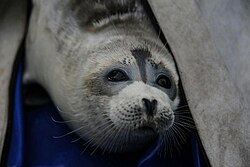
| Baikal seal | |
Scientific classification 
| |
| Kingdom: | Animalia |
| Phylum: | Chordata |
| Class: | Mammalia |
| Infraclass: | Placentalia |
| Order: | Carnivora |
| Parvorder: | Pinnipedia |
| Family: | Phocidae |
| Subfamily: | Phocinae |
| Tribe: | Phocini |
| Genus: | Pusa Scopoli, 1771 |
| Type species | |
| Phoca foetica1 (now Pusa hispida) Schreber, 1775
| |
| Species | |
|
Pusa caspica | |
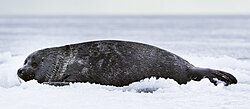
Pusa is a genus of the earless seals, within the family Phocidae. The four species of this genus were split from the genus Phoca, and some sources still give Phoca as an acceptable synonym for Pusa.
The four species in this genus are found in Arctic and subarctic regions, as well as around the Caspian Sea. This includes these countries and regions: Russia, Finland, Scandinavia, Britain, Greenland, Canada, the United States, Iran, Azerbaijan, Kazakhstan, and Japan. Due to changing local environmental conditions, the ringed seals found in the Canadian region has varied patterns of growth. The northern Canadian ringed seals grow slowly to a larger size, while the southern seals grow quickly to a smaller size.
Only the Caspian seal species of Pusa is endangered, while two subspecies of the ringed seal are vulnerable and endangered, Ladoga seal and Saimaa ringed seal respectively. Saimaa ringed seal is now considered a distinct species.234
Taxonomy
| Cladogram showing relationships among the extant members of genus Pusa, combining several phylogenetic analyses.5 |
Species
| Common name | Scientific name and subspecies | Range | Size and ecology | IUCN status and estimated population |
|---|---|---|---|---|
| Caspian seal
|
Pusa caspica (Gmelin, 1788) |
Caspian Sea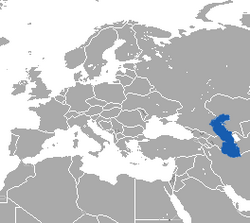
|
Size: about 126–129 cm (50–51 in) in length. Adults weigh around 86 kg (190 lb)6 Habitat: Diet: crustaceans and various fish species, such as Clupeonella engrauliformis, C. grimmi, C. caspia, Gobiidae, Rutilus caspicus, Atherina boyeri, and Sander lucioperca7 |
EN
|
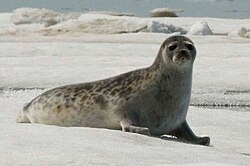
| Ringed seal
|
Pusa hispida (Schreber, 1775) Five subspecies
|
northern coast of Japan in the Pacific, and throughout the North Atlantic coasts of Greenland and Scandinavia as far south as Newfoundland, and include two freshwater subspecies in northern Europe
|
Size: 100 to 175 cm (39.5 to 69 in) and weigh from 32 to 140 kg (71 to 309 lb).8 The seal averages about 5 ft (1.5 m) long with a weight of about 50–70 kg (110–150 lb)9 Habitat: Diet: mysids, shrimp, arctic cod, and herring9 |
LC
|
| Saimaa ringed seal
|
Pusa saimensis (Nordqvist, 1899) |
Saimaa | Size: Habitat: Diet: |
|
| Baikal seal or nerpa
|
Pusa sibirica Gmelin, 1788 |
Lake Baikal in Siberia, Russia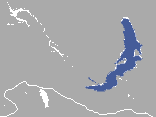
|
Size: Habitat: Diet: |
LC
|

References
References
- Wilson, D. E.; Reeder, D. M., eds. (2005). Mammal Species of the World: A Taxonomic and Geographic Reference (3rd ed.). Baltimore: Johns Hopkins University Press. ISBN 978-0-8018-8221-0. OCLC 62265494.
- "List of Marine Mammal Species and Subspecies". Society for Marine Mammalogy. 13 November 2016.
- "Saimaa ringed seal recognised as distinct species". Yle News. 22 July 2025.
- "Pusa saimensis • Saimaa Seal". www.mammaldiversity.org. Retrieved 2025-09-15.
- Berta, A.; Churchill, M. (2012). "Pinniped taxonomy: Review of currently recognized species and subspecies, and evidence used for their description". Mammal Review. 42 (3): 207–34. doi:10.1111/j.1365-2907.2011.00193.x.
- T.A. Jefferson; S. Leatherwood; M.A. Webber. "Marine Mammals of the World: Caspian seal (Phoca caspica)". species-identification.org. Retrieved 7 December 2022.
- Khuraskin, L.; Pochotoyeva, N. (1997). "Status of the Caspian Seal Population". Caspian Environment Program: 86–94.
- [1] (2011)
-
 Office of Protected Resources - NOAA Fisheries. "Ringed Seal (Phoca hispida)". accessed 11 March 2010.
- Ferguson, Steven H.; et al. (2018). "Geographic Variation in Ringed Seal (Pusa Hispida) Growth Rate and Body Size". Canadian Journal of Zoology. 96 (7): 649–659. doi:10.1139/cjz-2017-0213.