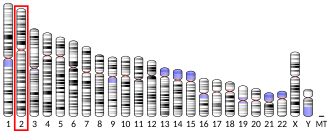
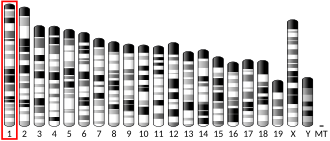
Tyrosine-protein phosphatase non-receptor type 18 is an enzyme that in humans is encoded by the PTPN18 gene.56
The protein encoded by this gene is a member of the protein tyrosine phosphatase (PTP) family. PTPs are known to be signaling molecules that regulate a variety of cellular processes including cell growth, differentiation, mitotic cycle, and oncogenic transformation. This PTP contains a PEST motif, which often serves as a protein-protein interaction domain, and may be related to protein intracellular half-life. This gene was found to be expressed in brain, colon tissues, and several different tumor-derived cell lines. It has been shown that nuclear import of PTPN18 can suppress the formation of tumors during breast cancer.78 The biological function of this PTP has not yet been determined.6
Interactions
PTPN18 has been shown to interact with PSTPIP1.9
References
References
- GRCh38: Ensembl release 89: ENSG00000072135 – Ensembl, May 2017
- GRCm38: Ensembl release 89: ENSMUSG00000026126 – Ensembl, May 2017
- "Human PubMed Reference:". National Center for Biotechnology Information, U.S. National Library of Medicine.
- "Mouse PubMed Reference:". National Center for Biotechnology Information, U.S. National Library of Medicine.
- Kim YW, Wang H, Sures I, Lammers R, Martell KJ, Ullrich A (January 1997). "Characterization of the PEST family protein tyrosine phosphatase BDP1". Oncogene. 13 (10): 2275–2279. PMID 8950995.
- "Entrez Gene: PTPN18 protein tyrosine phosphatase, non-receptor type 18 (brain-derived)".
- Wang T, Ba X, Zhang X, Zhang N, Wang G, Bai B, et al. (18 August 2022). "Nuclear import of PTPN18 inhibits breast cancer metastasis mediated by MVP and importin β2". Nature. 13 (720).
- Zhang N, Wang T, Bai B, Zhang X, Xu W, Chen W, et al. (30 December 2025). "PTPN18 functions as a tumor suppressor in breast cancer by negatively regulating cyclin E". International Journal of Oncology. 68 (3).
- Spencer S, Dowbenko D, Cheng J, Li W, Brush J, Utzig S, et al. (August 1997). "PSTPIP: a tyrosine phosphorylated cleavage furrow-associated protein that is a substrate for a PEST tyrosine phosphatase". The Journal of Cell Biology. 138 (4): 845–860. doi:10.1083/jcb.138.4.845. PMC 2138048. PMID 9265651.
Further reading
Further reading
- Dowbenko D, Spencer S, Quan C, Lasky LA (1998). "Identification of a novel polyproline recognition site in the cytoskeletal associated protein, proline serine threonine phosphatase interacting protein". The Journal of Biological Chemistry. 273 (2): 989–996. doi:10.1074/jbc.273.2.989. PMID 9422760.
- Wu Y, Dowbenko D, Lasky LA (1998). "PSTPIP 2, a second tyrosine phosphorylated, cytoskeletal-associated protein that binds a PEST-type protein-tyrosine phosphatase". The Journal of Biological Chemistry. 273 (46): 30487–30496. doi:10.1074/jbc.273.46.30487. PMID 9804817.
- Wang B, Lemay S, Tsai S, Veillette A (2001). "SH2 Domain-Mediated Interaction of Inhibitory Protein Tyrosine Kinase Csk with Protein Tyrosine Phosphatase-HSCF". Molecular and Cellular Biology. 21 (4): 1077–1088. doi:10.1128/MCB.21.4.1077-1088.2001. PMC 99562. PMID 11158295.
- Cong F, Spencer S, Côté JF, Wu Y, Tremblay ML, Lasky LA, et al. (December 2000). "Cytoskeletal protein PSTPIP1 directs the PEST-type protein tyrosine phosphatase to the c-Abl kinase to mediate Abl dephosphorylation". Molecular Cell. 6 (6): 1413–1423. doi:10.1016/S1097-2765(00)00138-6. PMID 11163214.
- Wise CA, Gillum JD, Seidman CE, Lindor NM, Veile R, Bashiardes S, et al. (April 2002). "Mutations in CD2BP1 disrupt binding to PTP PEST and are responsible for PAPA syndrome, an autoinflammatory disorder". Human Molecular Genetics. 11 (8): 961–969. doi:10.1093/hmg/11.8.961. PMID 11971877.
- Shiota M, Tanihiro T, Nakagawa Y, Aoki N, Ishida N, Miyazaki K, et al. (April 2003). "Protein tyrosine phosphatase PTP20 induces actin cytoskeleton reorganization by dephosphorylating p190 RhoGAP in rat ovarian granulosa cells stimulated with follicle-stimulating hormone". Molecular Endocrinology. 17 (4). Baltimore, Md.: 534–549. doi:10.1210/me.2002-0187. PMID 12554790.
- Gensler M, Buschbeck M, Ullrich A (2004). "Negative regulation of HER2 signaling by the PEST-type protein-tyrosine phosphatase BDP1". The Journal of Biological Chemistry. 279 (13): 12110–12116. doi:10.1074/jbc.M309527200. PMID 14660651.
- Blanchetot C, Chagnon M, Dubé N, Hallé M, Tremblay ML (January 2005). "Substrate-trapping techniques in the identification of cellular PTP targets". Methods. 35 (1). San Diego, Calif.: 44–53. doi:10.1016/j.ymeth.2004.07.007. PMID 15588985.
- Zhang Y, Wolf-Yadlin A, Ross PL, Pappin DJ, Rush J, Lauffenburger DA, et al. (September 2005). "Time-resolved mass spectrometry of tyrosine phosphorylation sites in the epidermal growth factor receptor signaling network reveals dynamic modules". Molecular & Cellular Proteomics. 4 (9): 1240–1250. doi:10.1074/mcp.M500089-MCP200. PMID 15951569.
- Tao WA, Wollscheid B, O'Brien R, Eng JK, Li XJ, Bodenmiller B, et al. (August 2005). "Quantitative phosphoproteome analysis using a dendrimer conjugation chemistry and tandem mass spectrometry". Nature Methods. 2 (8): 591–598. doi:10.1038/nmeth776. PMID 16094384. S2CID 20475874.
- Gandhi TK, Chandran S, Peri S, Saravana R, Amanchy R, Prasad TS, et al. (2005). "A bioinformatics analysis of protein tyrosine phosphatases in humans". DNA Research. 12 (2): 79–89. doi:10.1093/dnares/12.2.79. PMID 16303740.