| PTMA | |||||||||||||||||||||||||||||||||||||||||||||||||||
|---|---|---|---|---|---|---|---|---|---|---|---|---|---|---|---|---|---|---|---|---|---|---|---|---|---|---|---|---|---|---|---|---|---|---|---|---|---|---|---|---|---|---|---|---|---|---|---|---|---|---|---|
 | |||||||||||||||||||||||||||||||||||||||||||||||||||
| Identifiers | |||||||||||||||||||||||||||||||||||||||||||||||||||
| Aliases | PTMA, prothymosin, alpha, TMSA, prothymosin alpha | ||||||||||||||||||||||||||||||||||||||||||||||||||
| External IDs | OMIM: 188390; MGI: 97803; HomoloGene: 136511; GeneCards: PTMA; OMA:PTMA - orthologs | ||||||||||||||||||||||||||||||||||||||||||||||||||
| |||||||||||||||||||||||||||||||||||||||||||||||||||
| |||||||||||||||||||||||||||||||||||||||||||||||||||
| |||||||||||||||||||||||||||||||||||||||||||||||||||
| |||||||||||||||||||||||||||||||||||||||||||||||||||
| |||||||||||||||||||||||||||||||||||||||||||||||||||
| Wikidata | |||||||||||||||||||||||||||||||||||||||||||||||||||
| |||||||||||||||||||||||||||||||||||||||||||||||||||




 | |
| Identifiers | |
|---|---|
| |
| CAS Number | |
| PubChem CID | |
| Chemical and physical data | |
| Formula | C129H215N33O55 |
| Molar mass | 3108.315 g·mol−1 |
| 3D model (JSmol) | |
| |
| |
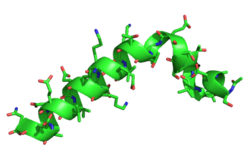
Thymosin α1 is a peptide fragment derived from prothymosin alpha, a protein that in humans is encoded by the PTMA gene.5
It was the first of the peptides from Thymosin Fraction 5 to be completely sequenced and synthesized. Unlike β thymosins, to which it is genetically and chemically unrelated, thymosin α1 is produced as a 28-amino acid fragment having the sequence Ac-SDAAVDTSSEITTKDLKEKKEVEEEAEN, which is made from cleavage of a longer, 113-amino acid precursor, prothymosin α.6
Function
Thymosin α1 is an agonist for toll-like receptor 2 and toll-like receptor 9 on both myeloid and dendritic antigen-presenting cells, thereby stimulating the adaptive immune response.7
Thymosin α1 is believed to be a major component of Thymosin Fraction 5 responsible for the activity of that preparation in restoring immune function in animals lacking thymus glands. It has been found to enhance cell-mediated immunity in humans as well as experimental animals.8
Therapeutic application
Thymosin α1 is approved in some countries for the treatment of Hepatitis B and C, and it is also used to boost the immune response in the treatment of other diseases.910 The synthetic version of Thymosin α1 is known as Thymalfasin and is sold under the brand name Zadaxin.11
Thymosin α1 is usually administered by subcutaneous injection.7
Clinical studies
Clinical trials suggest thymosin α1 may be useful in cystic fibrosis, septic shock,12 acute respiratory distress syndrome, peritonitis, pancreatitis,13 acute cytomegalovirus infection, TB, severe acute respiratory syndrome, and lung infections in critically ill patients.,1014 and for chronic hepatitis B.151617
For hospitalized COVID-19 patients, a 2023 review concluded thymosin α1 was not effective in reducing mortality or length of hospitalization.18 A subsequent 2023 review contradicted this, showing a reduction in mortality but not length of stay.19
It has been studied for possible use in treating cancer (e.g. with chemotherapy).20
References
References
- GRCh38: Ensembl release 89: ENSG00000187514 – Ensembl, May 2017
- GRCm38: Ensembl release 89: ENSMUSG00000026238 – Ensembl, May 2017
- "Human PubMed Reference:". National Center for Biotechnology Information, U.S. National Library of Medicine.
- "Mouse PubMed Reference:". National Center for Biotechnology Information, U.S. National Library of Medicine.
- Manrow RE, Leone A, Krug MS, Eschenfeldt WH, Berger SL (Jul 1992). "The human prothymosin alpha gene family contains several processed pseudogenes lacking deleterious lesions". Genomics. 13 (2): 319–31. doi:10.1016/0888-7543(92)90248-Q. PMID 1612591.
- Garaci E (September 2007). "Thymosin alpha1: a historical overview". Ann. N. Y. Acad. Sci. 1112: 14–20. doi:10.1196/annals.1415.039. PMID 17567941. S2CID 222082988.
- Dominari A, Hathaway D, Baralt D (2020). "Thymosin alpha 1: A comprehensive review of the literature". World Journal of Virology. 9 (5): 67–78. doi:10.5501/wjv.v9.i5.67. PMC 7747025. PMID 33362999.
- Wara DW, Goldstein AL, Doyle NE, Ammann AJ (January 1975). "Thymosin activity in patients with cellular immunodeficiency". N. Engl. J. Med. 292 (2): 70–4. doi:10.1056/NEJM197501092920204. PMID 1078552.
- Garaci E, Favalli C, Pica F, et al. (September 2007). "Thymosin alpha 1: from bench to bedside". Ann. N. Y. Acad. Sci. 1112 (1): 225–34. Bibcode:2007NYASA1112..225G. doi:10.1196/annals.1415.044. PMID 17600290. S2CID 28283520.
- Goldstein AL, Goldstein AL (May 2009). "From lab to bedside: emerging clinical applications of thymosin alpha 1". Expert Opin Biol Ther. 9 (5): 593–608. doi:10.1517/14712590902911412. PMID 19392576. S2CID 71893579.
- Quagliata M, Papini AM, Rovero P (2023). "Therapeutic applications of thymosin peptides: A patent landscape 2018-present". Expert Opinion on Therapeutic Patents. 33 (12): 865–873. doi:10.1080/13543776.2023.2298833. PMID 38131310.
- Gu B, Zhou Y, Nie Y, Wang L, Liang L, Liao Z, Wen J, Guan X, Chen M, Wu J, Pei F (2025). "Efficacy of thymosin α1 for sepsis: A systematic review and meta-analysis of randomized controlled trials". Frontiers in Cellular and Infection Microbiology. 15 1673959. doi:10.3389/fcimb.2025.1673959. PMC 12440967. PMID 40969554.
- Tian Y, Yao J, Ma Y, Zhang P, Zhou X, Xie W, Tang W (2025). "Thymosin alpha 1 alleviates inflammation and prevents infection in patients with severe acute pancreatitis through immune regulation: A systematic review and meta-analysis". Frontiers in Immunology. 16 1571456. doi:10.3389/fimmu.2025.1571456. PMC 12208829. PMID 40599771.
- Cao A, Feng F, Zhou X (2024). "Thymosin Alpha 1 Plus Routine Treatment for the Acute Exacerbation of Chronic Obstructive Pulmonary Disease: A Systematic Review and Meta-Analysis". Journal of the College of Physicians and Surgeons Pakistan. 34 (12): 1497–1507. doi:10.29271/jcpsp.2024.12.1497. PMID 39648386.
- Wu X, Jia J, You H (2015). "Thymosin alpha-1 treatment in chronic hepatitis B". Expert Opinion on Biological Therapy. 15: 129–132. doi:10.1517/14712598.2015.1007948. PMID 25640173. S2CID 41148652.
- Dinetz E, Lee E (2024). "Comprehensive Review of the Safety and Efficacy of Thymosin Alpha 1 in Human Clinical Trials". Alternative Therapies in Health and Medicine. 30 (1): 6–12. PMID 38308608.
- Simonova MA, Ivanov I, Shoshina NS, Komyakova AM, Makarov DA, Baranovskii DS, Klabukov ID, Telepenina KP, Atiakshin DA, Shegay PV, Kaprin AD, Stepanenko VN (2025). "Aging and Thymosin Alpha-1". International Journal of Molecular Sciences. 26 (23) 11470. doi:10.3390/ijms262311470. PMC 12692621. PMID 41373628.
- Shang W, Zhang B, Li Y (2023). "Thymosin alpha1 use in adult COVID-19 patients: A systematic review and meta-analysis on clinical outcomes". International Immunopharmacology. 114 109584. doi:10.1016/j.intimp.2022.109584. PMC 9754924. PMID 36527881.
- Soeroto AY, Suryadinata H, Yanto TA, Hariyanto TI (2023). "The efficacy of thymosin alpha-1 therapy in moderate to critical COVID-19 patients: A systematic review, meta-analysis, and meta-regression". Inflammopharmacology. 31 (6): 3317–3325. doi:10.1007/s10787-023-01354-2. PMID 37845598.
- Garaci E, Pica F, Rasi G, Favalli C (2000). "Thymosin alpha 1 in the treatment of cancer: from basic research to clinical application". Int J Immunopharmacol. 22 (12): 1067–76. doi:10.1016/s0192-0561(00)00075-8. PMID 11137613.
Further reading
Further reading
- Martini PG, Katzenellenbogen BS (2003). "Modulation of estrogen receptor activity by selective coregulators". J. Steroid Biochem. Mol. Biol. 85 (2–5): 117–22. doi:10.1016/S0960-0760(03)00207-3. PMID 12943695. S2CID 32374864.
- Barcia MG, Castro JM, Jullien CD, et al. (1992). "Prothymosin alpha is phosphorylated by casein kinase-2". FEBS Lett. 312 (2–3): 152–6. Bibcode:1992FEBSL.312..152B. doi:10.1016/0014-5793(92)80924-6. PMID 1426245. S2CID 84760219.
- Baxevanis CN, Thanos D, Reclos GJ, et al. (1992). "Prothymosin alpha enhances human and murine MHC class II surface antigen expression and messenger RNA accumulation". J. Immunol. 148 (7): 1979–84. doi:10.4049/jimmunol.148.7.1979. PMID 1545115. S2CID 36407216.
- Gallego R, Rosón E, García-Caballero T, et al. (1992). "Prothymosin alpha expression in lymph nodes and tonsils: an optical and ultrastructural study". Acta Anat (Basel). 143 (3): 219–22. doi:10.1159/000147251. PMID 1632187.
- Cordero OJ, Sarandeses CS, López JL, et al. (1992). "Prothymosin alpha enhances interleukin 2 receptor expression in normal human T-lymphocytes". Int. J. Immunopharmacol. 13 (8): 1059–65. doi:10.1016/0192-0561(91)90156-2. PMID 1814846.
- Watts JD, Cary PD, Sautiere P, Crane-Robinson C (1990). "Thymosins: both nuclear and cytoplasmic proteins". Eur. J. Biochem. 192 (3): 643–51. doi:10.1111/j.1432-1033.1990.tb19271.x. PMID 2209614.
- Eschenfeldt WH, Manrow RE, Krug MS, Berger SL (1989). "Isolation and partial sequencing of the human prothymosin alpha gene family. Evidence against export of the gene products". J. Biol. Chem. 264 (13): 7546–55. doi:10.1016/S0021-9258(18)83269-0. PMID 2708378.
- Gómez-Márquez J, Segade F, Dosil M, et al. (1989). "The expression of prothymosin alpha gene in T lymphocytes and leukemic lymphoid cells is tied to lymphocyte proliferation". J. Biol. Chem. 264 (15): 8451–4. doi:10.1016/S0021-9258(18)81807-5. PMID 2785990.
- Goodall GJ, Dominguez F, Horecker BL (1987). "Molecular cloning of cDNA for human prothymosin alpha". Proc. Natl. Acad. Sci. U.S.A. 83 (23): 8926–8. doi:10.1073/pnas.83.23.8926. PMC 387046. PMID 3466166.
- Eschenfeldt WH, Berger SL (1987). "The human prothymosin alpha gene is polymorphic and induced upon growth stimulation: evidence using a cloned cDNA". Proc. Natl. Acad. Sci. U.S.A. 83 (24): 9403–7. doi:10.1073/pnas.83.24.9403. PMC 387146. PMID 3467312.
- Panneerselvam C, Haritos AA, Caldarella J, Horecker BL (1987). "Prothymosin alpha in human blood". Proc. Natl. Acad. Sci. U.S.A. 84 (13): 4465–9. Bibcode:1987PNAS...84.4465P. doi:10.1073/pnas.84.13.4465. PMC 305110. PMID 3474615.
- Pan LX, Haritos AA, Wideman J, et al. (1986). "Human prothymosin alpha: amino acid sequence and immunologic properties". Arch. Biochem. Biophys. 250 (1): 197–201. doi:10.1016/0003-9861(86)90717-4. PMID 3532956.
- Kubota S, Adachi Y, Copeland TD, Oroszlan S (1995). "Binding of human prothymosin alpha to the leucine-motif/activation domains of HTLV-I Rex and HIV-1 Rev". Eur. J. Biochem. 233 (1): 48–54. doi:10.1111/j.1432-1033.1995.048_1.x. PMID 7588773.
- Garcia-Caballero T, Dominguez F, Roson E, et al. (1994). "Distribution of prothymosin alpha in rat and human adrenal cortex". Anat. Rec. 239 (1): 88–94. doi:10.1002/ar.1092390110. PMID 7913591. S2CID 38666222.
- Szabo P, Panneerselvam C, Clinton M, et al. (1993). "Prothymosin alpha gene in humans: organization of its promoter region and localization to chromosome 2". Hum. Genet. 90 (6): 629–34. doi:10.1007/BF00202480. PMID 7916742. S2CID 6902846.
- Maruyama K, Sugano S (1994). "Oligo-capping: a simple method to replace the cap structure of eukaryotic mRNAs with oligoribonucleotides". Gene. 138 (1–2): 171–4. doi:10.1016/0378-1119(94)90802-8. PMID 8125298.
- Tsitsiloni OE, Stiakakis J, Koutselinis A, et al. (1993). "Expression of alpha-thymosins in human tissues in normal and abnormal growth". Proc. Natl. Acad. Sci. U.S.A. 90 (20): 9504–7. Bibcode:1993PNAS...90.9504T. doi:10.1073/pnas.90.20.9504. PMC 47597. PMID 8415730.
- Sburlati AR, De La Rosa A, Batey DW, et al. (1993). "Phosphorylation of human and bovine prothymosin alpha in vivo". Biochemistry. 32 (17): 4587–96. doi:10.1021/bi00068a015. PMID 8485135.
- Rubtsov IuP, Vartapetian AB (1996). "[New intronless members of human prothymosin alpha genes]". Mol. Biol. (Mosk.). 29 (6): 1320–5. PMID 8592501.