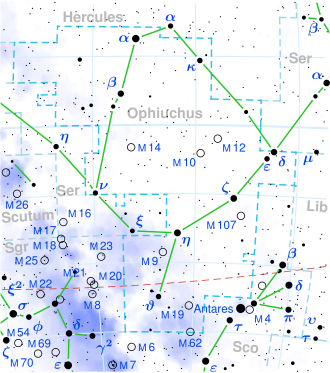
  | |
| Observation data Epoch J2000 Equinox J2000 | |
|---|---|
| Constellation | Ophiuchus |
| Right ascension | 16h 24m 06.18464s1 |
| Declination | −20° 02′ 14.3784″1 |
| Apparent magnitude (V) | 4.502 |
| Characteristics | |
| Evolutionary stage | horizontal branch3 |
| Spectral type | K0- II-III4 |
| U−B color index | +0.842 |
| B−V color index | +1.032 |
| Astrometry | |
| Radial velocity (Rv) | +0.605 km/s |
| Proper motion (μ) | RA: −20.291 mas/yr Dec.: −47.651 mas/yr |
| Parallax (π) | 16.35±0.25 mas1 |
| Distance | 199 ± 3 ly (61.2 ± 0.9 pc) |
| Absolute magnitude (MV) | 0.8063 |
| Details6 | |
| Mass | 1.61 M☉ |
| Radius | 11.45 R☉ |
| Luminosity | 65.9 L☉ |
| Surface gravity (log g) | 2.56 cgs |
| Temperature | 4,864 K |
| Metallicity [Fe/H] | −0.20 dex |
| Rotational velocity (v sin i) | < 1.07 km/s |
| Other designations | |
| ψ Oph, 4 Ophiuchi, BD−19°4365, FK5 1373, GC 22042, HD 147700, HIP 80343, HR 6104, SAO 1598928 | |
| Database references | |
| SIMBAD | data |
Psi Ophiuchi, which is Latinized from ψ Ophiuchi, is a single9 star in the equatorial constellation of Ophiuchus, next to the western constellation border with Scorpius. It has an orange hue and is visible to the naked eye as a faint point of light with an apparent visual magnitude of 4.50.2 It is approximately 199 light-years from Earth, based on parallax.1
It is an aging giant or bright giant star with a stellar classification of K0- II-III,4 indicating it has exhausted the supply of hydrogen at its core, then cooled and expanded. It presently has 11 times the girth of the Sun and 1.6 times the Sun's mass.6 It is a red clump giant, meaning it is on the horizontal branch and is generating energy through core helium fusion.3 It is radiating 66 times the luminosity of the Sun from its swollen photosphere at an effective temperature of 4,864 K.6
References
References
- Van Leeuwen, F. (2007). "Validation of the new Hipparcos reduction". Astronomy and Astrophysics. 474 (2): 653–664. arXiv:0708.1752. Bibcode:2007A&A...474..653V. doi:10.1051/0004-6361:20078357. S2CID 18759600. Vizier catalog entry
- Ducati, J. R. (2002). "VizieR Online Data Catalog: Catalogue of Stellar Photometry in Johnson's 11-color system". CDS/ADC Collection of Electronic Catalogues. 2237. Bibcode:2002yCat.2237....0D.
- Liu, Y. J.; et al. (2007). "The abundances of nearby red clump giants". Monthly Notices of the Royal Astronomical Society. 382 (2): 553. Bibcode:2007MNRAS.382..553L. doi:10.1111/j.1365-2966.2007.11852.x.
- Keenan, Philip C.; McNeil, Raymond C. (1989). "The Perkins catalog of revised MK types for the cooler stars". Astrophysical Journal Supplement Series. 71: 245. Bibcode:1989ApJS...71..245K. doi:10.1086/191373.
- Gontcharov, G. A. (2006). "Pulkovo Compilation of Radial Velocities for 35 495 Hipparcos stars in a common system". Astronomy Letters. 32 (11): 759–771. arXiv:1606.08053. Bibcode:2006AstL...32..759G. doi:10.1134/S1063773706110065. S2CID 119231169.
- Reffert, Sabine; et al. (2015). "Precise radial velocities of giant stars". Astronomy & Astrophysics. 574: A116. arXiv:1412.4634. Bibcode:2015A&A...574A.116R. doi:10.1051/0004-6361/201322360. hdl:10722/215277. S2CID 59334290. Vizier catalog entry
- De Medeiros, J. R.; Alves, S.; Udry, S.; Andersen, J.; Nordström, B.; Mayor, M. (2014). "A catalog of rotational and radial velocities for evolved stars". Astronomy & Astrophysics. 561: A126. arXiv:1312.3474. Bibcode:2014A&A...561A.126D. doi:10.1051/0004-6361/201220762. S2CID 54046583. Vizier catalog entry
- "psi Oph". SIMBAD. Centre de données astronomiques de Strasbourg. Retrieved 2019-10-26.
- Eggleton, P. P.; Tokovinin, A. A. (September 2008). "A catalogue of multiplicity among bright stellar systems". Monthly Notices of the Royal Astronomical Society. 389 (2): 869–879. arXiv:0806.2878. Bibcode:2008MNRAS.389..869E. doi:10.1111/j.1365-2966.2008.13596.x. S2CID 14878976.