| Oropendola | |
|---|---|
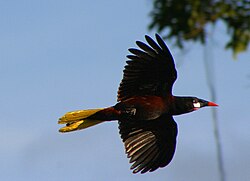
| |
| Montezuma oropendola (Psarocolius montezuma) | |
Scientific classification 
| |
| Kingdom: | Animalia |
| Phylum: | Chordata |
| Class: | Aves |
| Order: | Passeriformes |
| Family: | Icteridae |
| Genus: | Psarocolius Wagler, 1827 |
| Type species | |
| Oriolus cristatus Gmelin, 1788=Xanthornus decumanus Pallas, 1769 | |
| Species | |
|
See text | |
| Synonyms | |
| |
Oropendolas are a genus of passerine birds, Psarocolius, in the New World blackbird family Icteridae which are native to Central and South America.
They were once divided into two or three separate genera, but this is no longer the case. All oropendolas are large birds with pointed bills and long tails that are at least partly bright yellow. Males are typically larger than females. The plumage is typically chestnut, dark brown or black, although the green oropendola and olive oropendola have, as their names imply, an olive coloration to the head, breast and upper back. The legs are dark, but the bill is usually a strikingly contrasting feature, either pale yellow, or red-tipped with a green or black base. In several species there is also a blue or pink bare cheek patch.
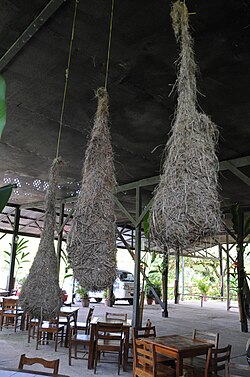
Oropendolas are birds associated with forests or, for a few species, more open woodland. These social birds feed on large insects and fruit. They are highly vocal and produce a wide variety of songs and calls, sometimes including mimicry. They are colonial breeders, with several long woven basket nests in a tree, each hanging from the end of a branch.
Taxonomy
The genus Psarocolius was introduced in 1837 by the German naturalist Johann Georg Wagler.1 The genus name combines the Ancient Greek ψαρ/psar, ψαρος/psaros meaning "starling" with κολοιος/koloios "jackdaw".2 Wagler did not specify a type species but in 1855 the English zoologist George Gray designated the type as Oriolus cristatus Gmelin, 1788.3 This a junior synonym of Xanthornus decumanus Pallas, 1769, the crested oropendola.45
The genus contains nine species:6
| Image | Common name | Scientific name | Distribution |
|---|---|---|---|
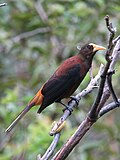 |
Russet-backed oropendola | Psarocolius angustifrons | 
|
 |
Dusky-green oropendola | Psarocolius atrovirens | 
|
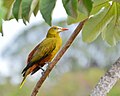 |
Green oropendola | Psarocolius viridis | 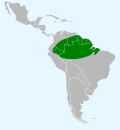
|
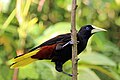 |
Crested oropendola | Psarocolius decumanus | 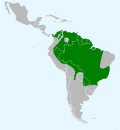
|
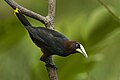 |
Chestnut-headed oropendola | Psarocolius wagleri | 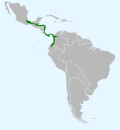
|
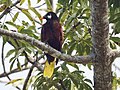 |
Montezuma oropendola | Psarocolius montezuma | 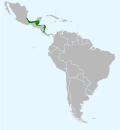
|
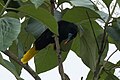 |
Black oropendola | Psarocolius guatimozinus | 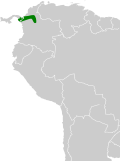
|
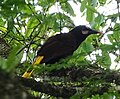 |
Baudo oropendola | Psarocolius cassini | 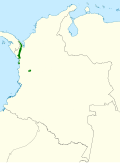
|
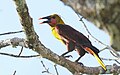 |
Olive oropendola | Psarocolius bifasciatus | 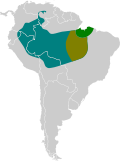
|
In 2002 Jordan Price and Scott Lanyon studied the phylogeny of the oropendolas using mtDNA cytochrome b and NADH dehydrogenase subunit 2 sequences. As can be observed from morphology, the band-tailed (Ocyalus latirostris) and the casqued oropendolas (Psarocolius oseryi) are the most distinct species. Genetically, they appear to be more closely related to the caciques, and both species would be classified in the genus Ocyalus. Furthermore, the casqued oropendola could be separated into Clypicterus, forming what would then become a monotypic genus (like Ocyalus).
Below is a cladogram based on the 2002 phylogenetic analysis' maximum likelihood phylogenetic tree:7
References
References
- Wagler, Johann Georg (1827). Systema Avium (in Latin). Stuttgart: sumtibus J.G. Cottae. pp. 337–338.
- Jobling, James A. "Psarocolius". The Key to Scientific Names. Cornell Lab of Ornithology. Retrieved 21 March 2026.
- Gray, George Robert (1855). Catalogue of the Genera and Subgenera of Birds Contained in the British Museum. London: British Museum. p. 68.
- Paynter, Raymond A. Jr, ed. (1968). Check-List of Birds of the World. Vol. 14. Cambridge, Massachusetts: Museum of Comparative Zoology. p. 138.
- Dickinson, E.C.; Christidis, L., eds. (2014). The Howard & Moore Complete Checklist of the Birds of the World. Vol. 2: Passerines (4th ed.). Eastbourne, UK: Aves Press. p. 371. ISBN 978-0-9568611-2-2.
- AviList Core Team (2025). "AviList: The Global Avian Checklist, v2025". doi:10.2173/avilist.v2025. Retrieved 21 March 2026.
- Price, J. Jordan; Lanyon, Scott M. (2002). "A robust phylogeny of the oropendolas: Polyphyly revealed by mitochondrial sequence data". Auk. 119 (2): 335–348. doi:10.1642/0004-8038(2002)119[0335:arpoto]2.0.co;2.
- ffrench, Richard; O'Neill, John Patton & Eckelberry, Don R. (1991): A guide to the birds of Trinidad and Tobago (2nd edition). Comstock Publishing, Ithaca, N.Y.. ISBN 0-8014-9792-2
- Hilty, Steven L. (2003): Birds of Venezuela. Christopher Helm, London. ISBN 0-7136-6418-5
- Jaramillo, Alvaro & Burke, Peter (1999): New World Blackbirds. Christopher Helm, London. ISBN 0-7136-4333-1
- Stiles, F. Gary & Skutch, Alexander Frank (1989): A guide to the birds of Costa Rica. Comistock, Ithaca. ISBN 0-8014-9600-4