| Psammodromus algirus | |
|---|---|
| |
Scientific classification 
| |
| Kingdom: | Animalia |
| Phylum: | Chordata |
| Class: | Reptilia |
| Order: | Squamata |
| Family: | Lacertidae |
| Genus: | Psammodromus |
| Species: | P. algirus
|
| Binomial name | |
| Psammodromus algirus | |

| |
| Range | |
| Synonyms2 | |
| |
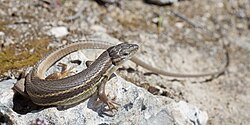
Psammodromus algirus, known commonly as the Algerian psammodromus or the large psammodromus, is a species of lizard in the family Lacertidae.12 The species is found in southwestern Europe and northwestern Africa.2
Subspecies
There are four subspecies:2
- Psammodromus algirus algirus (Linnaeus, 1758)
- Psammodromus algirus doriae Bedriaga, 1886
- Psammodromus algirus nollii Fischer, 1887
- Psammodromus algirus ketamensis Galán, 1931
Geographic range
Psammodromus algirus is found in North Africa (Morocco, Algeria, and Tunisia) and in Southwestern Europe (Iberian Peninsula: Portugal, Spain, Andorra, Gibraltar; southernmost France, and Italy near Lampedusa).2
The IUCN assessment from 2009 treats Psammodromus algirus nollii and Psammodromus algirus ketamensis as full species and restricts Psammodromus algirus to North Africa.1
Habitat
Psammodromus algirus typically occurs in dense bushy vegetation, but it can also venture to more open areas. It can be found at elevations up to 2,600 m (8,500 ft) above sea level, but it is more common at lower elevations.3
Diet
Psammodromus algirus preys mainly on terrestrial arthropods, specifically Orthoptera, Formicidae, Coleoptera, Hemiptera, and Araneae.4
Conservation status
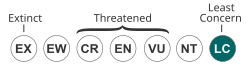
Psammodromus algirus is threatened by habitat loss.1
Description
Ppsammodromus algirus commonly reaches a snout-to-vent length (SVL) of about 7.5 cm (3.0 in), occasionally 9 cm (3.5 in). The tail is 2–3 times the body length. Dorsal colouration is usually metallic brownish with a pair of conspicuous white or yellowish stripes on both sides.3
References
References
- Mateo, J.A.; Cheylan, M.; Nouira, M.S.; Joger, U.; Sá-Sousa, P.; Pérez Mellado, V.; Martinez Solano, I.; Sindaco, R. (2016) [errata version of 2009 assessment]. "Psammodromus algirus". IUCN Red List of Threatened Species. 2009 e.T61558A86629654. doi:10.2305/IUCN.UK.2009.RLTS.T61558A12491246.en. Retrieved 14 June 2023.
- Psammodromus algirus at the Reptarium.cz Reptile Database
- Arnold, E. Nicholas; Ovenden, Denys (2002). A Field Guide to the Reptiles and Amphibians of Britain and Europe (2 ed.). London: Collins. ISBN 978-0-00-219964-3. 228 pp. + Plates 1–49. (Psammodromus algirus, pp. 127–128 + Plate 21, figure 2 + Map 90).
- Moreno-Rueda, Gregorio; Melero, Elena; Reguera, Senda; Zamora-Camacho, Francisco J; Álvarez-Benito, Inés (2018). "Prey availability, prey selection, and trophic niche width in the lizard Psammodromus algirus along an elevational gradient". Current Zoology. 64 (5): 603–613. doi:10.1093/cz/zox077. PMC 6178790.
Further reading
Further reading
- Boulenger GA (1887). Catalogue of the Lizards in the British Museum (Natural History). Second Edition. Volume III. Lacertidæ .... London: Trustees of the British Museum. (Taylor and Francis, printers). xii + 575 pp. + Plates I–XL. (Psammodromus algirus, new combination, p. 50).
- Linnaeus C (1758). Systema naturæ per regna tria naturæ, secundum classes, ordines, genera, species, cum characteribus, differentiis, synonymis, locis. Tomus I. Editio Decima, Reformata. Stockholm: L. Salvius. 824 pp. (Lacerta algira, new species, p. 203). (in Latin).