| Protorohippus Temporal range: Eocene (Wasatchian)
| |
|---|---|
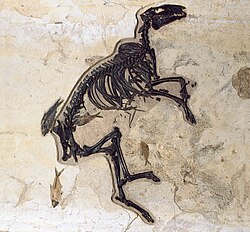
| |
| Fossil from the Green River Formation | |
Scientific classification 
| |
| Kingdom: | Animalia |
| Phylum: | Chordata |
| Class: | Mammalia |
| Infraclass: | Placentalia |
| Order: | Perissodactyla |
| Family: | Equidae |
| Genus: | †Protorohippus Wortman, 1896 |
| Type species | |
| Protorohippus venticolum (Cope, 1881)
| |
| Species | |
| |
| Synonyms | |
| |
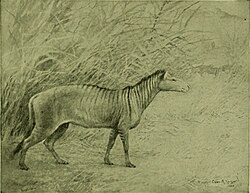
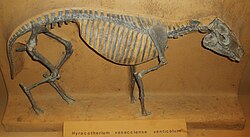
Protorohippus (Latin: "before" (pro), + Greek: "mountain" (oros), "horse" (hippos)1) is an extinct genus of equid that lived in the Eocene of North America.2
Palaeobiology
Based on oxygen and carbon isotope analysis of the teeth of P. montanum, the species is believed to have had two distinct birth seasons per year, a result of the diminished seasonality during the Early Eocene. It is possible that this phenomenon held for other early equids as well.3
References
References
- "Glossary. American Museum of Natural History". Archived from the original on 20 November 2021.
- Froehlich, D. J. (2002). "Quo vadis eohippus? The systematics and taxonomy of the early Eocene equids (Perissodactyla)". Zoological Journal of the Linnean Society. 134 (2): 141–256. doi:10.1046/j.1096-3642.2002.00005.x.
- D’Ambrosia, Abigail R.; Clyde, William C.; Fricke, Henry C.; Chew, Amy E. (15 November 2014). "Stable isotope patterns found in early Eocene equid tooth rows of North America: Implications for reproductive behavior and paleoclimate". Palaeogeography, Palaeoclimatology, Palaeoecology. 414: 310–319. Bibcode:2014PPP...414..310D. doi:10.1016/j.palaeo.2014.09.014. Retrieved 21 February 2025 – via Elsevier Science Direct.