| Protobothrops elegans | |
|---|---|
| |
Scientific classification 
| |
| Kingdom: | Animalia |
| Phylum: | Chordata |
| Class: | Reptilia |
| Order: | Squamata |
| Suborder: | Serpentes |
| Family: | Viperidae |
| Genus: | Protobothrops |
| Species: | P. elegans
|
| Binomial name | |
| Protobothrops elegans (Gray, 1849)
| |
| Synonyms | |
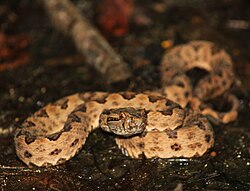
Protobothrops elegans is a pit viper species endemic to Japan in the southern Ryukyu Islands.13 No subspecies are currently recognized.34 Common names include: elegant pit viper,1345 Sakishima habu (サキシマハブ),6 and elegant tree viper.7
Description
Scalation of Protobothrops elegans includes 25 (sometimes 23) rows of dorsal scales at midbody, 179–192 (males) or 182–196 (females) ventral scales, 63–90 subcaudal scales, and 8 (sometimes 7 or 9) supralabial scales.5
During 1965–2011, 2447 snakebites from this snake are reported with one fatality.8
Geographic distribution
Protobothrops elegans is found in Japan in the southern Ryukyu Islands, specifically in the Yaeyama Islands.1 The type locality is unknown. Boulenger listed it as "---- ?" while Gray's original 1849 description gives "West Coast of [North?] America." A restriction to "Ishigaki-Shima [Ryukyu Islands, Japan]" was proposed by Stejneger (1907).2
References
References
- Ota, H.; Kidera, N. (2018). "Protobothrops elegans". IUCN Red List of Threatened Species. 2018 e.T96265465A96265478. doi:10.2305/IUCN.UK.2018-2.RLTS.T96265465A96265478.en. Retrieved 15 August 2022.
- McDiarmid RW, Campbell JA, Touré TA (1999). Snake Species of the World: A Taxonomic and Geographic Reference, Volume 1. Washington, District of Columbia: Herpetologists' League. 511 pp. ISBN 1-893777-00-6 (series). ISBN 1-893777-01-4 (volume).
- Protobothrops elegans at the Reptarium.cz Reptile Database. Accessed 15 August 2022.
- "Trimeresurus elegans". Integrated Taxonomic Information System. Retrieved 15 August 2022.
- Gumprecht A, Tillack F, Orlov NL, Captain A, Ryabov S (2004). Asian Pitvipers. (First Edition). Berlin: GeitjeBooks. 368 pp. ISBN 3-937975-00-4.
- Mehrtens JM (1987). Living Snakes of the World in Color. New York: Sterling Publishers. 480 pp. ISBN 0-8069-6460-X.
- Brown JH (1973). Toxicology and Pharmacology of Venoms from Poisonous Snakes. Springfield, Illinois: Charles C. Thomas. 184 pp. LCCCN 73-229. ISBN 0-398-02808-7.
- Matsuda, Seiko. 沖縄県における平成23 年の毒蛇咬症 [2011 Venomous Snakebite in Okinawa Prefecture] (PDF) (in Japanese). Okinawa Prefectural Institute of Health and Environment, Hygiene Science Group Eiko Maho. Archived from the original (PDF) on 2013-05-02. Retrieved 2013-03-11.
Further reading
Further reading
- Gray, J.E. (1849). Catalogue of the Specimens of Snakes in the Collection of the British Museum. London: Trustees of the British Museum. xv + 125 pp. (Craspedocephalus elegans, new species, p. 7.)