| formimidoyltransferase cyclodeaminase | |||||||
|---|---|---|---|---|---|---|---|
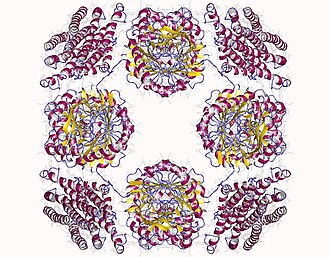 Formiminotransferase cyclodeaminase homooctamer, Rattus norvegicus | |||||||
| Identifiers | |||||||
| Symbol | FTCD | ||||||
| Alt. names | formiminotransferase cyclodeaminase | ||||||
| NCBI gene | 10841 | ||||||
| HGNC | 3974 | ||||||
| OMIM | 606806 | ||||||
| RefSeq | NM_006657 | ||||||
| UniProt | O95954 | ||||||
| Other data | |||||||
| Locus | Chr. 21 q22.3 | ||||||
| |||||||
Formimidoyltransferase cyclodeaminase or formiminotransferase cyclodeaminase (gene symbol FTCD in humans) is a bifunctional enzyme that catalyzes the following reactions:1
- conversion of formiminoglutamate and tetrahydrofolate into formiminotetrahydrofolate and glutamate (glutamate formimidoyltransferase activity, EC 2.1.2.5)
- subsequent deamination of formiminotetrahydrofolate to 5,10-methenyltetrahydrofolate and ammonia (formimidoyltetrahydrofolate cyclodeaminase activity, EC 4.3.1.4)
Its name comes from the two activities it catalyzes.
Role in pathology
Mutations of the FTCD gene cause glutamate formiminotransferase deficiency.1
References
References
- "Glutamate formiminotransferase deficiency". NIH. GARD. August 10, 2016. Archived from the original on December 29, 2016. Retrieved December 21, 2020.