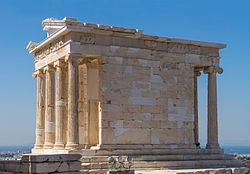
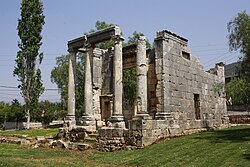
Prostyle and Prostylos (Greek: πρόστυλος), literally meaning "with columns in front",1 is an architectural term designating temples (especially Greek and Roman) featuring a row of columns on the front.2 The term is often used as an adjective when referring to the portico of a classical building, which projects from the main structure. First used in Etruscan and Greek temples, this motif was later incorporated by the Romans into their temples.
Examples of prostyle include the Temple of Athena Nike, Akropolis, Athens, a prostyle tetrastyle (i.e. with four columns). There are also prostyle hexastyle and prostyle octastyle temples.
This architectural element probably originated in the eastern Greek isles in the 8th century BC, but there are also many examples in archaic temples in southern Italy.3
The subsequent evolution of temple design came with the amphiprostyle, where there are rows of columns both in front and at the back of the temple.
Notes
Notes
- Harry Thurston Peck, Harpers Dictionary of Classical Antiquities (1898), Prostylos
- Fleming, John; et al. (1981). The Penguin Dictionary of Architecture. Harmondsworth, Middlesex, England: Penguin Books. p. 254.
- "Annuario della Società Botanica Italiana 1935". Giornale Botanico Italiano. 42 (1): 244–249. January 1935. doi:10.1080/11263503509437934. ISSN 0017-0070.