| Propliopithecus Temporal range:
| |
|---|---|
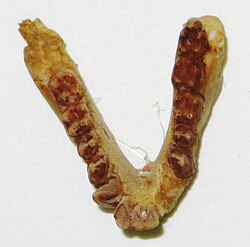
| |
| Propliopithecus haeckeli | |
Scientific classification 
| |
| Kingdom: | Animalia |
| Phylum: | Chordata |
| Class: | Mammalia |
| Infraclass: | Placentalia |
| Order: | Primates |
| Infraorder: | Simiiformes |
| Superfamily: | †Propliopithecoidea |
| Family: | †Propliopithecidae |
| Genus: | †Propliopithecus Schlosser, 1910 |
| Type species | |
| †Propliopithecus haeckeli Schlosser 1911
| |
| Species | |
| |
| Synonyms1 | |
| |
Propliopithecus is an extinct genus of primate.
The 40 cm (1 ft 4 in) long creature resembled today's gibbons. Its eyes faced forwards, giving it stereoscopic vision. Propliopithecus was most likely an omnivore. It is possible that Propliopithecus is the same creature as Aegyptopithecus. If that would be the case the name Propliopithecus would take precedence over Aegyptopithecus according to ICZN rules, because it was coined earlier.2
Human-like dental features
Propliopithecus had small canine teeth, lacked spaces to fit the canine teeth of the other jaw into, and had molars very similar to those of Australopithecus. These features set Propliopithecus apart from Aegyptopithecus, which had big canine teeth along with other more normal simian dental features.34
Palaeobiology
Palaeoecology
The low rates of tooth chipping in Propliopithecus suggests that it did not regularly consume hard foods. Multiple instances of dental caries are known from P. chirobates, suggesting it ate a diet of soft and sweet fruits.5
References
References
- "†Propliopithecus Schlosser 1911 (monkey)". FossilWorks. Retrieved 20 February 2019.
- Palmer, Douglas (1999). The Marshall Illustrated Encyclopedia of Dinosaurs & Prehistoric animals. London: Marshall Editions Developments Ltd. ISBN 978-3-8290-6747-8.
- Yves Coppens: Ape, Africa and Man
- Bjorn Kurten: The age of mammals
- Towle, Ian; Borths, Matthew Robert; Loch, Carolina (13 December 2023). "Tooth chipping patterns and dental caries suggest a soft fruit diet in early anthropoids". American Journal of Biological Anthropology. 183 (2). doi:10.1002/ajpa.24884. ISSN 2692-7691. Retrieved 17 January 2026 – via Wiley Online Library.