| Component type | Passive |
|---|---|
| Inventor | General Electric1 |
| Pin names | anode, gate and cathode |
| Electronic symbol | |
 | |
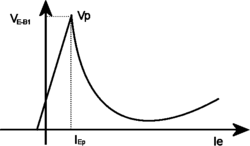
A programmable unijunction transistor (PUT) is a three-lead electronic semiconductor device which is similar in its characteristics to a unijunction transistor (UJT), except that its behavior can be controlled using external components. In a UJT, the base region is divided into two parts by the emitter. The two parts of the base form a voltage divider, which sets the operating point of the UJT. That voltage divider can be programmed with two physical resistors connected to the gate terminal of the PUT. This allows the designer some control over the operating point of the PUT.2
Construction
In construction, the programmable transistor is similar to the silicon controlled rectifier (SCR). Like SCR, it consists of four layers ‒ PNPN ‒ but its gate is connected to the second layer (N-type), not the third one (P-type) as with SCR.1
Applications
- It is used to trigger thyristors.
- It is also used as a relaxation oscillator.
As of 2012 ON Semiconductor manufactured a part: 2N6027. 2N6028 was also made in the past.1
References
References
- Jim Keith. "Programmable Unijunction Transistor Flasher". Archived from the original on 2018-03-05.
- "PUT - Programmable Unijunction Transistor - Working, Construction, Biasing - D&E notes". www.daenotes.com. 15 December 2017. Archived from the original on 2018-01-05.