| Procervulus Temporal range: Miocene
| |
|---|---|
| |
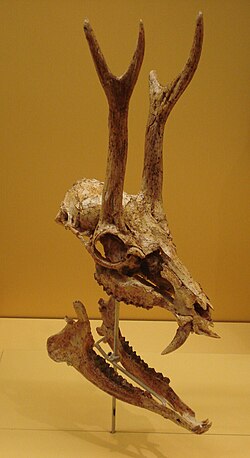
| Skull, Museum Mensch und Natur, München | |
Scientific classification 
| |
| Kingdom: | Animalia |
| Phylum: | Chordata |
| Class: | Mammalia |
| Infraclass: | Placentalia |
| Order: | Artiodactyla |
| Family: | Cervidae |
| Subfamily: | †Procervulinae |
| Genus: | †Procervulus |
Procervulus is an extinct genus of deer found in Europe.1 It possessed horns that were not shed.2
Palaeobiology
Life history
Enamel histology reveals Procervulus ginsburgi had a rapid daily secretion rate (DSR) and enamel extension rate (EER) as well as a short crown formation time (CFT), each of these variables suggesting a fast life history for this species. This is in contrast to Procervulus praelucidus, whose life history was significantly slower.3
-
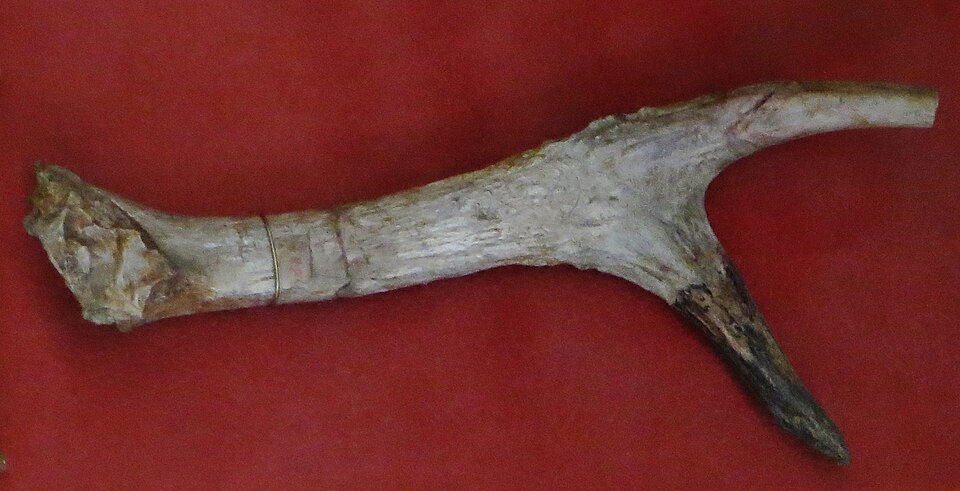 Antler of Procervulus aurelianensis
 -
 Procervulus dichotomus Left Hemi-Mandible MHNT
References
References
- Pilgrim, G. E. (1941). "X.—The relationship of certain variant fossil types of "horn" to those of the living Pecora". Journal of Natural History. Series 11. 7 (38): 172–184. doi:10.1080/00222934108527149.
- Ginsburg, L. (1988). "La faune des mammifères des sables Miocènes du synclinal d'Esvres (Val de Loire)" [The mammalian fauna of the Miocene sands of the syncline Esvres (Loire Valley)]. Comptes Rendus de l'Académie des Sciences. II (in French): 319–22.
- Cuccu, Andrea; Calderón, Teresa; Azanza, Beatriz; DeMiguel, Daniel (23 January 2025). "First insights into the life history of the Early Miocene deer Procervulus ginsburgi from Spain". Journal of Anatomy. 247 (3–4): 842–855. doi:10.1111/joa.14220. ISSN 0021-8782. PMC 12397087. PMID 39854115. Retrieved 14 May 2026 – via Wiley Online Library.