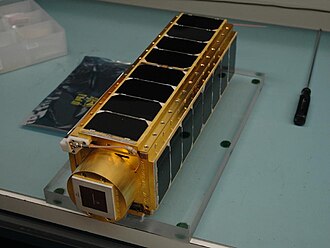
 PRESat satellite | |
| Mission type | Technology demonstration |
|---|---|
| Operator | NASA |
| COSPAR ID | 2008-F01 |
| Mission duration | Failed to orbit 60 days (planned) |
| Spacecraft properties | |
| Bus | 3U CubeSat |
| Manufacturer | NASA Ames Research Center |
| Launch mass | 4.5 kg (9.9 lb) |
| Power | Solar cells and batteries |
| Start of mission | |
| Launch date | 3 August 2008, 03:34 UTC |
| Rocket | Falcon 1 # 3 |
| Launch site | Kwajalein Atoll, Omelek |
| Contractor | SpaceX |
| Orbital parameters | |
| Reference system | Geocentric orbit (planned)1 |
| Regime | Low Earth orbit |
| Perigee altitude | 330.0 km (205.1 mi) |
| Apogee altitude | 685.0 km (425.6 mi) |
| Inclination | 9° |
| Period | 90.0 minutes |
PharmaSat Risk Evaluation Satellite (or PRESat) nanosatellite, for NASA, was about the size of a loaf of bread, weighed about 4.5 kg (9.9 lb) and was constructed in six months.2
Spacecraft
The PRESat, 3U CubeSat, contained a micro-laboratory with a controlled environment packed with sensors and optical systems that could detect the growth, density and health of yeast cells. PRESat was to demonstrate its ability to create a space science laboratory using environment control techniques to monitor the levels of pressure, temperature and acceleration.2
Launch
The satellite was lost in the failure of the third Falcon 1 launch, on 3 August 2008, at 03:34 UTC.3
Mission
Although NASA was not able to test this payload in space, NASA mission managers and payload engineers achieved success in this low-cost mission by rapidly pulling together expertise from across the agency to develop, build and ground-test a fundamental space biology micro-laboratory. The communications team also successfully established a fully operational South Pacific Ground Communication System using two ground stations, which were transported and installed at Kwajalein Atoll in the Marshall Islands and at the Universidad Centroamericana in El Salvador.2
References
References
- "PRESat". Gunter's Space Page. 11 December 2017. Retrieved 15 October 2021.
- "NASA Nanosatellites Catch Ride on Rocket, Demonstrate Technology". SpaceNews. 31 July 2008. Retrieved 3 August 2025.
- "Launch Log". Jonathan's Space Report. 21 July 2021. Retrieved 15 October 2021.