| Praearcturus Temporal range:
| |
|---|---|
| |
| Lectotype specimen of P. gigas | |
Scientific classification 
| |
| Kingdom: | Animalia |
| Phylum: | Arthropoda |
| Subphylum: | Chelicerata |
| Class: | Arachnida |
| Order: | Scorpiones |
| Family: | †Praearcturidae |
| Genus: | †Praearcturus Woodward, 1871 |
| Species: | †P. gigas
|
| Binomial name | |
| †Praearcturus gigas Woodward, 1871
| |
| Synonyms | |
| |
Praearcturus is an extinct genus of arthropod, most likely a scorpion, known from the Devonian period of what is now Britain. It is the only genus in the family Praearcturidae and contains the single species P. gigas.
Taxonomic history
The type fossil was discovered in Rowlestone, England, and was described as a giant isopod in 1871 by Henry Woodward.12 It was later interpreted as a scorpion by Rolfe (1980), who claimed that it was based on the personal communications by L. Størmer (1974) and E. N. Kjellesvig-Waering (1978) and the published figures by Rolfe (1969).3 While type specimen is from the Lower Devonian of Old Red Sandstone,45 single tergite remain is known from Lower Devonian of Wyoming and fragmentary cuticles referrable to this genus is known from Famennian of Portishead.46 Based on comparisons to modern scorpions, the species could have reached a total length of nearly 1 metre (3.3 ft), possibly making it one of the largest scorpions known.7
However, Dunlop and Garwood expressed uncertainty regarding the scorpion interpretation for Praearcturus in 2024, for the fragmentary type material seemed to lack definitive features of scorpions and arachnids.5 In the same year, Braddy also questioned its identity as a scorpion and considered that the original interpretation as a crustacean is more likely, with the supposed pedipalp (claw) of a scorpion more likely being a cheliped of a crustacean. He further supported his argument based on the "grooves and pustular ornament on its carapace and cheliped, and recurved first tergum", and suggested that Bennettarthra could be synonymous with Praearcturus as both taxa show similar morphological features.8
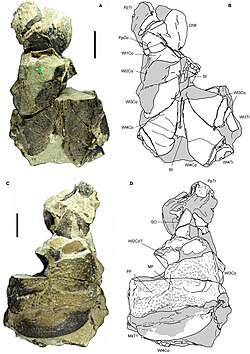
In 2026, Howard and colleagues recorded photographs and CT scans of the lectotype and other assigned remains of Praearcturus, and argued that the taxon most likely represents a scorpion. They suggested that the shape of its sternum most closely resembles that of Eramoscorpius, and that its carapace and chelae are similar to those of other scorpions, though noted that its large size and opisthosoma with epimera (triangular lateral extensions of tergite) may possibly indicate an aquatic or semi-aquatic lifestyle. Additionally, they agreed with Braddy (2024) that Bennetarthra is a junior synonym based on comparison of their type material, and further proposed that Brontoscorpio is also possibly synonymous with Praearcturus, as the original materials of both species are considered indistinguishable from P. gigas.9
References
References
- "Mindat.org". www.mindat.org. Retrieved 2021-12-28.
- Woodward, H. (1871). "On the remains of a giant isopod Praearcturus gigas (H. Woodward) from the Old Red Sandstone of Rowlestone quarry, Herefordshire". Transactions of the Woolhope Field Naturalist's Club. 1870: 266–270.
- Rolfe, W.D.I. (1980). "Early Invertebrate Terrestrial Faunas" (PDF). In Panchen, A.L. (ed.). The Terrestrial Environment and the Origin of Land Vertebrates. Vol. Systematics Association Special 15. Academic Press. pp. 117–157.
- Kjellesvig-Waering, E. N. (1986). "A restudy of the fossil Scorpionida of the world". Palaeontographica Americana. 55: 1–287.
- Dunlop, Jason A.; Garwood, Russell J. (2024-12-06). "A review of fossil scorpion higher systematics". PeerJ. 12 e18557. doi:10.7717/peerj.18557. ISSN 2167-8359. PMC 11627080.
- Lamsdell, James C.; Braddy, Simon J.; Tetlie, O. E. (2009). "Redescription of Drepanopterus abonensis (Chelicerata: Eurypterida: Stylonurina) from the late Devonian of Portishead, UK". Palaeontology. 52 (5): 1113–1139. Bibcode:2009Palgy..52.1113L. doi:10.1111/j.1475-4983.2009.00902.x. S2CID 129243775.
- Dunlop, J. A.; Selden, P. A. (2013). "Scorpion fragments from the Silurian of Powys, Wales" (PDF). Arachnology. 16 (1): 27–32. doi:10.13156/arac.2013.16.1.27. S2CID 128679832.
- Braddy, S. J. (2024). "Carcinosomatoid eurypterid palaeoecology and phylogeny: ichnology and palaeocommunities". Neues Jahrbuch für Geologie und Paläontologie – Abhandlungen. 312 (2): 167–181. doi:10.1127/njgpa/2024/1206.
- Howard, Richard J.; Garwood, Russell J.; Edgecombe, Gregory D.; Legg, David A. (2026). "A revision of Praearcturus gigas : a giant scorpion from the Lower Devonian (Lochkovian) of Britain". Palaeontology. 69 (3). doi:10.1111/pala.70064. ISSN 0031-0239.