| Primary pigmented nodular adrenocortical disease | |
|---|---|
| Other names | PPNAD |
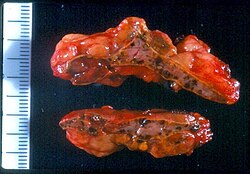 | |
| Macroscopic appearance of adrenal gland in PPNAD following adrenalectomy | |
Primary pigmented nodular adrenocortical disease (PPNAD) was first reported in 1984 by Carney et al. PPNAD is a rare form of adrenocorticotropic hormone (ACTH)-independent Cushing's syndrome, resulting in the enlargement of the cortex of the adrenal glands.1
It often occurs in association with Carney complex (CNC), a rare syndrome that involves the formation of abnormal tumours that cause endocrine hyperactivity.
Signs and symptoms


PPNAD is a rare cause of high cortisol levels in the blood.23
PPNAD can present with overt, subclinical, cyclic, or atypical forms of hypercortisolism, which can make diagnosis difficult4. The effects of PPNAD can often be cyclical so the symptoms of Cushing's syndrome will not always be as severe, which may complicate diagnosis.5 High cortisol levels can lead to psychological disturbances such as anxiety or depression and insomnia. Bone health can deteriorate, leading to an increased fracture risk.6
The classic symptoms of Cushing's syndrome include rapid central weight gain, a puffy red face (also known as 'moon face'), and a buffalo hump at the back of the neck due to fat deposits. Skin changes in Cushing's syndrome include thinning and bruising easily, developing striae and hyperpigmentation at skin folds. The hormonal changes can lead to hirsutism, males developing breast tissue, females no longer having periods and both sexes may become infertile.
PPNAD often occurs in late childhood or adolescents,3 and patients may have a shorter stature than average, due to ACTH-dependent growth suppression.6 Women have a significantly higher prevalence of PPNAD than men, with women being diagnosed at a younger age.7
CNC is found to be a co-morbidity with PPNAD within 66% of patients, and 94.29% of patients with PPNAD will have osteoporosis/osteopenia.4
CNC is usually inherited, however it can also occur sporadically.8 A visible sign of CNC is abnormal, spotty skin hyperpigmentation. There may also be myxomas which can appear as lumps in the skin and breast as well as often being present in the heart, which can lead to multiple cardiovascular problems.9 The majority of people with PPNAD will have some of these signs/symptoms due to the strong association between PPNAD and CNC.
Characterisation
PPNAD is characterised by small, pigmented micronodules on the adrenal cortex which often produce cortisol.4
Causes
The main cause of isolated PPNAD is a mutation of PRKAR1α, located at chromosome 17q22-24, which is the gene encoding the regulatory R1α subunit of protein kinase A (PKA). Germline heterozygous PRKAR1α inactivation mutations are present in 80% of CNC patients affected by Cushing's syndrome.410 There are over 117 mutations of the PRKAR1α gene that can cause CNC, with many of these mutations producing premature stop codons, thus resulting in the complete loss of PRKAR1α protein. CNC patients have also been discovered with an unusually shortened PRKAR1α protein, detected in tumours and leukocytes, following a splice-site mutation, which causes exon-6 skipping.11 Therefore, both haploinsufficiency and the complete loss of PRKAR1α can lead to the increased PKA activity observed in PPNAD patients, due to the disruption of the cyclic-adenosine monophosphate (cAMP) signalling pathway.12 cAMP signalling is important in endocrine function and development, and dysregulation can lead to disease.12
Sahut-Barnola et al. used a mice model to conditionally knockout the PRKAR1A gene from cells of the adrenal cortex and observed that PRKAR1A gene knockout resulted in the development of pituitary gland-independent Cushing's syndrome, as well as an increase in PKA activity.13 The R1α loss caused the adrenal glands to become hyperactive and hyperplastic, through the resurgence of fetal-like cells with cell renewal defects within the adult adrenal cortex, which resulted in tumor growths. This mouse KO model reflects development of PPNAD in human cases.13
Inactivation of phosphodiesterase 11 A4 (PDE11A4), located at 2q31-5, has also been identified in PPNAD patients without PRKAR1α mutations. PDE11A4 is another participant of the cAMP signalling pathway.14
Diagnosis
Diagnosis usually occurs upon histological investigation for causes of suspected Cushing's syndrome. High levels of cortisol observed in patients with PPNAD are not suppressed upon administration of dexamethasone (dexamethasone suppression test), and upon MRI or CT imaging, the pituitary will show no abnormalities. Measuring ACTH will confirm that the cause of the patients Cushing's syndrome is ACTH-independent. The nature of Cushing's syndrome itself is periodic, which can make diagnosing PPNAD increasingly difficult, and the small nodules on the adrenal glands can be missed on CT.715
Histologically, PPNAD presents as multiple small adrenocorical nodules with cytoplasmic pigmentation and inter-nodular cortical atrophy.4
Diagnosis of PPNAD can be difficult to determine preoperatively as CT scan findings can be variable i.e. appear normal or suggest unilateral adrenal lesions therefore impeding the correct diagnosis. NP-59 scintigraphy may be particularly useful in identifying the bilateral nature of the disease.16
Gene studies are not necessary for diagnosis as there are clear gross and histological diagnostic markers, as the nodules can usually be seen clearly in both cases A positive family history of PPNAD has been shown to be associated with abnormal histological findings, e.g. mitotic figures, which may further hinder diagnosis. At the point where abdominal CT scanning and pituitary fossa MRI show no clear abnormalities, adrenalectomy may be performed.15
Treatment
After diagnosis, it is important for patients to be continually monitored. The most common treatment for PPNAD is replacement therapy and bilateral laparoscopic adrenalectomy; the process by which both adrenal glands are removed by a small incision.2
Patients who have received an adrenalectomy will also be prescribed a replacement therapy of mineralocorticoid and glucocorticoid steroids to maintain physiological levels.1718
References
References
- Larsen, Jennifer L; Cathey, W.J; Odell, William D (1986). "Primary adrenocortical nodular dysplasia, a distinct subtype of cushing's syndrome. Case report and review of the literature". The American Journal of Medicine. 80 (5): 976–84. doi:10.1016/0002-9343(86)90648-0. PMID 3010718.
- Choi, Kyung Mook; Seu, Jae Hong; Kim, Yong Hyun; Lee, Eun Jong; Kim, Sang Jin; Baik, Sei Hyun; Choi, Dong Seop (1995). "Cushing's Syndrome Due to Primary Pigmented Nodular Adrenocortical Disease - A Case Report Reviews of the Literature-". The Korean Journal of Internal Medicine. 10 (1): 68–72. doi:10.3904/kjim.1995.10.1.68. PMC 4532033. PMID 7626560.
- Courcoutsakis, Nikos; Prassopoulos, Panos; Stratakis, Constantine A (2010). "CT Findings of Primary Pigmented Nodular Adrenocortical Disease: Rare Cause of ACTH-Independent Cushing Syndrome". American Journal of Roentgenology. 194 (6): W541. doi:10.2214/AJR.09.4056. PMID 20489078.
- Sun, Julian; Ding, Lin; He, Liping; Fu, Hang; Li, Rui; Feng, Jing; Dong, Jianjun; Liao, Lin (2024-06-26). "The clinical characteristics and pathogenic variants of primary pigmented nodular adrenocortical disease in 210 patients: a systematic review". Frontiers in Endocrinology. 15 1356870. doi:10.3389/fendo.2024.1356870. ISSN 1664-2392. PMC 11240189. PMID 39006359.
- Stratakis, Constantine A; Kirschner, Lawrence S; Carney, J. Aidan (2001). "Clinical and Molecular Features of the Carney Complex: Diagnostic Criteria and Recommendations for Patient Evaluation". The Journal of Clinical Endocrinology & Metabolism. 86 (9): 4041–6. doi:10.1210/jcem.86.9.7903. PMID 11549623.
- Wagner-Bartak, Nicolaus A; Baiomy, Ali; Habra, Mouhammed Amir; Mukhi, Shalini V; Morani, Ajaykumar C; Korivi, Brinda R; Waguespack, Steven G; Elsayes, Khaled M (2017). "Cushing Syndrome: Diagnostic Workup and Imaging Features, with Clinical and Pathologic Correlation". American Journal of Roentgenology. 209 (1): 19–32. doi:10.2214/AJR.16.17290. PMID 28639924.
- Liu, Xinming; Zhang, Siwen; Guo, Yunran; Gang, Xiaokun; Wang, Guixia (November 2022). "Treatment of Primary Pigmented Nodular Adrenocortical Disease". Hormone and Metabolic Research = Hormon- und Stoffwechselforschung = Hormones et Metabolisme. 54 (11): 721–730. doi:10.1055/a-1948-6990. ISSN 1439-4286. PMC 9649297. PMID 36130700.
- Stratakis, Constantine A; Kirschner, Lawrence S; Carney, J. Aidan; Pack, Svetlana D; Taymans, Susan E; Giatzakis, Christoforos; Cho, Yee Sook; Cho-Chung, Yoon S (2000). "Mutations of the gene encoding the protein kinase a type I-alpha regulatory subunit in patients with the Carney complex". Nature Genetics. 26 (1): 89–92. doi:10.1038/79238. PMID 10973256. S2CID 36818715.
- Jain, Sonia; Maleszewski, Joseph J; Stephenson, Christopher R; Klarich, Kyle W (2015). "Current diagnosis and management of cardiac myxomas". Expert Review of Cardiovascular Therapy. 13 (4): 369–75. doi:10.1586/14779072.2015.1024108. PMID 25797902. S2CID 6935363.
- Bertherat, Jérôme (2006). "Carney complex (CNC)". Orphanet Journal of Rare Diseases. 1 21. doi:10.1186/1750-1172-1-21. PMC 1513551. PMID 16756677.
- Gangoda, L; Doerflinger, M; Srivastava, R; Narayan, N; Edgington, L E; Orian, J; Hawkins, C; O'Reilly, L A; Gu, H; Bogyo, M; Ekert, P; Strasser, A; Puthalakath, H (2014). "Loss of Prkar1a leads to Bcl-2 family protein induction and cachexia in mice". Cell Death and Differentiation. 21 (11): 1815–24. doi:10.1038/cdd.2014.98. PMC 4211378. PMID 25012505.
- Kong, Gyeyeong; Lee, Hyunji; Vo, Thuy-Trang T.; Juang, Uijin; Kwon, So Hee; Park, Jisoo; Park, Jongsun; Kim, Seon-Hwan (October 2022). "Functional characteristics and research trends of PDE11A in human diseases (Review)". Molecular Medicine Reports. 26 (4): 298. doi:10.3892/mmr.2022.12814. ISSN 1791-3004. PMC 9434997. PMID 35929507.
- Sahut-Barnola, Isabelle; De Joussineau, Cyrille; Val, Pierre; Lambert-Langlais, Sarah; Damon, Christelle; Lefrançois-Martinez, Anne-Marie; Pointud, Jean-Christophe; Marceau, Geoffroy; Sapin, Vincent; Tissier, Frédérique; Ragazzon, Bruno; Bertherat, Jérôme; Kirschner, Lawrence S; Stratakis, Constantine A; Martinez, Antoine (2010). "Cushing's Syndrome and Fetal Features Resurgence in Adrenal Cortex–Specific Prkar1a Knockout Mice". PLOS Genetics. 6 (6) e1000980. doi:10.1371/journal.pgen.1000980. PMC 2883593. PMID 20548949.
- Cazabat, Laure; Ragazzon, Bruno; Groussin, Lionel; Bertherat, Jérôme (2006). "PRKAR1A mutations in primary pigmented nodular adrenocortical disease". Pituitary. 9 (3): 211–9. doi:10.1007/s11102-006-0266-1. PMID 17036196. S2CID 95749.
- Manipadam, Mariet; Sen, Sudipta; Abraham, Rachel; Simon, Anna (2011). "Primary pigmented nodular adrenocortical disease". Journal of Indian Association of Pediatric Surgeons. 16 (4): 160–2. doi:10.4103/0971-9261.86881. PMC 3221162. PMID 22121318.
- Vezzosi, Delphine; Tenenbaum, Florence; Cazabat, Laure; Tissier, Frédérique; Bienvenu, Marie; Carrasco, Carmen A; Laloi-Michelin, Marie; Barrande, Gaëlle; Lefebvre, Hervé; Hiéronimus, Sylvie; Tabarin, Antoine; Bertagna, Xavier; Legmann, Paul; Vantyghem, Marie-Christine; Bertherat, Jérôme (2015). "Hormonal, Radiological, NP-59 Scintigraphy, and Pathological Correlations in Patients with Cushing's Syndrome Due to Primary Pigmented Nodular Adrenocortical Disease (PPNAD)". The Journal of Clinical Endocrinology & Metabolism. 100 (11): 4332–8. doi:10.1210/jc.2015-2174. PMID 26390100.
- Liu, James K; Fleseriu, Maria; Delashaw, Johnny B; Ciric, Ivan S; Couldwell, William T (2007). "Treatment options for Cushing disease after unsuccessful transsphenoidal surgery". Neurosurgical Focus. 23 (3): E8. doi:10.3171/foc.2007.23.3.10. PMID 17961031.
- Shenoy, B. V; Carpenter, P. C; Carney, J. A (1984). "Bilateral primary pigmented nodular adrenocortical disease. Rare cause of the Cushing syndrome". The American Journal of Surgical Pathology. 8 (5): 335–44. doi:10.1097/00000478-198405000-00002. PMID 6329005.