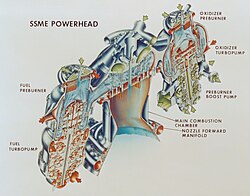
A liquid rocket engine powerhead (or powerpack) is the collective term for the section of a rocket engine consisting of turbopumps, preburners / gas generators, and all the requisite equipment for a non-pressure-fed engine cycle, minus the combustion chamber and the expansion nozzle.12
Components and engine cycle
The principal elements of a powerhead are the turbopumps, which raise propellant pressures from tank to injector levels. A gas generator or one or more preburners that produce relatively cool working gas to drive the turbines, and the ducts, manifolds and valves that route the propellants between them and into the main combustion chamber (in closed cycles) or overboard (in open cycles).3
The complexity of the powerhead is largely set by the engine's thermodynamic cycle. In an open gas-generator cycle, a small fraction of the propellants is burned and the turbine exhaust is dumped overboard, giving a mechanically simple but slightly less efficient powerhead. In a staged combustion cycle the preburner gas is routed into the main chamber instead, raising performance but demanding higher pressures, more demanding seals and more careful materials selection. In a full-flow staged combustion cycle the entire propellant flow passes through two preburners - one fuel-rich, one oxidizer-rich - each driving its own turbopump. Spreading the turbine load across the full propellant flow keeps turbine inlet temperatures lower than in conventional staged combustion.34
Examples
Space Shuttle Main Engine
The RS-25 used a closed, fuel-rich staged combustion cycle. Its powerhead - the two preburners, the hot-gas manifold and the main injector, to which the two high-pressure turbopumps were bolted, was repeatedly redesigned during the Shuttle programme to improve durability, including the introduction of a two-duct hot-gas manifold in 1995, a redesigned high-pressure oxidizer turbopump and a large-throat main combustion chamber.56
Integrated Powerhead Demonstrator
The Integrated Powerhead Demonstrator (IPD) was a joint NASA / Air Force Research Laboratory technology programme run from the mid-1990s through the 2000s with prime contractors Pratt & Whitney Rocketdyne and Aerojet. It was a 1.1 MN (250,000 lbf) ground demonstrator of a hydrogen/oxygen full-flow staged combustion cycle using hydrostatic bearings in the turbopumps in place of conventional rolling-element bearings.4 Component testing of the workhorse preburner and oxidizer turbopump took place at the John C. Stennis Space Center E-1 stand in 2002-2003, followed by integrated tests of the full demonstrator that reached the 100% power level on 12 July 2006, no flight engine was developed.74
J-2X
For the J-2X upper-stage engine, developed by Pratt & Whitney Rocketdyne for the Constellation and Space Launch System programmes, NASA used a dedicated powerpack assembly, designated PPA1A (tested in 2008 with heritage J-2S turbomachinery) and PPA2 (tested in 2012 with new J-2X hardware), to characterize the turbopumps, gas generator and ducting independently of the thrust chamber.8 On 8 June 2012, a 1,150-second PPA2 firing at the Stennis A-1 test stand set a duration record for the centre's A Test Complex. The previous record had been a 1,075-second SSME test in August 1989.9
BE-4
Blue Origin ran parallel full-scale powerpack and injector test programmes during development of the BE-4 methane/oxygen engine. SpaceNews described the powerpack as "the set of valves and turbopumps that provide the proper fuel/oxidizer mix to the injectors and combustion chamber". On 13 May 2017 the company lost a set of powerpack test hardware on one of its West Texas test stands, calling such incidents "not unusual during development".10
Raptor
SpaceX's Raptor, a methane/oxygen full-flow staged combustion cycle engine, became the first engine of that cycle to power a vehicle in flight when it flew on the Starship Super Heavy in April 2023.11
References
References
- Pasquale M Sforza (27 September 2011). Theory of Aerospace Propulsion. Elsevier. p. 441. ISBN 978-0-12-384889-5.
The combustion chamber with its associated equipment and structure is often called the powerhead...
- Chowdhury A, et al. (2016). Conceptual design of a supercritical oxyfuel combustor based on LOX/methane rocket engine technologies. 14th International Energy Conversion Engineering Conference. p. 4636.
- Sutton, George P.; Biblarz, Oscar (2017). "Turbopumps and Their Gas Supplies". Rocket Propulsion Elements (9th ed.). Hoboken, NJ: John Wiley & Sons. ISBN 978-1-118-75365-1.
- "New Rocket Engine Combustion Cycle Technology Testing Reaches 100% Power Level" (Press release). NASA. July 19, 2006. AFRL-06-087. Retrieved May 25, 2026.
- Space Shuttle Main Engine (SSME) Enhancements (PDF) (Report). NASA Marshall Space Flight Center. March 2002. FS-2002-03-60-MSFC. Retrieved May 25, 2026.
Considered the backbone of the engine, the powerhead consists of the main injector and two preburners, or small combustion chambers.
- Biggs, Robert E. (1992). "Space Shuttle Main Engine, The First Ten Years" (PDF). In Doyle, Stephen E. (ed.). History of Liquid Rocket Engine Development in the United States, 1955–1980. American Astronautical Society History Series. Vol. 13. American Astronautical Society. pp. 69–122.
- Sass, J. P.; Raines, N. G.; Ryan, H. M. (May 10–13, 2004). Facility Activation and Characterization for IPD Workhorse Preburner and Oxidizer Turbopump Hot-Fire Testing at NASA Stennis Space Center (PDF). 1st JANNAF Liquid Propulsion Subcommittee Meeting. Las Vegas, NV: NASA. SSTI-8080-0001.
- "NASA's J-2X Engine Kicks Off 2012 with Powerpack Testing" (Press release). NASA. June 5, 2012. Release HQ-12-030. Retrieved May 25, 2026.
The powerpack comprises components on the top portion of the engine, including the gas generator, oxygen and fuel turbopumps, and related ducts and valves that bring the propellants together to create combustion and generate thrust.
- "NASA Surpasses Test Facility Record with J-2X Powerpack Test" (Press release). NASA. June 8, 2012. Retrieved May 25, 2026.
- Foust, Jeff (May 14, 2017). "Blue Origin suffers BE-4 testing mishap". SpaceNews. Retrieved May 25, 2026.
- "SpaceX Raptor". Wikipedia. Retrieved May 25, 2026.