| Powderpost beetle | |
|---|---|

| |
| Dorsal view of Lyctoxylon dentatum | |
Scientific classification 
| |
| Kingdom: | Animalia |
| Phylum: | Arthropoda |
| Clade: | Pancrustacea |
| Class: | Insecta |
| Order: | Coleoptera |
| Suborder: | Polyphaga |
| Family: | Bostrichidae |
| Subfamily: | Lyctinae Billberg, 1820 |
| Tribes and genera | |
| |
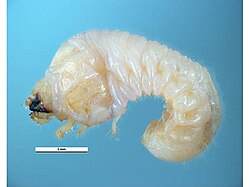
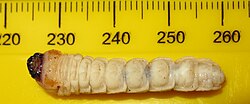
Powderpost beetles are a group of seventy species of woodboring beetles classified in the insect subfamily Lyctinae.1 These beetles, along with spider beetles, death watch beetles, common furniture beetles, skin beetles, and others, make up the superfamily Bostrichoidea. While most woodborers have a large prothorax, powderpost beetles do not, making their heads more visible. In addition to this, their antennae have two-jointed clubs. They are considered pests and attack deciduous trees, over time reducing the wood to a powdery dust. The damage caused by longhorn beetles (family Cerambycidae) is often confused with that of powderpost beetles, but the two groups are unrelated. The larvae of the Cerambycidae are white, straight and generally flat-headed, whereas those of the Bostrichidae are white and C-shaped.
Name
The term "powderpost" comes from the fact that the larvae of these beetles feed on wood and, given enough time, can reduce it to a mass of fine powder. Because of this behavior, they are considered pests. These beetles can survive in colder climates.
Life cycle
Powderpost beetle larvae spend months or years inside wood while developing, feeding mainly on the starch content. Their presence is only apparent when they emerge as adults, leaving behind pinhole-sized openings, often called "shot holes".2 They may also leave piles of powdery frass below. Shot holes normally range in diameter from 1⁄32 inch (0.79 mm) to 1⁄8 inch (3.2 mm), depending on the species of beetle. If wood conditions are right, female beetles may lay their eggs and re-infest the wood, continuing the cycle for generations.
Target materials
Powderpost beetles feed on deciduous trees, including certain hardwoods or softwoods depending on the species. Some hardwoods are naturally immune if they have low starch content or if their pore diameters are too small for the female beetle's ovipositor to lay her eggs in.
Wood preservatives can be used to prevent beetle infestation. Common treatments may use borate, and frequently structural fumigation.
Items that can be infested by powderpost beetles include wooden tools or tool handles, frames, furniture, gun stocks, books, toys, bamboo, flooring, musical instruments, and structural timbers. One instance of a 2023 American-made Fender guitar containing powderpost beetle larvae was reported in 2026, after the larvae had tunneled their way out and left small holes in the ash body. 3
References
References
- Allaby, Michael (1999), "Lyctidae", A Dictionary of Zoology, Encyclopedia.com, retrieved 6 July 2010
- "Powderpost Beetles — Entomology — Penn State University", College of Agricultural Sciences, Pennsylvania State University, retrieved 7 July 2010
- BEWARE OF USA-MADE TELES FROM 2023! The short version of my story is that my American Vintage II '51 Telecaster reissue, made in 2023, had powder post beetle larvae in the wood when it was built, and they've been tunneling out of the guitar since I bought it used. I noticed the first two holes—almost perfectly round, and the size of a pin head—about a week after I brought the guitar home. I don't know if they were there when I bought the guitar, or if they came out afterwards. (Pics 1&2) I brought it to the shop, and they were skeptical about it being bugs, but agreed to fill the holes and refinish the fill. The guitar sounds and plays fantastic, so I agreed to that. Bummer that it dings the resale value, but I'm not planning on reselling it. (Pics 3&4) A couple of months later, when I'd grown pretty attached to it, I took the pickguard off while doing some wiring to reverse the control plate and disconnect the tone pot from the neck pickup. Guess what I found. (Pic 5) One of them had dug into the underside of the pickguard on its way out. (Note the "frass" or powder that gives the beetle its name in the top hole.) At this point it's well past the warranty coverage from the shop, and I just wanted to believe that these holes had been overlooked by the shop, not new holes. So I just hoped for the best. Which wasn't smart. Last week I picked it up, and there was a new, tiny hole, all the way through the pickguard. (Pic 6) So this critter has definitely gotten out of the guitar and into my house. For all I know, there's a hundred more in there, and I feel sick. Like, this is supposed to be a special guitar, and it's filling up with holes before my eyes. Per the University of Wisconsin info I linked at the bottom of this post, I bought a freezer that gets down to 10 degrees, and I'm storing the body there for a week or so to kill anything else that might be living there. I emailed all the pics to the shop and to Fender customer service, acknowledging that it's used and I'm not owed any warranty, but they need to know they had a QC problem in 2023. Fender actually responds right away, asking for copies of the receipt, serial number, and my contact info. I'm shocked that they might offer something--but I dare to hope. I provide the info, and THEN they tell me they can't help me because it's a used instrument. Super disappointing, after getting my hopes up. But the shop still says they're willing to take it back, and I might take them up on it. The upshot: I would not recommend buying an ash-bodied, MIUSA Fender made in late 2023. The beetles surely didn't only lay eggs in the board that made my guitar. Either the lumber wasn't adequately dried, or it was stored somewhere vulnerable to infestation before it was assembled and lacquered. These beetles only dig through lacquer to get OUT of the wood, not into it. (If you're skeptical about the bugs, please check this link
Bibliography
- Borowski, Jerzy; Węgrzynowicz, Piotr (2012). The Powderpost Beetles of the World (Coleoptera: Bostrichidae): Keys for the Identification of Species, Volume 1. Mantis. ISBN 9788362860036.
External links
External links
- Media related to Lyctinae at Wikimedia Commons
- Data related to Lyctinae at Wikispecies
- Lyctinae at Fauna Europaea
- Powderpost Beetle Fact Sheet from the National Pest Management Association with information on habits, habitat and prevention
- Museum pests including powderpoke Archived 2004-12-11 at the Wayback Machine at the National Park Service.
- Powderpost beetles – The other, other wood destroying insects from Michigan State University Extension.
- [1] the effect of beetles on wooden structures.